June 27th, 2018 · Comments Off on Alexandria Ocasio-Cortez: A True Climate Hawk
My political life, other than the unending outrage over the Trump kakistocracy outrages, is dominated by the need to #FlipThe10th — to get rid of #ExtremistComstock and do my part for adding one D to the House. With that in mind, it is hard with everything in life to be watching with detail races around the country. Now, I had sort of noticed Alexandria Ocasio-Cortez. I’d seen — and been impressed by — her campaign ad. But I didn’t have the money or energy to do much there and, thus, sort of ‘out-of-sight’, out of mind.
This morning, this tweet entered my thread:
The only American politician I've ever seen with a climate change plan that is in line with intergenerational justice: @Ocasio2018.
And, well, wow … So, it is rich … with lots of quality … and a freshman in the House won’t be able to pass everything but, well, her Mobilizing Against Climate Change is perhaps the most serious, most aggressive, and most interconnected three paragraphs that I have seen from a politician.
Mobilizing Against Climate Change
First off, let me say Alexandria has me on the title … we need, as communities, as nations, as humanity, to mobilize in action. That is World War II-like talk. And, that is what we require.
In order to address runaway global climate change, Alexandria strongly supports transitioning the United States to a carbon-free, 100% renewable energy system and a fully modernized electrical grid by 2035.
Yes … and yes … and, these are aggressive goals that are, however, potentially achievable if we “mobilize”.
She believes renewable fuels must be produced in a way that achieves our environmental and energy security goals, so we can move beyond oil responsibly in the fight against climate change. By encouraging the electrification of vehicles, sustainable home heating, distributed rooftop solar generation, and the conversion of the power grid to zero-emissions energy sources, Alexandria believes we can be 100% free of fossil fuels by 2035.
“100% free of fossil fuels by 2035” is an aggressive objective … and, well, even if we mobilize, we might not achieve it … but having that goal and mobilizing to achieve it would mean that we would be well on our way by that time.
Furthermore, Alex believes in recognizing the relationship between economic stability and environmental sustainability.
Yes … YES … YES!!! We would all be better off with this truism embedded in our politics and our lives.
It’s time to shift course and implement a Green New Deal – a transformation that implements structural changes to our political and financial systems in order to alter the trajectory of our environment. Right now, the economy is controlled by big corporations whose profits are dependent on the continuation of climate change. This arrangement benefits few, but comes at the detriment of our planet and all its inhabitants. Its effects are life-threatening, and are especially already felt by low-income communities, both in the U.S. and globally. Even in NY-14, areas like Throgs Neck, College Point, and City Island are being affected by erosion and rising sea levels. Rather than continue a dependency on this system that posits climate change as inherent to economic life, the Green New Deal believes that radically addressing climate change is a potential path towards a more equitable economy with increased employment and widespread financial security for all.
As someone somewhat weaned on this intellectually by people like Van Jones and Majora Carter, a “Green New Deal” is a path to offer real improvement to lives, to help address economic inequality, and move us toward actual policy to #ActOnClimate.
Climate change is the single biggest national security threat for the United States
This is certainly true in the mid and long term — at the moment, it is clear that @RealDonaldTrump and his @GOP collaborators are a bigger threat.
But, in the mid and long term, unchecked climate change is an existential threat to the Republic and modern civilization.
and the single biggest threat to worldwide industrialized civilization, and the effects of warming can be hard to predict and self-reinforcing. We need to avoid a worldwide refugee crisis by waging a war for climate justice through the mobilization of our population and our government. This starts with the United States being a leader on the actions we take both globally and locally.
Absolutely … absolutely … absolutely …
After reading this paragraphs, I have to say that I agree fully with Holthaus:
a climate-change plan in line with intergenerational justice.
In short, an announced plan to invest to spark innovation and deployment of clean energy systems that would be less expensive than coal in traditional economic terms — without requiring inclusion of the substantial externality costs from exploiting coal for electricity.
Less than five years later, Google abandoned RE<C with a rather confused explanation that achieving that, alone, wouldn’t solve climate change challenges. Was this simply mistaken ‘silver bullet reasoning’ or a Google implicit acknowledgment that renewable energy prices would plunge without Google needing to play a leading role in their development or …? Uncertain.
A bit more than a decade after that original announcement, there is a simple reality: in economic transaction after transaction, in locality after locality around the globe, RE<C is a marketplace reality.
From Texas, for example,
“This was first and foremost a business decision and if you win the business argument, then you’re gonna win the environmental argument,” Republican Georgetown, Texas, Mayor Dale Ross said.
“It’s a totally different landscape out there, … in the state of Texas, since January 1, four coal plants have closed. This is the economics of the matter. You buy wind and solar for, say, $18 a megawatt. You buy coal for $25. You have that choice. Which one are you gonna buy?”
Whether you are a mayor, a business owner, or a homeowner, clean energy is coming out on top in terms of new generating capacity.
You have that choice. Which one are you gonna buy?
Simply put, we have reached (passed) the point where going clean is the best choice for the pocket book, for employment, for the economy, for human health, and the planetary climate system.
BP’s chief economist, Spencer Dale, is perhaps one of those for who the old EF Hutton ad applies: when Spencer Dale speaks, people should listen. Thoughtful, substantive, and often incisive about what has happened, is happening, and might/potentially could happen in the energy sector.
Dale’s presentations aren’t only substantive, but articulately engaging and done in a way that encourages others to engage and challenge him rather than simply sit back and nod their head yes.
Yesterday, BP released their 2018 statistical energy review with a Dale speech as the core portion of this event. While there is much of interest in the document and in Dale’s discussion, this post primarily focuses on — challenges — one specific point emphasizing material from one specific slide.
Coal’s percentage of the electricity sector is at the same level as 1998: is this the item of greatest concern?
Dale emphasizes his concern:
Striking: because despite the extraordinary growth in renewables in recent years, and the huge policy efforts to encourage a shift away from coal into cleaner, lower carbon fuels, there has been almost no improvement in the power sector fuel mix over the past 20 years.
This statement suggests a stagnation, a treading water moving in place as if the energy (electricity) sector is not amid massive change.
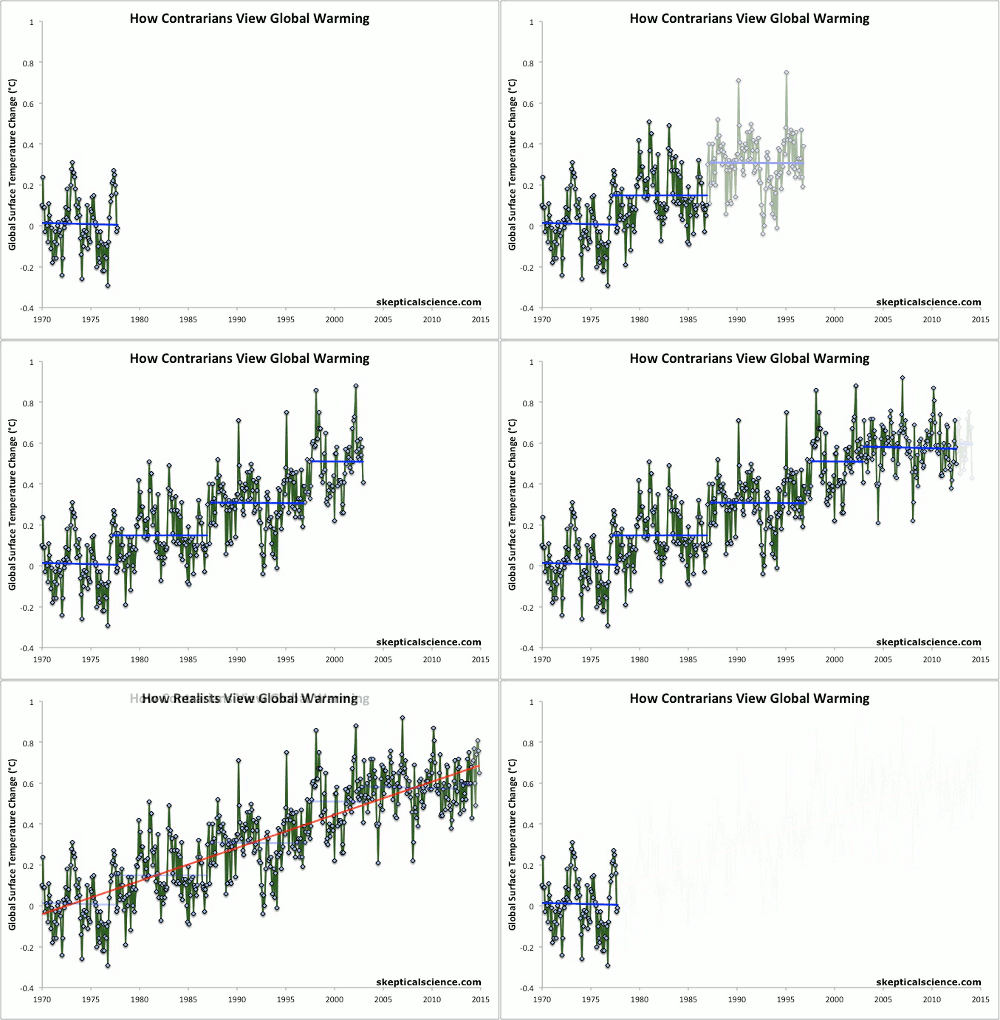
With all due respect to Spencer Dale (and, the opening words to this post should make clear that he merits serious respect), that slide and his focus on it recalled to me what the climate-science community nicknames the escalator chart of climate-science denial.
The Science Denialist Escalator
When it comes to statistical and trend analysis, a simple reality: it often matters (tremendously) where one begins. Yes, the global share of electricity provided by coal is roughly today where it was 20 years ago. And, yes, this is not a good thing as humanity should have been driving coal out of the energy sector a long time ago. However, focusing on that 20 year parallel masks a reality that Dale is quite aware of: that there has been major change within the electricity sector in the past decade that has been accelerating year-to-year. At the beginning of the 2010s, many forecasters saw a rosy future for coal which was being reflected in massive acquisition binges by firms like Peabody Energy. The years since have seen massive change to that unhealthy forecast, reflected in Peabody’s bankruptcy, with massive declines in wind and solar prices, massive increases in solar and wind penetration, natural gas displacing coal, energy efficiency entering the market, etc, etc, etc …
The major growth in ‘new’ renewables is masked in a graphic like Dale’s, as the non-fossil figure includes hydropower and nuclear power — both significant players in the global electricity market — and the ‘new renewables’ (essentially wind and solar) needed to grow to significant levels before they would notably shift the ‘non-fossil’ line in graphic like that. Look closely at that graphic and you will see a meaningful edging upward in that blue line toward the end of the period.
More directly, in the past few years, we are seeing
Minimal new coal plants coming on line.
Planned coal plants being delayed and canceled.
Coal power plants being closed … often early.
Significant shares of new power generation provided by wind and, increasingly, solar.
Bidding for future power having renewable energy coming in at a price below — often half the price of — the cost of operating existing coal plants.
Etc …
Etc ..
Etc …
As a small window on this, in the late 2000s, coal plants provided more than 50 percent of U.S. electricity. That share is barely above 30 percent today … and, despite the great efforts of the Trump administration, there is little prospect of going back up over the long time rather than continuing down (an accelerated) downward path.
A graphic with solely the past five years providing details down to wind and solar in the electricity market would have provided a vastly different window on coal’s prospects than a high-level, decades-long slide. Using this, solely, might have been deceptive external to a longer-trend graphic but would have been useful to highlight that things can change (significantly) in the energy sector and, perhaps now, far more rapidly than some conceive.
Energy is a complex space with many dynamics. Dale had much ground to cover in his presentation. However, using that one slide and those words as the core discussion about coal in the power sector was deceptive and potentially harmful to effective decision-making..
Two charts from BP this week. First shows picture BP focused on, suggesting power sector has barely changed in the past 20 years.
As another point of contention, Dale made this comment:
It’s worth remembering that, when commentators proclaim that the world is electrifying, power demand in the developed world hasn’t grown for the past 10 years.
Yes, “power demand” has been flat in no small part because of massive ‘negawatts’ impacts of efficiency measures across the economy from LED lighting taking over to artificial intelligence tools enabling shockingly rapid advances in industrial process efficiencies. Even with growing services powered by electricity, efficiency is enabling that growth to occur with flat demand. While, just as with retirement of coal is happening too slowly, economic electrification isn’t occurring at the pace necessary for a <1.5C future, the flat power demand curve in the developing world doesn’t prove a priori that electrification isn’t occurring.
June 14th, 2018 · Comments Off on Setting a PATH forward on bottled water?
PATH Water
Let’s be clear: bottled water is an ever growing problem around the world. Rather than using tap water, where it is safe (perhaps with a filter), or creating good public water systems, an ever-growing number of people are getting their H20 in plastic water bottles. That plastic contributes to climate change (lots of oil to make the bottles and for transporting water in trucks and not pipelines), contributes to plastic pollution, often is (far less) healthy than getting water for your tap, and is FAR FAR less expensive (for the individual and society) than filling up a glass from the tap. Simply put, we have a serious drinking problem — the bottled water phenomena.
Thus, count me as a bit wary when I received (after the fold) a press release email for PATH Water — an aluminum can bottled water. Seriously, is it that much better to have a can to (hopefully) recycle rather than the plastic to (hopefully) recycle. In my doubting mind, I asked for a sample to figure out what I thought. A bit later, those two pictured bottles …
So, before anything else, the ‘drinking’ and use experience. I referee (a lot of) soccer — sometimes over 10 hours in a weekend. And, thus go through lots of (refilled) water bottles (filled from tap, not plastic). And, water is the primary ‘fluid’ drunk in my household. So, how did PATH stand up: out of the bottle, their reverse osmosis water was about the best (perhaps right wording might be ‘least’) tasting water I’ve experienced from a bottle.
And, after having drunk their water I’ve been refilling PATH Water’s bottles because they are sturdy and more comfortable to drink from than the dozen or so different metal (or refillable plastic) bottles in the closet.
As to recycling: aluminum is far less energy intensive to recycle than plastic, far more likely to recycle than plastic, and far less damaging to the environment than plastic if thrown away. From PATH Water
Aluminum is a much more highly valued commodity than plastic, therefore companies have more incentive to recycle and reuse that recycled material in future. Not only do people recycle aluminum at twice the rate of plastic, but the process of recycling, transportation, and distribution aluminum has a significantly smaller carbon footprint (range from 10-50% depending on the material compared to) compared to other liquid packaging alternatives like plastic or glass. Aluminum is infinitely recyclable, while plastic often gets downcycled, resulting in more waste.
Thus, if one is going to be ‘single use’ water bottle, perhaps PATH Water is providing a better solution than plastic.
Now, the PATH Water team seems focused on helping drive down the plastic water bottle program including through education in California public schools. Thus, this isn’t solely about building up gross revenue.
Now, I still stand behind ‘fill up from the tap’ but if PATH can have some people buy their bottles and then reuse them … time after time … they are providing a real service. (And, well, hopefully putting themselves and ‘disposable water bottle’ providers out of business.)
Having the opportunity to turn on the tap and have clean, drinkable water is core to a well-run, civilized society. “Drinkable”, regretfully, all too often means lead (think Flint) and other dangerous materials.
Courtesy of #WorldEnvironmentDay, a stark statement as to one set of dangerous materials in that tap water that few of us ever think about.
Contamination rate of drinking #water with microscopic plastic fiber:
-> USA: 94% -> Beirut, Lebanon: 94% -> New Delhi, India: 82% -> Kampala, Uganda: 81% -> Jakarta, Indonesia: 76% -> Quito, Ecuador: 75% -> Europe: 72%#WorldEnvironmentDaypic.twitter.com/VyXfrbdF6P
May 31st, 2018 · Comments Off on Are electric bus projections electrifying enough? IEA example
Forecasting is tough. And, there is a perception problem, forecasts are taken all too often as some form of firm projection that can be taken to the bank rather than a look to the future within a set of assumptions. Forecasting amid great change — technological or otherwise — is even tougher. And, we are amid a period of great (often very tough to predict, to forecast) change.
Major forecasting organizations (both public (such as EIA, IEA, IEEJA), non-profit, and private) have had a horrendous track record when it comes to clean-energy penetration since roughly the turn of the century. Writ large, in the forecasting world, one should see roughly a balance of over- and under-estimates over the years as analysts learn and seek to adapt their analytical approaches to real-world events. When it comes to clean energy systems (wind and solar), however, there are few and far between examples of ‘over estimates’ as to the pace of penetration and the falling prices — with the vast majority of forecasting efforts showing extremely pessimistic undershooting as to solar and wind system progress.
Electric transportation appears to be following the same trend. See, for example, Daniel Cohan on why the EIA electric vehicle forecasting is unduly pessimistic. The latest IEA report on electric vehicles seems to have its issues as well. Let us focus on an arena undergoing incredibly rapid change: large vehicles, in this case, electric buses.
There will be 1.5 million electric buses in use worldwide by 2030, up from 370,000 last year, according to the IEA.
Almost 100,000 electrified city buses were sold last year, 99 percent of them in China.
Look at those two sentences:
370,000 electric buses operating in 2017
100,000 added to fleets in 2017
1.5 million to be in use by 2030
Okay, the IEA forecast essentially assumes that electric bus production / sales will be totally flat from 2017 through 2030 as 100,000/year would mean a total of 1.3M electric buses added to fleets from 2018 through 2030. If we combine that with the 0.37M of existing electric buses in fleets, this would would put the total at 1.67M with a margin of 0.17M for retirements (on systems that typically operate in range of 15+ years dependent on fleets). Does anyone want to bet that IEA is right: that electric bus production, which has been going up faster than solar penetration the past 36 months or so, will suddenly stop growing?
May 25th, 2018 · Comments Off on Good Politics Trump Good Policy? (Gas Price edition #372)
That feeling at the pump …
When it comes to energy prices, gasoline has been and remains the most visceral touch point for Americans (and, well, likely drivers around the world). Few really connect the turning on of a light bulb to that monthly electricity bill while essentially everyone with a (non-electric) car has experienced the smelly hands while watching the dollars go up far faster than the gallons while filling up the car.
Almost no Americans have internalized that, whether at $2.50, $3.50, or more per gallon, the “price” paid at the pump is only a fraction of the true price that we pay per gallon — in terms of health security risks, and environmental damage. (And, of course, it is far below the price at the pump paid in other industrialized nations.) Without internalizing the true cost (more likely in ballpark of $15 per gallon or so), Americans react to marginal price increases: talk of abundant oil and price drops, SUV sales skyrocket … prices increase and screaming begins.
Gasoline prices are going up … a lot … under Trump despite the ‘drill, baby, drill’ mentality of the fossil-foolish Republican Party and extremely high US oil production.
Since Trump’s inauguration, U.S. gas has jumped 60 cents per gallon, meaning the average American household is paying nearly $300 more a year for gas. In that time, gas has risen from $2.33 to $2.92 per gallon as of the week of May 21, 2018, a 25.7 percent increase.
Senate Democratic Leader Charles Schumer (N.Y.) is ripping the White House over high gas prices, arguing President Trump’s decision to withdraw from the Iran nuclear deal is putting a pinch on middle-class wallets.
“According to energy analysts and experts, President Trump’s reckless decision to pull out of the Iran deal has led to higher oil prices.”
And, others have joined this assault. Public Citizen’s campaign is to “Blame Trump at the Pump”
With a 15-foot tall inflatable oil barrel and signs saying “Blame Trump at the Pump,” Public Citizen activists alerted motorists passing the Exxon station southeast of Union Station in Washington, D.C., to the fact that their wallets will take a bigger hit than in years past, and that Trump is partly to blame. …
“As Americans fuel up to visit friends and family this Memorial Day weekend, they should blame Trump at the pump for the highest prices in four years,” said Madeline Page, campaign coordinator for Public Citizen’s clean cars program. “Trump should reverse course on his dangerous policies that threaten to steal billions from hardworking families.”
The Trump Factor in Oil Prices: Geopolitical Risk could drive prices to over $100 per barrel according to Total’s CEO
To be clear, it is far from simply political partisans associating rising oil (and, thus, gas) prices with Trump (anti-)diplomacy. Last week, Patrick Pouyanné, Chairman and CEO of Total S.A., spoke last week at CSIS. He sees a real potential for over $100 per barrel oil due to increased geopolitical risk.
you have geopolitics and the announcement on Iran clearly is pushing the price up. … you have many impacts on the supply for many geopolitical events not linked to supply and demand … I would not be surprised to see $100 per barrel in the coming months because, clearly, you will have impacts.
Thus, there is truth and reality here:
Team Trump’s shoot-from-the-hip disruption of international relations and ripping up of treaties is creating geopolitical risk that is increasing oil (and, therefore, gas) prices.
These increased gas prices do impact consumers.
Increased payments at the pump are higher, for middle class Americans, than money received due to the Trump tax program to benefit the wealthiest of Americans (and, well, overseas investors in the US stock market).
The politics are superb: bash Trump over the head, legitimately, for hurting Americans in the pocket book (and worsening the US trade deficit) for its (anti)diplomacy driving up oil prices.
However, those superb politics clash with a fundamental reality: low gas prices do not (as per above) reflect actual costs (as fossil fuel company profiteer with “external” costs ‘socialized’ and not in the price paid at the pump). And, those externalized costs have extremely serious impacts … and lower prices at the pump, a priori, worsens and increases those external costs since lower gasoline prices fosters higher gasoline consumption with more pollution. (And, not just near term: SUV sales go up with lower gasoline prices.)
As per all the times of increased gasoline prices and politicking over them, the loudspeaker noise misses the fundamental issue: high gasoline prices isn’t ‘the’ problem, the problem is that those ‘high’ prices are going to enrich foreign powers (including adversaries like Putin’s Russia) and increase oil company profits and not to helping address (reduce) the externalities from burning fossil fuels and drive a more prosperous future for America and Americans.
The gasoline tax has not increased in a quarter-century — seemingly multiple lifetimes ago, well before the era of iPhones, Facebook, and Dancing With The Stars. Revenue from that tax, degraded by inflation, doesn’t come close to covering highway construction and maintenance costs. With inflation, that 18 cents per gallon should be in the 30-35 cent range — simply to have kept pace with inflation. It should be in the 50-60 cent range simply to keep up with the increased costs and requirements for having a 21st century road system. And, as a user fee to cover true costs, it should be significantly higher than that to account for the costs of burning gasoline — from cancer to asthma to climate change.
To rail against high gasoline prices (even with the legitimate attribution of (at least some causation) to bad Trump policy) is to undermine efforts to boost transportation funding resources through (at a minimum) inflation adjusting the gas tax and, even more importantly, efforts to address the external costs from burning fossil fuels (especially climate impacts).
Whether Democratic politicians, activist groups like Public Citizen or otherwise, those concerned about fostering a better funded US infrastructure program, desirous of policies that foster a better American future for all, and understand the need to #ActOnClimate should be extremely cautious about seeking to exploit gas prices for political purposes.
Comments Off on Good Politics Trump Good Policy? (Gas Price edition #372)Tags:Energy · gasoline
May 1st, 2018 · Comments Off on DC’s electric buses — for tourists and for urban health
The District of Columbia is taking serious steps forward in line with its Climate Change plans . These include strengthening building codes for greater energy efficiency, sustainability, and livability; programs for cleaning up the electricity sourcing (including solar on 50 government buildings); and investments to make the urban environment quieter and cleaner with more effective public transit.
Eliminate more than 243,980 lbs of CO2 emissions annually
Provide cost savings of more than $6 million during a 12 year lifetime.
Reduce noise pollution throughout the District
In terms of that cost savings, this is both due to using electricity rather than diesel (perhaps a savings of 50 percent on fuel costs — but not sure of exact figures) and due to (greatly) reduced maintenance costs (electric engines don’t have the moving parts and other problematic maintenance issues of internal combustion engines.
Not mentioned there:
Diesel pollution has serious health impacts within cities — going electric eliminates that pollution load from these buses.
Every diesel bus replaced by electric means that less much mediocre/horrible odor on the streets.
Figuratively and literally in the United States market, diesel buses stink.
There are also significant performance improvement elements of going electric.
The buses batteries can, as what are called “V2G” (vehicle-to-grid) systems come into more common use, provide grid services when not operating to improve electrical system performance while earning revenue for the Circulator system.
Electric vehicles have higher performance — in terms of braking and acceleration — which could help improve bus service (on time and such) and potentially improve safety.
Electric buses provide, well, simply a far more comfortable passenger experience and could well lead to boosting use of public transit.
Truly, electric buses are a very smart (major) first step for electrification of road transit (the top candidate for electrification: railroads) with tremendous benefits for the urban environment.
Thus, kudos to the District of Columbia government for moving forward to making electric buses part of the DC transit solution. And, a plea to Virginia jurisdictions to follow DC’s lead.
April 24th, 2018 · Comments Off on Individuals can change world: Mumbai man drives beach clean ups, species return
To live in interesting times … we face the cursed reality that we live in a highly interesting time. Tremendous technology advances both create opportunity and threaten us. Communications leaps forward enable humans to have incalculable amounts of information at our finger tips while also enabling/facilitating the Putin’s interference in other nations’ democracies and elections. Humans are developing technologies and means to improve lives while reducing environmental impacts even as humanity is increasing greenhouse gas emissions and worsening climate catastrophe risks and impacts. As per (a paraphrased) Dickens,
It is the best of times, it is the worst of times, it is the age of wisdom, it is the age of foolishness, it was the epoch of belief, it is the epoch of incredulity, it is the season of Light, it is the season of Darkness, it is the spring of hope, it is the winter of despair, we have everything before us, we have nothing before us, we are all going direct to Heaven, we are all going direct the other way …
Amid all this, we need heroes — whether they are the neighbor who organizes a great youth volleyball program or are voting rights advocates fighting for free electionsor medical researchers discovering disease cures or entrepreneurs delivering innovative means to accelerate clean energy penetration to address energy poverty — and we need to recognize them.
This post is to share a new hero to me — someone who dedicated much of his own time and motivated others to join him in fighting pollution. And, well, has shown a remarkable success.
Bombay High Court lawyer Afroz Shah has led a three-year effort to clean up Mumbai’s (once) incredibly filthy Versova Beach. This effort, which pulled in thousands of volunteers (Versova Beach Volunteers), is credited with “removing more than 13 million kg of toxic waste” (13,000 tons) since 2015. Shah spent every single weekend in that time collecting trash — helping spark those 1,000s of unnamed others (perhaps 30-50 people in a typical weekend) in transforming a devastated space into something headed toward a living ecosystem.
?“On the left, a photograph of part of Versova beach taken on August 6, 2016. On the right is an image of the beach tweeted on May 20, 2017.” CNN
As to that living ecosystem, after two decades of absence, turtles have returned to the beach.
On a breezy morning of March 22, 2018, Bombay High Court lawyer Afroz Shah was strolling on Mumbai’s Versova beach when he witnessed an incredible sight: nearly 100 olive ridley sea turtle hatchlings waddling towards the sea.
Week 127 .
Fantastic news for Mumbai .
We got back Olive Ridley Sea Turtle after 20 years. Historic moment
Nested and Hatched at our beach. We facilitate their journey to ocean.
The core to a pure libertarian thinking could be …
Absolute liberty of individual action … as long as …
that does no harm to others.
Absent encounters with the real world (such as how the complexity of the modern world makes ‘total knowledge’ for decision making essentially impossible for individuals so that they can consciously choose their level of risk in purchases in the market place), perhaps like how Communism might appeal to many absent considering how the ideology has confronted reality, this Libertarian conception has great appeal.
For too many self-proclaimed libertarians, the ‘anti-government’ element of “absolute liberty” drives out actual consideration of that second bullet: the do no harm. The most egregious space likely arises when it comes to “externalities” of pollution and environmental impacts: such as diseases from chemical industrial plant waste, damaged ecosystems from agricultural runoff, and leeching chemicals from trash threatening drinking water. Prominent among this are the major impacts from the burning of fossil fuels, most notably the climate impacts.
When considering motivations for climate science denial, many libertarians are driven toward denying climate change science for core ideological reasons: admitting to the reality of climate change and the scope of the problem drives one toward ‘governmental’ roles in finding paths forward to address these risks. While ideology shapes almost everyone’s perspective on the world, problems/opportunities, and best paths forward, when it comes to to many self-proclaimed libertarians and climate science, the ideology requires rejecting reality.
That caveat, “to many”, matters. There are many libertarians who are honest to data and seek to promote paths forward honest with that data, honest with reality, that align (at least partially) with their ideological preferences. When it comes to climate change, that ‘honest to data’ strain of Libertarian is best represented by the Niskanen Center’s climate science and policy work within the Climate Unplugged project. As Niskanen has explained,
Why would a think tank chock-full of libertarian expats join with environmentalists and represent local governments in a lawsuit [about climate change]? Because we take property rights and the rule of law seriously.
For many (most) concerned about climate change risks, a strong hope has been to have basic common ground as to the science, some commonality as to risks, and then debate/fight/work together toward ‘best paths forward’. While perhaps having realms of disagreement with Niskanen Center staff’s basic preferences and ideological perspectives, (almost all of) those with fidelity to climate science and seeking action on it are absolutely ready to sit down and work with Niskanen Center staff to debate paths forward and find arenas of common ground for collaboration.
While long aware of Niskanen Center work, this post is spark by news that hit the inbox yesterday. Around the world, there are a growing number of legal challenges about climate change, lawsuits seeking faster government action, government prosecution of Corporations for misleading the public (critically, for legal reasons, their shareholders and investors), and against companies (primarily fossil fuel firms) for their share of climate damage. These include, in the United States alone, lawsuits against “big oil” by cities and counties (San Mateo, Marin, Imperial Beach, San Francisco, Oakland, Santa Cruz, Santa Cruz County, City of Richmond, New York City, City of Boulder, Boulder, San Miguel) and youth lawsuits in multiple states (AK CO FL ME MA NM NC WA).
The full discussion as to why Niskanen is doing this is well worth a read. In terms of being honest to their ideology and perspective as to how best deal with ‘externalities’, this might be the key paragraph:
conservative and libertarian intellectuals who embrace what is known as “free market environmentalism” have long argued that pollution is a trespass on private property that is best dealt with whenever possible by common law action—not by legislators acting to referee such trespasses via sweeping environmental laws with (heavily politicized) utilitarian calculations in mind. By representing the interests of their constituents in this case, that’s exactly what these municipalities are trying to do.
The Niskanen discussion makes clear allegiance to honest evaluation of data and scientific analysis
There is little factual dispute about the fundamentals. Despite the omnipresent drumbeat of climate denialism from some corners of the right, the oil industry concedes that climate change is real, that it is largely if not entirely driven by the industrial emissions of greenhouse gases, and that the products they manufacture are the source of much of those emissions.
Addresses inadequacies in the U.S. political response
Even the most limited, half-hearted policy measures are now being rolled back by the Trump administration. Sorry Boulder and San Miguel, say ExxonMobil and Suncor, but the politicians have decided that we get to destroy property and impose costs on taxpayers without consequence or complaint.
And, provides a thoughtful examination of why industry (oil producers and refiners) should bear responsibility, not consumers;
But aren’t oil consumers, rather than oil producers, really the responsible parties here? No. Courts have repeatedly ruled that manufacturers are liable for the damages their products cause, especially when they know in advance that their products, if used as intended, will cause that harm. And that’s exactly the case here. The oil industry has known since a least 1957 that burning fossil fuels will eventually warm the planet to dangerous levels, and that the cost of that warming would prove monumental. Rather than alert the public and engage in good-faith conversation about how society should respond, the oil industry sought to mislead and deny what they knew about the risks of fossil fuel consumption until very recently.
The Niskanen Center’s Climate Unplugged project, their active involvement in these climate lawsuits, and their well argued announcement of that involvement make clear that there is ground for commonality and actual ‘bipartisan’ (across the political spectrum) collaboration and cooperation when honest and truthful engagement exist across the parties.
The Niskanen announcement — along with much of their other work — is well worth a read across that political spectrum.
Note: For an indication as to some ‘rejection’ of/reaction to Niskanen Center’s moves among their ideological peers, see this twitter interaction.