February 5th, 2018 · Comments Off on (R)Evolution, not war
Human society has faced major shifts, periods of significant change, ranging from the printing press to the industrial revolution to the information age to the massively expansive set of changes in the 21st century from communications to biotechnology to energy systems. And, when it comes to economic moves off 19th energy systems — the burning of coal — Senator Ed Markey capture it right:
Trump says there’s a war on coal
iPhones weren't a war on rotary phones, they were a revolution
The horseless carriage wasn’t a war on horses, it was a revolution
The ice box wasn't a war on salted meats, it was a revolution#cleanenergy isn't a war on coal, it's a revolution
The telegraph and telephone weren’t a war on the Pony Express and signal fires, but a (r)evolution in how we communicate and share information.
Cell phones weren’t a war on copper lines and emails weren’t a war on the US postal service but a leap frog past them but another (r)evolution in how we communicate and share information.
Steamships weren’t a war on clipper ships and horseless carriages weren’t a war on horses but a (r)evolution in how we move around the world.
Canning and refrigeration weren’t a war on salt, but a (r)evolution in how we store and ship food.
Moving into the 21st century with cost-effective, clean solar, wind, storage, smart grind, and other clean-energy options isn’t a war on 19th energy systems but a (r)evolution to a better system.
Well said. I would add that clean, renewable energy is the next stage in an advanced society that values efficiency, jobs, energy security, health, and the environment. https://t.co/tIIpjOnxso
Donald Trump and other fossil fools are caught in false rhetoric about a ‘war on coal’ that ignores technical, economic, and financial realities. They wish to drive the United States into reinvesting and relying on a costlier, less-efficient energy system that will cost Americans more and disadvantage the nation economically against those embracing the ever-less expensive and cost-advantaged clean-energy systems.
RFF study estimates 27,000 deaths, $72 billion higher electricity costs (2020-2045) under DOE coal & nuclear subsidy proposalhttps://t.co/USiu7r0Mhe
Greenpeace did a series of quite interesting analyses, over time, about what it might take to pursue a clean Energy [r]Evolution enabling phasing out coal and other fossil fuels. Thus, the use of ‘[r]evolution] rather than Senator Markey’s Revolution.
Press releases are often designed to spin, to put things in as favorable a light as possible, and to (by their very nature) boost visibility. Putting aside those intended to deceive, the “profession” of public affairs tends to that spin and even the most well-intentioned spin can inadvertently deceive (especially against a larger context). For example, as discussed before, breathless press releases about a laboratory advance with batteries or solar cell efficiency or making fuel from air can lead to viral ‘we’ve solved the world’s problems’ commentary. While vulnerable, myself, to this sort of techno-optimism, these viruses (viral events) typically ignore the realities of the challenges of transformation from laboratory success to mass commercial deployment: everything from the simple truth that the lab test might not prove true with more extensive testing; to the very long timelines from lab invention to marketplace; and to the obstacles placed before innovation in the market place itself.
Sometimes, the press release writers strive, seriously, to avoid the potential for misunderstanding and unreasonable use of the press release and the underlying work. Regretfully, this effort doesn’t necessarily prevent misuse. I fear a recent press release will be misrepresented as a ‘don’t worry, be happy’ story re climate change when, well, that is not the case. A moment for truth before discussing the Scripp’s press release that sparked this post:
Now, Scripps’ researchers have done work to try to quantify, with some detail, how much solar radiation might decrease in the coming decades and the impact of this on climate change. The press release author, Robert Monroe, is quite careful to emphasize that any such ‘cooling’ due to reduced solar radiation will not ‘solve’ climate change.
Here is the opening sentence:
The Sun might emit less radiation by mid-century, giving planet Earth a chance to warm a bit more slowly but not halt the trend of human-induced climate change.
And, the closing words:
a main conclusion of the study is that “a future grand solar minimum could slow down but not stop global warming.”
Now, knowing that Donald Trump, Devin Nunes, and other climate-science deniers have no tendency to skew — or outright misrepresent and/or lie — data, is it unreasonable that the ‘movie critic’ clip and representation of this report and press release might be something like …
grand solar minimum … increases risk of dangerous global cooling if warming is reduced …
Consider those words … that is (a) absolutely not what the press release author nor study’ author’s concluded and/or emphasized but (b) is actually just a twisted variation on that conclusion. Implausible (that ‘if warming is reduced’ such that we might have ‘dangerous global cooling’) but not outright false (by definition, if there is reduced solar radiation AND reduced human pollution that then creates a greater chance of cooling — even if that ‘greater chance’ is somewhere in range of a null probability).
On a more benign level, what is the chance of the casual journalist (that casual tweeter) emphasizing something like “scientist predict sun will warm less by mid-century and reduce climate change risks” — not intending to mislead but, in a casual or character limited effort to communicate, misleading nonetheless?
Honestly, how far should a press release author go in striving to structure language to avoid those who will, shamelessly, manipulate the language and misrepresent the fundamental work? What wording forestalls the ‘casual’, unthinking, misrepresentation? Perhaps, in this case, how about this headline:
Climate change will not be stopped by cooler sun
In this world of ‘tweet shares’, that headline is what the vast majority of people would see and would the opening words to frame the thinking of anyone who read past the headline (including reporters and bloggers) thinking of doing a story.
Would that be better science communication and reduce risks of (intentional or unintentional) misleading others? Perhaps …
January 29th, 2018 · Comments Off on The Climate of Climate in the 2018 election
For many election cycles, those aware of the serious nature of climate change (and the opportunities acting to mitigate it will create) have advocated for greater political discussion of climate change. In the 2008 presidential election, in part due to a dedicated effort to ask questions of candidates in key primaries, ‘climate’ seemed — at least for a moment — to be a meaningful part of the political discussion. Regretfully, ‘climate silence’ dominated the election debates — with nary a question, cycle after cycle, from journalists about it. The Village (traditional pundits) didn’t see climate change as worthy of question choosing instead, for example in 2016, to focus on far more critical issues like Clinton emails.
2018 might represent a turning point. The move to recruit (and elect) scientists (notably from 314 action: “The Pro-Science Resistance”), Donald Trump’s (and the GOP’s) decided anti-science climate denial, Trump’s withdrawal from the Paris Accords, the growing clarity that climate change is an not a remote issue (in geography, time, and species) but a problem of today impacting all Americans, and the range of American climate catastrophes in 2016 all seem to be factors in boosting the potential that “climate” will be a campaign issue in many of the mid-term elections.
As a sign that this might be the case, when looking at (Democratic) candidate web pages, it appears that far more mention climate than might have been the case in the past.
Do you see climate in elections as an environmental story, political, or a cross-cutting story. And, within your institutions, how do you work with other reporters on reporting this.
Three of the panelists engaged the question:
Brady Dennis of the Washington Post wonders how and whether climate will enter the election discussion, that it will be drown out by Trump and Russia and other stories. He commented that “I am a little perplexed about how to elevate climate in the discussion” and, in essence, asked for help in figuring out how to do so and i identifying “places where this will be a top-level issues”
Pat Rizzuto of Bloomberg said that there is a reporter specifically focused on identifying and reporting on campaigns where environmental issues matter.
Matthew Daly, AP, commented that “From the Capital, it is interesting to see that there is a bipartisan climate caucus, that there are Republicans willing to stand up and say that climate change is real. This is an underreported story … it is shocking that it is shocking.”*
A fossil fuel lobbyist (Frank Maisano) followed the above with a comment that
I’ve been doing this for 20 years and I’ve been waiting for this (climate) to matter in the election. Even when Steyer dumped millions and millions, it didn’t matter. I don’t think it will matter this year.
Will it (climate change) matter in elections this year? Almost certainly not as much as it should, but here is another indication of what just might be a changed environment: a candidates’ climate forum in Texas 7th this past weekend with the seven candidates in the Democratic primary drew 400 people in the hall along with Facebook viewers.
Speaking at the Houston Climate Forum. Texas should be the national leader on environmental efforts and protecting our air, water, and public lands. pic.twitter.com/yKal9xoQCk
When voters care, candidates respond. At the first candidate forum I attended last year, I cringed at the nonsensical response I got to my question about climate. This time, asking seven more challenging questions to seven candidates, I found almost all the responses to be thoughtful and well informed.
As a professor, I could tell the candidates had done their homework. They couldn’t bluff their way to an easy A with voters who cared.
And, Cohan’s perspective on the political implication:
Whoever is elected to Congress this November, they’ll know there’s a motivated contingent of voters eager to see a more vigorous federal response to climate.
TX-07 is, of course, just one district when there are 435 Congressional races. If climate matters there, that doesn’t necessarily mean that it will elsewhere. Tough, as Cohan concluded:
And if we’ve shown that to be true in the oil patch of a red state, perhaps similar events elsewhere could provide a wake-up call to other representatives as well.
SEJ journalists, on that panel and otherwise, might wish to pay attention to Cohan and the TX-07 climate forum as it just might be an indicator that 2018 could well be the year when climate change truly does become a meaningful part of U.S. elections.
While many reasons exist for this, a simple reality: every single major forecasting institution (both public and private) has consistently, since roughly the turn of the century, under forecast future progress in solar and wind energy. (See after fold for a sampling of the literature on this.) Forecasts have consistently (and often quite significantly) projected much higher costs and much lower deployments than what has occurred in the real world.
While too many simply think of these problems as esoteric ‘energy-geekdom’, these forecasts have real impacts on decision-making in the public and private sectors. One, not very small, example is a big news item this week: General Electric is potentially going to be broken up. One of the key underlying factors behind this might just have been energy forecasts of growing thermal power in the decades to come — forecasts that are turning out to have been wildly off mark. And, GE made significant bets (in acquiring Alstom and Baker-Hughes), apparently, due to senior executives (and Board of Directors) myopically relying on these forecasts without paying attention to the serious critiques about forecasting. (Again, see below for a taste of those criticisms.)
As an example of a perhaps self-evident item that too many simply ignore but which Toyoda made quite clear in his presentation: it’s China and India, stupid. Writ large, over the next 35 years, China will add the equivalent of US energy demand to its power sector and India will add the equivalent of an European Union. Want to understand (and, inherently, influence) what will happen globally, in terms of energy demand and supply (including carbon implications), these are the two places meriting the most focus.
Forecasts are useful for helping frame understanding for the future and to help shape decision-making — not through the specific forecasted numbers, but about the potential implications from differences and commonalities across scenarios in terms of investment requirements, policy options, and otherwise. As per above, however, a consistent pattern of significantly under-forecasting renewable energy has had serious real-world impact and continuation of pessimistic forecasting against clean energy options will likely to continue to create problems.
IEEJ 2018 Scenario parameters (Institute for Energy Economics Japan)
The IEEJ forecast has three core scenarios. A reference (base-line), a peak oil demand (think electrification with electric vehicles), and an advanced technologies (investment to address climate change). To the right is a slide (from another presentation) that appeared in CSIS talk that lays out some of the high-level assumptions for each scenario.
Focusing solely on solar,
The “reference” case has 0.2 to 1.5 terrawatts (TW) of solar PV capacity deployed from 2015 to 2050.
The (aggressive) “Advanced Technologies” case has 2.5TW.
That does seem like a significant, even aggressive, jump from that baseline (what will occur if we don’t do things differently) and to the advanced technologies (there is a dedicated aggressive effort to invest to address climate change) scenarios.
What is actually happening, however, in the world and what are others projecting:
In 2017, according to Bloomberg New Energy Finance (BNEF), there was 98 gigawatts (GW) of solar deployments with “a minimum” of 107GW projected for 2018.
(Note: this post is aggregating, for simplicity, all solar deployment with a comparison against PV. A large-scale forecast, like IEEJ’s, that is aggregating ‘clean’ should have ‘all solar’ in electricity generation (e.g., including CST plants) and not ‘just’ photovoltaic in its scenario assumptions.)
In 2016, according to IEA, solar accounted for 43 percent of global net additional electricity generation capacity, the majority in 2017, and those trends will continue.
Solar (and wind) prices are plummeting so much, according to IRENA, that they will be at the low end OR below fossil prices by 2020.
Actual contract offerings of solar are showing this trend. Just released Colorado bids for solar PLUS storage were far below the offered prices for coal and, in fact, are below the prices of electricity from already existing coal-fired plants.
Assuming that there will be zero growth year-to-year in solar deployments (which is a laughably bad assumption for any planner), 33 years of solar deployments at the BNEF ‘minimum’ projection for 2018 (107GW) would give a total additional deployment by 2050 of 3531GWs (3.5TW) or 1TW more than IEEJ’s aggressive Advanced Technologies forecasting scenario (which, btw, went from 2015 to 2050: adding 2015-2017 adds more than 200GWs to this simple comparative calculation).*
A simple question (okay, not so simple to answer) asked of Toyoda at CSIS with that background as to actual solar deployments versus IEEJ’s projection:
Considering (a) how forecasting has been so uniformly pessimistic about renewable technology and (b) the significant implications of erroneous forecasts, did IEEJ consider doing an actually aggressive solar/wind forecast.
In response to the question and in conversation after the session, the answer might be summarized two-fold:
solar is really complicated and not uniform across the globe (yes),
perhaps that is a good idea to consider.
Trying to forecast such a dynamic arena as solar pv deployment is not easy, with the challenges of trying to understand/model innovation (technological, business), policy priorities and change, financial issues (global economic situation, financing costs, …), social priorities, etc … It seems clear, on the face of it, that IEEJ’s ‘aggressive’ solar forecast radically understates what a reasonable “aggressive” scenario would look like. To understand what an ‘aggressive’ forecast re 2050 deployment might look like, here are four (very simplistic approach) examples:
Indefinite growth at 10 percent per year from 2018 through 2050
Indefinite growth at 5%/yr
10%/yr growth through 2027, 5%/yr 2028-2037, 2.5%/yr 2038-2050
5%/yr through 2027, 2.5%/yr 2028-2037, 1.25%/yr 2038-2050
What, in terms of additional solar capacity, results from the above simplistic assumptions for feeding into a forecasting scenario:
10%/yr = 23.8TW of additional solar capacity by 2050
5%/yr = 8.6TW
10% and then slowing: 11.4TW
5% and then slowing: 6.3TW
There is a radical difference between 6.3TW-23.8TW and 2.5TW for use in an ‘aggressive’ forecast scenario (and, well, 0.2-1.5TW in a baseline scenario) to help understand options moving forward and to help drive energy forecasting.
Due to the range of problems with the above (assumes zero retirements over time and just additions to the total solar capacity, doesn’t account for any questions of materials supplies, doesn’t discuss other energy systems, isn’t placed against likely world total energy demands (with expansion from 2014 total grid-connected electricity capacity (roughly 6.5TW)), etc, etc, etc …), these aren’t hard figures to include into a forecast. On the other hand, this approach provides a framing to understand that the IEEJ ‘aggressive forecast’ might be an order-of-magnitude (or more) below what a plausible “solar-heavy” future could look like.
Analysts and analysis are there to provide a framework for and to assist decision-makers have the potential for making better decisions. Even the best analysis can’t survive a bad decision-maker. On the other hand, it takes an exceptional decision-maker to make optimum decisions when provided faulty analysis.
When it comes to clean energy, energy forecasting has consistently provided decision-makers (not all of who are exceptional) faulty analysis. From the EIA to IEA to IEEJ to …, the world’s energy analysts owe decision-makers far better when it comes to forecasting plausible clean-energy futures.
For decades, those advocating for a clean-energy revolution had to advocate for better analysis and calculations to demonstrate that going clean (solar, wind, efficiency) was the better, smarter choice. Traditional financial structures and analysis favors dirty solutions: emphasizing upfront (rather than life-cycle costs), discounting heavily future benefits, stove-piping analysis without considering systems implications, discounting (typically ignoring) risks (such as potential fuel price fluctuations), ignoring ‘co-benefit’ steams, leaving negative externalities out of the equation, and … Within those traditional approaches, the deck was stacked against choosing the clean solution. Analysts focused in this arena, trying to find paths to enable the right choice to be the preferred and easy choice laid out many paths.
Focusing on life-cycle costs is a better economic approach …
Purchase prices come with associated long(er) term costs which are frequently (far) higher than that purchase price — across all of the economy. Focusing on sticker price can, often, lead to a less optimal longer-term cost structure.
‘Going clean’ might cost more upfront, but that the long-term costs for a cleaner options would be better.
Understand and incorporate co-benefits
Job creation
Increased productivity (in government, business, and education)
Reduced maintenance costs
Improved health
Increased capability
Incorporate risk calculations
Price fluctuations/uncertainty
Supply/service disruption
Policy change
Consider systems benefits, value externalities
Incorporate/understand how ‘paying more’ for one part of a system can reduce costs elsewhere … leading to same or lower purchase price for better long-term payoff.
Benefits (reduced local temperatures, reduced run-off, etc …)
Price in pollution costs
e.g., end the hidden subsidies to polluting options by privatizing the costs into the transaction (rather than leaving these socialized, to be born by all, even those not involved in the transaction).
And, well, so on …
When doing such fully-burdened cost-benefit analyses (whether for an individual home (accounting for “home performance and comfort” rather than simply “energy costs”) or designing schools or climate action across an entire economy), the return-on-investment for ‘clean’ almost always came out powerfully better than traditional, polluting ways.
Whether for the individual looking at a light-bulb purchase price at the hardware store, the CFO deciding how to invest Corporation resources, or the School Board making decisions on school construction, this sort of ‘comprehensive’ robust analysis — that fell outside typical ‘green-eyeshade’ accounting norms, practices, and rules — was a long haul. There were/are such decision-makers ready to think that way — but most people don’t calculate and compare across six options a decade of energy costs when buying a television and few CFOs think about work force productivity when making energy-efficiency investment decisions.
A frustration — what, financially (and societally) would be ‘the right choice’ wasn’t ‘the easy choice’ and simply wasn’t easily evident as ‘the right choice’ to decision-makers at many levels across the economy.
Increasingly, across economies and across different levels of decision-makers, this environment is changing — quite radically. (Seemingly convoluted and) Complicated analyses are, increasingly, no longer required as the simplest of (traditional) financial calculations are now, often, showing that the clean choice is the better financial choice.
For example, the Google calculation of RE<C (renewable energy costing less than coal) is increasingly becoming reality. When proposed a decade ago, this seemed a lofty objective — to drive down the price of new renewables (like solar and wind) to well below the price of new coal plants. In market after market, renewables (especially solar and wind) are blasting through that target: it isn’t just cheaper to install new wind and/or solar electricity than coal (and, often, natural gas), that new build wind and solar is cheaper than continuing to operate existing coal facilities. This new reality is why, around the globe, renewable electricity is the vast majority of new electrical generation capacity with new coal plants disappearing from planning and existing coal plant retirements (or conversions to natural gas) occurring on an almost daily basis.
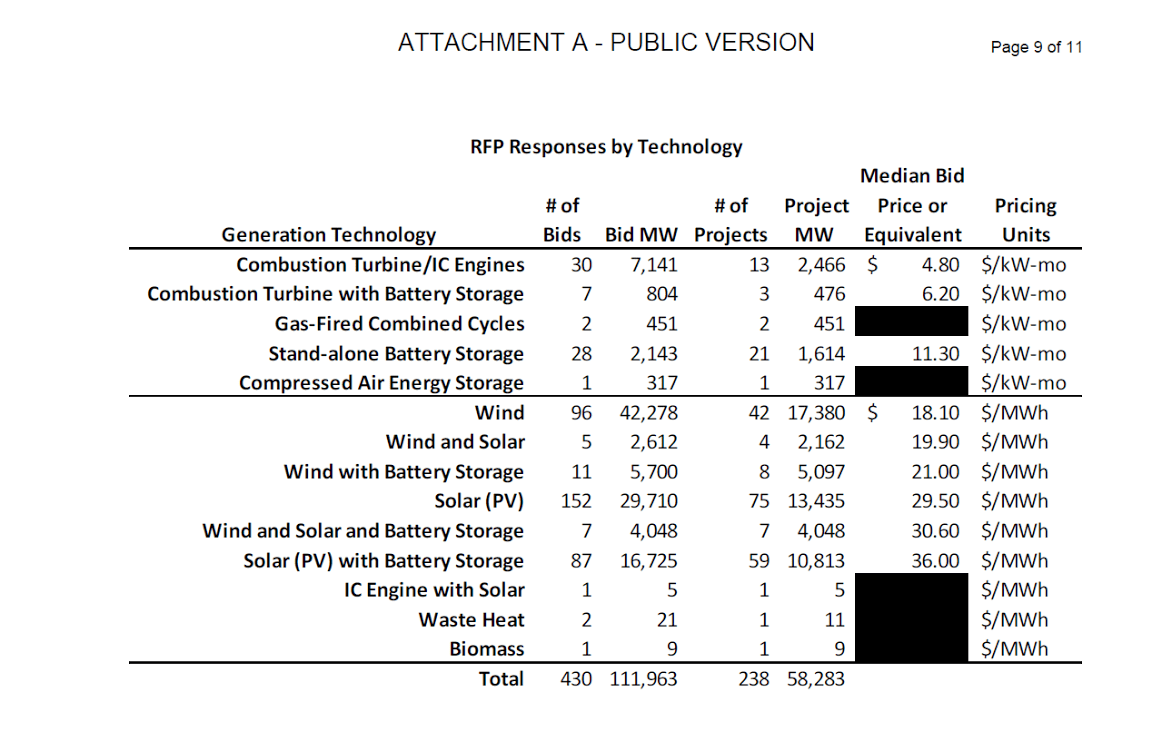
Colorado’s recent bidding for electricity is making real news and providing (yet) another blunt signal that the renewable revolution is real and even accelerating. As part of a long-term plan, XCEL Energy put out a request for proposals for new electricity generation. Released on about the slowest news moment, 29 December, solar and wind prices blew away polluting electricity options without requiring any form of the considerations above. And, including in storage still left the wind and solar costs far below coal costs — even existing coal generation costs.
With numbers like these, any fiscally sensible planner won’t just be buying clean energy for new generation but considering paths toward retiring out more expensive fossil fuel generation — as fast as possible. As Joe Romm put it, this is how coal dies — super cheap renewables plus battery storage.
Solar, wind, and battery prices are dropping so fast that, in Colorado, building new renewable power plus battery storage is now cheaper than running old coal plants. This increasingly renders existing coal plants obsolete.
Solar and Wind underbid fossil fuels in Colorado
As David Roberts points out, what is key here is that this is real world, not some theoretical analytical game.
Usually, when we talk about how renewable energy will evolve in the next five years, we rely on analysts and projections. This is different.
When a utility puts out a request for proposals (RFP) — asking developers to bid in for the chance to build new energy resources — the developers who respond aren’t guessing, or boasting. They are laying down a marker that might get called. They are promising only what they are confident they can deliver.
That makes the responses to an RFP a clear snapshot of the state of the industry, relatively unembellished by ideology or public relations spin.
The real world — the people doing green-eyed calculations — are stating that they can deliver not just RE<C, but renewable energy far less expensively than coal. That matters.
And, in a post filled with many key points, this point cannot be emphasized enough:
This particular snapshot reveals that, on the ground, renewable energy costs are falling faster than even the most optimistic analyst had projected.
While there is constant discussion of the problems of IEA and EIA forecasting when it comes to renewable energy, even the most aggressive analysts (okay, there might be some exceptions … but, well, I don’t know them) have been pessimistic about the course of clean energy options. Wind (onshore and offshore), solar (especially pv), storage, smart grid, and … are blowing through predictions of penetrations and costs.
Let’s face it: In most areas of life, when you look past the hype at the real numbers, it’s depressing. Renewable energy is one area where that typical dynamic is diverted. The closer you look, the better the news gets!”
When it began under Secretary Chu, the Department of Energy’s SunShot program had a target of 5 cents per kilowatt hour for industrial solar in the desert Southwest by 2020. That was clearly seen as a stretch goal and, well, many thought it a stretch too far. That 5 cents is more than double the median solar bid in Colorado. (Note, yes, bids are for 2023 but this is meant as exemplary.)
Analytical groups like Lazard and Bloomberg New Energy Finance do excellent work, with massive data analysis, and strive hard ‘to get it right’. And yet, the prices bid in Colorado — and in project after project around the world — are a fraction of their projected prices decades from now. As Roberts highlights,
The financial advisory firm Lazard issues a much-watched analysis each year of the “levelized cost of energy (LCOE),” a measure that purports to directly compare energy sources based on total costs. Its 2017 analysis estimated that solar+batteries has an LCOE of $82/MWh. You might notice that the median Xcel bid for solar+storage is less than half that. …
Saudi Arabia recently saw bids for utility-scale solar at under $20/MWh, which is less than half Lazard’s lowest estimate for the range of solar LCOE ($46/MWh).
At an auction in Chile last year, a solar+storage project won at $34.40/MWh, which is a third lower than the lowest Lazard LCOE estimates for solar alone.
A company called ViZn Energy Systems, which uses flow batteries rather than lithium-ion, is promising $27/MWh solar+storage by 2023, when the Xcel projects are scheduled to be online. By comparison, Bloomberg New Energy Finance projects an average LCOE of a little higher than that for solar alone in 2030.
Now, as Roberts does explain, there is lots of complexity in calculations and the individual situations around each project (subsidies, quality of renewables, etc …) but the real world is increasingly showing that the lowest cost option within traditional financing calculations is renewable.
The Xcel RFP in Colorado is a relatively small signal, but it is one of many sending the same message: renewable energy is not “alternative” any more. Costs are dropping so fast it’s difficult to keep track. It is the cheapest power available in more and more places, and by the time children born today enter college, it is likely to be the cheapest everywhere. That’s a different world.
All that analytical effort for ‘fully-burdened’ isn’t irrelevant in this “different world” even as it is less required to enable decision-makers to make a cleaner, better for humanity choice when seeking to make the best choice within their ‘stove-piped’ calculations. If — IF — that broader analysis is incorporated, as well, it will even further accelerate moves toward clean energy solutions.
January 16th, 2018 · Comments Off on How will you handle Trump’s #SOTU? Here is a #climate leaders’ approach
On 31 January, Trump will mouth a State of the Union speech. Expect — if he doesn’t go off script too much — that much of the traditional media (The Village) will gush about how he stayed on message, that maybe this is a new Trump, that …
Bluntly, it is revolting to consider that a man who should be yelling at the TV in his underwear eating McDonald’s food with wrappers on the floor around him in a retirement home treating him for developing dementia is, instead, the one to be yelled at when he is on TV.
For me, I dealt with this conundrum, in 2018, by volunteering to be a judge in a High School science fair: give a little back to the community rather than have my blood pressure rising to dangerous levels live tweeting an event that, well, is one of the millions of things of the Trump/GOP kakistocracy* that simply shouldn’t be occurring.
I made that commitment before learning of something perhaps more appropriate … a DC event to educate and mobilize on climate. Here is that climate event at George Washington University, in DC, as ‘response’ to Trump’s State of the Union.
After Trump’s first State of the Union, join us for Fossil Free Fast:
The Climate Resistance. Sen. Bernie Sanders, Bill McKibben of 350.org, Varshini Prakash of the Sunrise Movement, Rev. Yearwood of the Hip Hop Caucus, Jacqueline Patterson of the NAACP, and many more will deliver the state of the climate movement.
They will share stories on the urgency of the current political and climate crisis, and how we can resist the Trump Administration’s attacks on our climate.
This truly does sound like a worthwhile event to attend and pay attention — something far better than listening to pundits wax rhapsodically over Trump’s oratory.
* Kakistocracy: A key term to know. One of the very few ‘pleasures’ and benefits of the Trump presidency is learning new language and terms to capture what is going on.
Within seconds of the outrageous nightmare scenario being announced as reality, scientists around the world started to mobilize to capture key science information and data from US government websites to maintain knowledge in what some suspected would be a Dark Ages period. Some thought this is absurd, that the Trump-istas just wouldn’t go there.
Anyone looking at the official websites of the Environmental Protection Agency, the Department of Energy, or the White House might be under the impression that climate change isn’t a threat.
That’s because the Trump Administration has been systematically scrubbing its online references to climate change,
the words “climate change” and “carbon” have been stripped from government websites across a wide range of agencies, including the departments of Health and Human Services, Transportation, the Interior, Energy and State, the report found. They have been replaced with vaguer terms like “sustainability” and “emissions.”
The group also found a wide swath of alterations to climate change webpages.
The White House no longer lists climate change as a priority.
EPA, along with the departments of State and Energy, removed language related to U.S. international obligations to address climate change.
Hundreds of pages at the EPA site that were designed to help local and state governments mitigate the effects of climate change have been removed.
The Interior Department scrubbed a website for tribal climate programs of the word “climate change.”
The National Institute of Environmental Health Sciences dropped a link to an educational fact sheet about climate change and human health.
the Bureau of Land Management altered and removed language and links about climate change, renewable energy and the overall mission of the agency and took down its climate change webpage without replacing it.
When it comes to climate science: “We’re sorry, that page can’t be found.”
Every day is pretty good until we remember that these destructive fossil fools are in control of the U.S. government. And, from promoting polluting fuels to damaging the development of science to reducing data collection to disappearing basic science from government websites, Team Trump is choosing to #ActOnClimate: to act to make the climate situation worse.
January 8th, 2018 · Comments Off on Global Warming is a hoax: I froze on the soccer field in record cold temperatures
Refereeing youth soccer: a way to clear my mind, get some exercise, interact with people, contribute to society, and to get yelled at by people who don’t have a clue about actual rules and regulations but who, because their child is on the field, is the world’s leading expert.
In early November, refereeing a tournament — game after after game — was a stunningly chilling experience. Actually, in terms of pure refereeing, this ‘All Stars’ tournament was actually a good experience. From the coaches and players in 11 games over two days, a lot of positive feedback (the sincere ‘it was against us but you made the right call’ sort of comments are nice to get in that end of game handshake) along with some complicated situations requiring actual judgment about how best to manage the game, to protect players while enabling them to play …
The tournament was — as above — stunningly chilling. Not normal to tell players, before a game, ‘it is cold — I don’t care if you are wearing winter coats, gloves, or hats as long as your jersey is on top, it is clear to all which team you’re on, and I can see your number …’
While the broader Northeast has been visited by many record highs over recent years, a record low is much less common these days. For instance, this is the first record low in November for Washington since 1976. It is the first record low overall in the city since February 2015. That one was the first since May 2002.
Right, a great day to be out on fields with essentially no wind breaks for a good 12 hours of so. Was quite happy to have some hot liquids at home afterwards each day.
Now, those Post articles had a sad element to it that is all too common when it comes to The Washington Post discussions of extreme weather situations: climate change is absent. That failure, sadly, is all too common across US media where underreporting climate change is all too common a case. Virtually no record low temperatures for an extended period — when there are lots of high temperature records — is, well, … without explanation as to potential (actual) causes?
Guess readers are supposed to read between the lines to ‘know’ that this is the case.
Now, that was back in November. This past week, with the Polar Vortex bomb, the entire US East Coast has been hit with terrifying cold temperatures that make that November day look like a heat wave. In reading and watching news coverage of the East Coast’s beyond (below) frosty start to 2018, that gap is just as stunning. The primary driver of ‘this relates to climate change’ were the rare reactions to Trump’s tweeting and certainly not a major portion of the press coverage.
And, for those living under severe cold, there is little coverage telling them that the rest of the world is hotter than normal. Alaska is missing winter. California is dry, hot, and still smoldering from massive fires. And, well, Australia is almost literally burning up with highways literally melting.
The rollercoaster rumbles on!
Temperature records possible over next day or two for east coast of US (cold) and eastern Australia (heat). pic.twitter.com/0838oj7ZvZ
The streets of Boston were flooded with icy waters that carried dumpsters away. Cars in nearby Revere, Mass., were nearly buried in frozen floodwaters. Wind chills in parts of New Hampshire could hit 100 degrees below zero (That’s not a typo, as the New York Times points out).
In Australia, however, it’s summer — and a remarkably hot one. So hot that part of a freeway in Victoria on Australia’s southeastern coast was “melting.” Several hundred miles northeast, in the greater Sydney area, Australians spent Sunday in the most sweltering heat in nearly 80 years.
Such is the extreme weather greeting 2018 from opposite ends of the globe
So reads an online post from the Capital Weather Gang, The Washington Post Capital Weather Gang. The article points out these extremes and — unlike so many other Post pieces — actually has a discussion mentioning climate change.
Australia’s heat wave — and the United States’s bomb cyclone — both come on the heels of the second-warmest global year on record since the 1800s.
A new report, pointing to signs of climate change such as thawing of Arctic ice and wildfires, says the global average surface air temperature in 2017 exceeded 14.7 degrees Celsius (58.46 Fahrenheit), making last year a bit cooler than 2016, the warmest on record. But 2016 included the tail end of a strong El Niño in the tropical Pacific, and that bumped up temperatures that year, as well as in 2015
We all naturally focus on our own backyard — or our own soccer field/football pitch. “Global Warming”, climate change, is a global event. With global temperatures continuing their upward path, if (when) it is unusually cold in your backyard it is very likely that it is unusually hot in others’ backyards.
In any event, with temperatures barely cracking the teens in the past few days in my backyard, quite glad to be in front a roaring fireplace than out refereeing a tournament.
Comments Off on Global Warming is a hoax: I froze on the soccer field in record cold temperaturesTags:Energy
People are protesting in the streets — calling for more openness and, even more strongly, policies to boost economic performance. As to the latter, for example, calls to end Iran’s major support for various militant and military forces (Syria, Hamas, otherwise ..>) and use that money at home.
The protests are serious.
There have been a variety of crackdowns, with at least several dozen killed so far.
— Brad Johnson SUBSCRIBE TO HILLHEAT.NEWS (@climatebrad) January 3, 2018
Let’s be clear: just one can’t say ‘the Syrian Civil War was created by human-driven climate change’, climate change is just one of many factors driving today’s unrest in Iran. Bad government economic policies, few jobs for young people, continued efforts to suppress openness, massive increases in smart phone ownership (with less fettered access to the world and each other), and … there are a multitude of factors at play in this complex situation. But one cannot (unless rejecting realities, like Trump and his #alternativefacts supporters) deny that human-driven climate change,
is helping drive the disruption/unrest in Iran (with a 14-year drought), and
is disrupting international security and creating increased risks for upheaval, refugee movements, conflict.
“Fishermen at a small port in Sistan, Iran are looking into the dried Hamoon lake, where once was a place for fishing but after big drought in last decade they lost their jobs and most of them have immigrated to large cities around. December 2016” Ako Salemi (http://www.akosalemi.com/climate-change-in-iran.html)