November 27th, 2009 · Comments Off on News from the Arctic: The NOAA 2009 Report Card II
This guest post from BillLaurelMD provides a window on change in the Arctic — a window that we might prefer not to look through, but look we must. This is the next in an occasional series of diaries on the state of Northern Hemisphere Arctic sea ice, written in memory of Johnny Rook, who passed away in early 2009. He was the author of the Climaticide Chronicles.
In November 2009, the National Oceanographic and Atmospheric Administration issued a report card on the condition of the Arctic in 2009. I diaried the sections on changes noted in the Arctic atmosphere and sea ice. Now for the section on Greenland, where we find the largest land-based ice sheet in the Northern Hemisphere.
I’ll start with a description of the Greenland Ice Sheet and the methods used to determine whether it’s gaining or losing ice. Then I’ll talk about the results of studies over the last few years regarding the stability and mass balance of the ice sheet. Last, I’ll put those research results into the context of the NOAA 2009 Arctic Report Card.
November 26th, 2009 · Comments Off on Talk Radio and Climate Change — a perspective
This guest post is from CertaiNOT, who listens to talk radio so that you don’ t have to …
Environmental groups thinking of protesting anywhere to support action on climate change should consider picketing the Limbaugh and Hannity superstations. There may be no better place to get Obama’s back and show support for global warming action during the Copenhagen climate summit.
Limbaugh and Hannity both have been giving “Climate-gate” full attention, complete with guest denial ‘experts’, claiming it is proof that global warming is a hoax. Environmentalists, Americans, will be making a huge mistake to let “Climate-gate” play out on TV and print and blogs, expecting this to be hashed out in the MSM between flat earther denialists and rational informed environmentalists.
The GOP talk radio machine loves something like this where they can say the ‘liberal’ trad media is ignoring the ‘facts’ and they can go on and on unnoticed by the left. GOP talk radio has been doing the heavy lifting on Overton windows for 20 years and is negating recent gains (like electing a president who believes) toward passing meaningful climate action.
Coal pollutants affect all major body organ systems and contribute to four of the five leading causes of mortality in the U.S.: heart disease, cancer, stroke, and chronic lower respiratory diseases. This conclusion emerges from our reassessment of the widely recognized health threats from coal. Each step of the coal lifecycle (mining, transportation, washing, combustion, and disposing of post-combustion wastes) impacts human health. Coal combustion in particular contributes to diseases affecting large portions of the U.S. population, including asthma, lung cancer, heart disease, and stroke, compounding the major public health challenges of our time. It interferes with lung development, increases the risk of heart attacks, and compromises intellectual capacity.
Global Warming is a massively serious threat for which emissions from burning coal are a major contributor. It should be enough to decide that coal should not be part of our collective future. Let’s, however, put the pesky issue of catastrophic climate change aside.
Acidification of the oceans is terrifying for anyone who wants seafood or cares about planetary health and comes, in no small part, due to Co2 emissions from burning coal. Let’s, however, forget about the viability of the oceans to support complex ecosystems.
The material in Coal’s Assault on Human Health should provide enough reason to move away from coal toward a clean energy future (and fuller employment with clean energy jobs). In the words of Kristen Welker-Hood, SCD MSN RN, PSR’s director of environment and health programs.
These stark conclusions leave no room for doubt or delay.
The time has come for our nation to establish a health-driven energy policy that replaces our dependence on coal with clean, safe alternatives.
Business as usual is extracting a deadly price on our health.
This guest post from Josh at Enviroknow is the most comprehensive and organized post about ClimateGATE that has emerged to date. Josh will be updating this excellent reference document here.
First of all, this story should never have been called ClimateGate. Given the similarities between this smear job and the Swift Boat attacks on Senator John Kerry, SwiftHack is a far more appropriate name.
I’ve attempted to cover the major points of interest in this story. Consider this post a perpetual work in progress. It will be continually updated. Please leave appropriate links and angles I’m missing in the comments.
For your convenience, the following 6 points each links to the corresponding section of this post:
This guest post comes from Devilstower and is relevant for thinking about Clean Energy Jobs that should result from the Jobs Summit and a coming jobs bill.
Meteor Blades has already written a well-researched and authoritative article on the job summit. So consider this one the completely personal, off-the-cuff alternative cup o’ free advice to our president and everyone else involved in trying to find ways to connect Americans with paychecks.
Despite the $100s of millions (and likely more accurately, $billions) of resources expended on disinformation, mediocre reporting by the mass media, and the active embrace of falsehoods as part of political manipulation by many of a political party’s leadership, the vast majority of Americans adhere themselves to the basic facts that the globe is warming and that we have a responsibility to do something about it.
November 24th, 2009 · Comments Off on Energy Bookshelf: Contemplating A “World Without Ice”
We ever so casually talk of Arctic ice retreats, the potential for Greenland ice meltage, and the implications of Antarctic ice mass falling due to global warming. Centimeters or inches, those 2100 implications seem so remote and, well, insignificant to most. Henry Pollack’s A World Without Ice provides a strong window on the essential nature of ice caps and glaciers for the global climate in which humanity evolved and human civilization developed. He lays out a disturbingly dire picture of the implications ahead of us as, incrementally, permanent ice masses melt away from the global landscape
Chapter 6, Human footprints, perhaps is my favorite section of the book, perhaps because “ClimateGate” and the denierosphere have me thinking (again) about the reasons that foster anti-science syndrome when it comes to the Theory of Global Warming. From the opening pages of that chapter:
IPCC scientists in their 2007 Assessment Report concluded that “most of the observed increase in globally averaged temperature since the mid-20th century is very likely (90% probability) due to the observed increased in anthopogenic greenhouse gas concentrations.”
Nothing shocking or especially well written (actually confusing to too many), thus Pollack ends the paragraph with:
Ninety percent certainty is an extraordinary statement of confidence in the conclusion–were you to go to a casino and be offered the opportunity to win at any game nine times out of ten, you would surely play with great confidence and very likely leave with a bundle of cash.
James Inhofe and ilk are seeking to convince humanity that a 90+% chance should be bet against. However, in this case, we’re not betting our wallets but literally our and the rest of humanity’s futures. When getting people (and institutions) to place the bet, there are too many factors that enable the self-proclaimed skeptics to confuse the situation.
Thus, Pollack then moves on to an examination of reasons for skepticism (such as rampant anti-science syndrome suffering due to religious reasons; “deliberate disinformation and propaganda from the fossil fuel industry”). He then has a coherent several pages laying out why it is fundamentally against human nature to understand and embrace the issue of climate change:
Our own eyes: we live in our spaces, our own ‘environments’. “We are not born with global vision or a sense of history.”
We tend to focus “on contemporary local concerns”. Our evolution works against the long time frame as “humans did not need to know what the local climate would be like a century into the future” as “they were much more concerned with the necessities of the here and now, and had little time or inclination to ponder the abstract world.”
“Daily activities are separated from the subsequent effects those activities have on the climate.” It is near impossible for people to connect “increasing the setting of one’s thermostat in one’s home … to the reality that these activities slowly but steadily increase the absorption of infrared radiation in the atmosphere and warm the planet.”
“People feel very insignificant and powerless compared to the forces of nature. … what people do not appreciate is that, collectively, the almost seven billion people on Earth today, with millions of big machines, are staggeringly powerful and becoming more so every year. It is the sum of activities of billions of individuals … that is indeed changing Earth’s climate.” Pollack then quotes Robert F. Kennedy
Few will have the greatness to bend history itslef but each of us can work to change a small portion of events and in the total of all those acts will be written the history
Perhaps even more powerful, Pollack quotes Iain Couzin about army ants:
No matter how much you look at an individual army ant, you will never get a sense that when you put 1.5 million of them together, they form bridges and columns.
Thus, we the ‘army of human ants’, incapable of fundamental impact on the global system as individuals, are, collectively, changing the global climate system — and not for the better.
Clean Energy Jobs Go To The Cleaners: $50 million per year for 9,000 jobs
Coin-operated laundromats almost require rivers to operate, with their industrial-like washing machines gobbling up 60 gallons or more of water. And, since there is no incentive for those pumping in quarters to go cold, rather than hot, we’re actually talking about rivers of steaming water. That water heating requires a lot of energy, typically coming from natural gas water heaters. When it comes to active solar power, heating water (or, at times, preheating water) is currently one of the most cost effective paths in terms of energy value per dollar of investment. Laundromats (and other institutional laundries, such as hospitals) are prime places for solar hot water due to the high volume, 365 days a year water usage. And, there a number of solar hot water systems already in place in laundromats (such as this huge one in Chicago (proclaimed as the world’s largest laundromat) and this laundromat/car wash in Jamaica Plains, MA (pdf)). As for the last, due to federal and state incentives, the payback period should be less than five years while ensuring the owner against fluctuating energy prices.
Yet, laundromats are one of those classic split incentive situations which can hinder making longer term investments toward energy efficiency. It is hard for any business to invest for a long-term ROI, perhaps especially one that is relying on quarters going into slots in a constant chime. And, it can be hard for small businesses to secure long-term financing that might enable them to do even something that should provide a five-year return on investment. Perhaps one percent of laundromats are using solar hot water heating when it might make sense for the vast majority of the 35,000 U.S. coin-operated laundromats.
The question then: how can we spark laundromat use of solar hot water, cost effectively, in a way that will get people to work and help cut into our greenhouse emissions while earning owners more money and helping cut the costs of those on the lower economic end of the spectrum who are using these services? A multifaceted approach could do the trick:
Increase federal assistance for commercial solar hot water systems for laundry services by 5% for 2010 and 2011 (to 35% of cost) to highlight a fiscal benefit and make this an upfront payment rather than a tax credit.
Additional assistance through Federal loan program availability to provide an interest rate of six percent for funding these loans.
Provide 95% funding that would be paid-back via real-estate taxes over a 12 year period
Very quickly, the math:
Assume $100,000 average cost for installed system.
Federal costs per system:
$5,000 per system cost for additional federal money with an additional $1500 implied cost for moving from tax credit to ‘cash payment’ system.
Additional $3500 implied cost through assistance for lower interest rate.
Thus, each $10k of additional Federal government cost to spark $100,000 in local business activity.
At 18 jobs per $1 million, each $100k of Federal cost creates 18 direct and indirect jobs.
$50 million in additional funding per year would spark $500 million into commercial solar hot water systems through supporting 5,000 laundromats moving to solar hot water systems each year.
This $50 million in funding would support 9000 jobs spread throughout the United States.
In addition to the jobs benefits, this program would help foster renewable energy services’ capacities throughout the United States, help reduce greenhouse gas emissions, spark increased small-business profits, and potentially lead to lower costs for laundromat users.
This program can easily be expanded to support other large water demand services (such as hotel, hospital, and other commercial laundries) with similarly high payoffs in terms of job creation and sparked economic activity per dollar invested.
Clean Energy Jobs Go To The Cleaners: $50 million per year for 9,000 jobs
November 24th, 2009 · Comments Off on Theory, hypotheses, and the like: a scientist’s take
For too many Americans, a ‘theory’ is a casual thing like ‘I have a theory as to where I lost the keys.’ They then translate this casual understanding, mentally, when they hear “Theory” referencing science without truly understanding the import of the word. This guest post from chemist chparadise provides perspective on this.
There’s been enough of a brouhaha around [the web] and on “climate skeptics” sites lately that it inspired me to write briefly my own take on how scientists view such things as hypothesis, theory, fact, and the like. Other scientists may have their own way of phrasing things, but I like to think that I’m sticking fairly close to the line for the scientific method.


 about “
 to operate, with their industrial-like washing machines gobbling up 60 gallons or more of water. And, since there is no incentive for those pumping in quarters to go cold, rather than hot, we’re actually talking about rivers of steaming water. That water heating requires a lot of energy, typically coming from natural gas water heaters. When it comes to active solar power, heating water (or, at times, preheating water) is currently one of the most cost effective paths in
 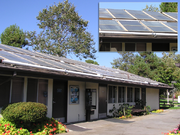 terms of energy value per dollar of investment.