March 22nd, 2010 · Comments Off on With HCR ‘done’, will we pay attention to Climate Change?
This guest post from chparadise provides some important information about the climate ‘state of play’.
While the focus has (rightfully) been on HCR, climate change news hasn’t been fully dead. In fact, it may have been easy to miss a couple notes:
2010 is very likely to be the hottest year on record. This was predicted based on the presence of a modest El Nino and as I’ve shown below the fold, the prediction’s so far been borne out.
NASA has another paper coming out that the last decade was damn hot.
Stanford study confirming that media coverage of climate change is presenting a false balance that misleads the public.
(Apologies if this link doesn’t work – my school has an institutional subscription to Science Magazine) New study shows that burning brush may help forests retain more CO2 by promoting larger tree health.
House Natural Resources Committee Chairman Nick Rahall, D-W.Va., for his leadership on the Restore Our American Mustangs (ROAM) Act to overhaul the Interior Department’s management of wild horses on public lands and restore the prohibition on the commercial sale and slaughter of wild horses and burros; and for skillfully guiding 11 wildlife protection measures successfully through that Committee and to approval by the full House.
“Chairman Rahall has done a remarkable job leading the House to pass an extraordinary breadth of important wildlife measures, as well as personally championing the cause of wild horses on public lands,” said Wayne Pacelle, president and CEO of The HSUS. “He has made the House Natural Resources Committee a real force for good on behalf of animals, and we are so grateful for his compassion, tenacity and skillful legislative work.”
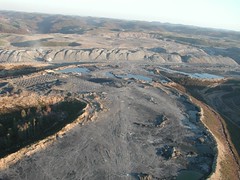
With this announcement, it is hard to exaggerate the extent to which the Humane Society’s leadership is wearing blinders in a tunnel-visioned focus on a very narrow definition of their charter, without looking to a broader definition of what humane human interaction with other species should entail. While Rahall might have been a superstar when it comes to the ROAM Act, he has been an even greater superstar in defense of the coal-mining industry in its reckless endangerment not just of humanity’s future, but literally the survival of untold numbers of other species.
Some 200 members of the House proposed legislation to abolish the method, but it went to the Roads and Transportation Committee, where Rahall is vice chairman.
“I blocked it,” he said. “I kept it from even having a hearing on it. It would have passed Congress overwhelmingly. It was a freebie. Republicans would have voted to end mountaintop removal.”
As described by Bob Kincaid, a broadcaster and activist in the Coal River Valley area of West Virginia:
“The Humane Society couldn’t have consulted with anyone working to save the fauna of southern Appalachia. It’s impossible to think of Representative Rahall as a “humane legislator” in light of the thousands and thousands of wild animals he’s condemned to death or dislocation via his slavish dedication to perpetuating Mountaintop Removal.
Mountaintop Removal has destroyed over five hundred Appalachian mountains and buried over a thousand miles of streams in one of the most biodiverse regions of the entire planet. Those mountains Rep. Rahall has helped kill were home to deer, bears, bobcats, squirrels, raccoons, possums, foxes, rabbits, hawks, owls, snakes, lizards, songbirds, fish, frogs and sundry other living things for which Congressman Rahall shows openly hostile disdain. His disregard for West Virginia’s wildlife population is further manifested in the fact that he actively opposes real science that has proven beyond question that the ecological harm done by Mountaintop Removal is irreversible over a span of time measured in tens of thousands of years.
The Humane Society has a motto: “Great and Small: We stand by all amimals.” They make a mockery of this by giving an award to awarding someone so integral to enabling the incredibly destructive practice of mountain-top removal to continue unabated, even in the face of overwhelming scientific evidence as to MTR’s destructiveness. Simply put, the Humane Society is wearing blinders when it comes to its thinking about and definition of what matters in terms of humanity’s treatment of other creatures on earth.
Let’s consider just one clean-energy sector, the smart grid, for its job-creation potential.
Here is where Sharan takes a misstep into misleading rather than informing. He has chosen to stove-pipe into a very narrow space. It is Sharan’s expertise area and let’s grant him the expertise. And, we can simply (at no cost to the discussion) assume that he correctly discusses the specific item / arena within the article: about how, within this arena, execution of a more efficient and more automated electrical grid could lead to lower employment in the specific domain of meter reading. Yes, “smart” meters that can be read remotely, via a computer linkup, will lead to lowered employment in having meter readers trudging through our yards to get to the meters. Yes, a transition to a clean energy economy will lead to some job losses … even as it creates new jobs and new opportunities.
Even within the “smart grid” example, Sharan doesn’t deal (at all) with the likely new opportunities for the creation of smarter appliances and the installation of these systems. He doesn’t discuss the business opportunities in helping government, business, and individual develop integrated ‘smart homes’ to interact with the Smart Grid.
Sharan doesn’t …
Sharan doesn’t give readers any indication as to the complicated system-of-systems that is impacted and relates back to energy.
Sharan doesn’t offer up the potential that there are arenas where clean energy policies would create growth.
Sharan doesn’t provide a truthful discussion.
While we might require fewer meter readers (and lowered pollution from their driving around our neighborhoods), will we need electricians to install smarter homes? Will stores selling appliances see greater business flow (and thus more sales people, installers, etc …) due to people upgrading toward greater energy efficiency? Will there be more people employed insulating homes?
Sharan does, however, remind us of those who warned that that electric trolleys and internal combustion engines would hurt the career prospects of buggy whip salesmen and stable boys who would have less horse manure to collect. Sharan does, however, remind us of those who focused on how email hurts postal revenues. Sharand does remind us of all those doomsayers who fight change, focusing on the reality that change can have costs even while bringing greater benefits. Sharan does … provide us some of that manure for stable boys to clean up.
Our energy “system” is incredibly complex. A stove-piped discussion, which fails to link into the complexity, has a high potential for misinforming. And, that is what Sharan’s oped does. While providing likely correct information about the specific career field of electrical meter reading, that true information fosters truthiness about the opportunities for explosive growth and win-win-win-win-win-win space with serious promotion of clean energy jobs.
UPDATE: The always thoughtful Natasha Chart, in The Dirty Jobs Myth, has this concluding thought to her dissection of Sharan’s fallacial piece:
In the end, the biggest myth Sharan perpetuates is that the high employment path is the do-nothing option, in which we now consider it good news when the economy loses jobs more slowly.
Rather, the path to more jobs is in creating new industries that will help us avoid the limits and harms of fossil fuels. Which should be obvious, because creating new industries is the way the US economy has gained most of its jobs before. Using innuendo to steer the country away from one of the most promising of new global industries is a grave disservice.
Yes, those who are fighting so mightedly to confuse the public about the state of climate scientists are like OJ Simpson’s lawyers. They are seeking delay and inaction via confusion and misdirection on technicalities, trying to overshadow the overwhelming evidence that convicts their clients (such as coal-fired electricity plants …)
Even though the scientific community is increasingly solid in the evidence and analysis showing human impacts on the climate and even though “all 15 of the warmest years on record have come in the last two decades”
because of a recent onslaught of attacks on the science of climate change, fewer Americans now believe humans are warming the planet than did just a few years ago.
The doubters of climate science have launched an enormously clever — and effective — campaign, and it’s worth trying to understand how they’ve done it. The best analogy is perhaps the O.J. Simpson trial.
The “dream team” of lawyers assembled for Simpson’s defense had a problem: The evidence against their client was formidable. … So Johnnie Cochran, … decided to attack the process, arguing that it put Simpson’s guilt in doubt — and doubt, of course, was all they needed. Hence, those days of cross-examination about exactly how Dennis Fung had transported blood samples and which racial slurs LAPD Det. Mark Fuhrman had used.
In his closing arguments, Cochran compared Fuhrman to Adolf Hitler and called him “a genocidal racist, a perjurer, America’s worst nightmare and the personification of evil.” His only real audience was the jury, many of whom had good reason to dislike the Los Angeles Police Department, but the team managed to instill considerable doubt in lots of Americans tuning in on TV as well. That’s what happens when you spend week after week dwelling on the cracks in a case, no matter how small they may be. They made convincing mountains from the molehills they had to work with.
Yes, even the guiltiest client can get off when they have near unlimited resources and a band of advocates willing to throw decency, ethics, and truthfulness out the window to ‘defend their client’. While OJ’s acquittal might have been a travesty in terms of real justice, it is hard to say that it fundamentally damaged the fabric of society or America’s (and Americans’) security. That is not the case with the bands of global warming deniers, enabled by a gullible media ever-too-ready to play “he says, she says” games in a “faux and balanced” approach to reporting where ‘all sides’ are treated equally, no matter the truthfulness of discussion and solidity of arguments on both sides.
As McKibben notes, the very body of evidence substantiating the science, “beyond any reasonable doubt,” creates the very opening for the Johnny Cochran-like anti-science syndrome sufferers to confuse the public discussion and hinder support for public action.
And, well, the articulate nature of those willing to forgo fact and truthfulness in the fight to distort the discussion enables seizing hold of events to confuse a public which is, politely, not incredibly science literate. Thus, screaming about DC snow storms while Vancouver (and many other parts of the world) are setting record hot spells, is as if they were stating “if the winter glove won’t fit, you must acquit.” Just like the OJ trial, as Bill writes, “These are the things that stick in people’s heads.”
The self-proclaimed skeptics are “playing on our deep-seated resistance to change”. Dealing intelligently with climate change, moving toward an Energy Smart future, provides great promise but it will require change and action on our part. Far easier to make a joke about snowfall and go back to watching TV.
With all due respect to Bill, there is something seriously wrong in this discussion:
In the long run, the climate-deniers will be a footnote to history. But by delaying action, they will have helped prevent us from taking the steps we need to take while there’s still time.
The second sentence is true. The consequences from climate disruption are already and will be far worse because of the climate deniers’ strenuous efforts to derail actions to deal with our fossil foolish addictions. If we are able to avoid utterly catastrophic climate change, it will certainly be despite deniers’ efforts to foster a superhighway toward disaster. But, as to ‘footnote’ … we have already had species disappear from the planet. There will be more extinctions. We already have had serious impacts on human civilization. There will be more damage to come. Their impact on the damage that humanity and the planetary ecosystem has and will suffer from Global Warming already merits far more than a footnote …
February 25th, 2010 · Comments Off on Energy Smart Tom speaks directly, talks tough …
Representative Tom Perriello (D-VA-5) was one of the first candidates to make the Energy Smart list. Today, not for the first time, he provided a clear statement as to why he merited and continues to merit a prominent position in the ‘must support’ list for anyone concerned about fostering a prosperous and secure America future.
Interviewed by David Roberts, Grist, Perriello spoke strongly about the imperative for better energy policy, including the necessity of putting a price on carbon. While too many in the Commonwealth are flaunting their anti-science syndrome credentials, Perriello is speaking forthrightly and directly. His narrow victory in 2008 has him in the Republican cross hairs for defeat this November but Perriello doesn’t speak directly — he speaks with great integrity and from principle. That characteristic, of having the courage of convictions and being able to speak coherently about them, goes a long way with voters who might disagree in a specific case but who respect a clear-speaking politician with principles.
From the interview:
Perriello strongly defended his vote in favor of the American Clean Energy and Security Act, emphasizing the importance of putting a financial price on carbon, stating directly that those burying their hands in the sand are putting America (and Americans) at risk
I would vote for any aggressive energy-independence effort. This is the challenge of our time—the jobs opportunity, the national security challenge, the scientific challenge of our era. Any plan that uses market forces to signal a carbon-constrained environment is going to move us in the right direction. People who don’t support this kind of aggressive energy independence are just selling Americans short.
What is interesting is that Perriello seems open to something like the CLEAR Act (a Cap/Trade plus Dividend) since “always preferred a tax shift with a major reimbursement on payroll taxes,” but his priority is “a way to get to 218 [votes] on a victory for America’s energy independence and national security”.
Perriello was directly dismissive of Senate inaction (with, literally, 100s of passed House items awaiting action in the Senate). And, he used the sort of direct words (words that light the passion of many in the Tea Bag movement who seem, truly, to want Washington to work on solutions — or get out of the way) that politicians too rarely use.
If we were going to wait for the Senate to do anything, we would do nothing. This stuff should have been done 10 to 20 years ago. We’re so far behind China, Europe, and other areas in the energy jobs of the future because neither party has had the guts to take this on. There are so many spineless people in D.C. To me, the new politics—“change we can believe in” —was about starting with what would solve our problems, not what would get us reelected. Whether you do it early or late is not the issue. The issue is, is this going to make America more competitive and safer? I think it will.
The American people respect results: they want jobs, they want the country to be safer. The House has produced a historic agenda in that regard, and the Senate hasn’t. But it’s not about pointing fingers; it’s about getting it done. …
I’m sick of starting with what can we get through the Senate; let’s start with what solves the damn problem. Until the Senate gets its head out of its rear-end and starts to see the crisis we’re in, our country is literally at risk.
Perriello highlighted the importance of providing a structure that business can work with, highlighting that investors and businessmen “need predictability” in government policy to foster investment and innovation.
Every week the Senate doesn’t act, it either freezes that investment and innovation or it sends it overseas. We’re giving up jobs. The Senate—the ridiculous tactics of the Republicans and the timidity of the Democrats—is standing in the way of the kind of job creation we need.
Tom spoke to problems in our political system. For example, about some of his Republican colleagues:
Keep in mind that cap-and-trade is a Republican idea. It was a good idea when the Republicans came up with it and it continues to be when Democrats support it. It’s a good idea because it uses capitalism to solve a core problem. When Republicans are honest with themselves—many of them come up to me and say, “Look, I’d love to support it, I know this is the right approach, but if I do this I’ll have a primary challenger tomorrow.” That’s not conviction politics. That’s spinelessness. There’s a lot of posturing that goes on up here.
About the difference between a 30 minute and 30 second discussion.
Unfortunately, good ideas, ideas that could save our country, sometimes take 30 minutes to explain and only 30 seconds to demagogue. In between those two things is leadership, and we haven’t had the moral courage to take this on.
Tom has a simple question that he sees at the core of what should drive policy discussion:
Does this solve the problem? Is this a solution worthy of the American people? And if it is, then great; let’s move forward with it.
Head over and read the whole interview. It is worth your time.
If this is the sort of voice, the sort of leader you would like to see in the US Congress, consider sending a href=”http://www.actblue.com/page/energysmart”>Energy Smart Tom some support.
Comments Off on Energy Smart Tom speaks directly, talks tough …Tags:energy smart
February 24th, 2010 · Comments Off on The tyranny of the quarterly profit report: Musings on the President’s speech to the Business Roundtable
President Barack Obama spoke to and met with the Business Roundtable today in a speech that could be described as extending an arm, seeking agreement to work together for the common good. This could be a real challenge as, for example, Obama challenged business leaders to lead beyond the daily stock ticker and the quarterly profits report.
It is undoubtedly in the short-term interest of individual corporations to pay less in taxes and deal with fewer regulations. But it is in the long-term interest of all companies to do business in a nation that maintains the world’s best research facilities and universities; a nation with public schools that graduate highly-skilled, highly-educated workers; a nation with functioning railways and airports; a nation that is not dragged down by crushing debt.
The tragic dilemma between short-term and long-term interests is an underpinning of how Corporate America works, with “The Street” quick to punish a business that sacrifices what is perceived to be too much today for what is seen as an uncertain payoff tomorrow. The variation of quarterly profits by a few percent has more meaning to too many investors (and too many financial talk show hosts) than significant opportunities or significant risks tomorrow (or, even worse, the day after tomorrow). In addition, other than ‘goodwill’ gestures receiving plaudits and good publicity, Wall Street doesn’t reward businesses for perceived sacrifices for the common good.
These are tremendous challenge in getting businesses (and, well, the entire culture and nations) engaged in climate mitigation. The daily stock ticker, quarterly profit reporting, and the massive discounting of the future is no small part of that. There are very (VERY) few business enterprises which will truly thrive amid catastrophic climate chaos. Even so, as climate disruption mounts, the polar ice melts, and the risks of climate change become more apparent, there are few on Wall Street ready to embrace concerted action to mitigate climate change even as seizing a leading position in the clean energy revolution offers such strong potential for tomorrow’s profits even while insuring against tomorrow’s risks.
President Obama spoke to this opportunity and the fact that, with every passing moment, America is falling behind.
we need to build an economy where we borrow less and produce more. We need an economy where we generate more jobs here at home and send more products overseas. We need to invest and nurture the industries of the future, and we need to train our workers to compete for those jobs.
Nations around the world, from Asia to Europe, have already realized this. They’re putting more emphasis on math and science. They’re building high-speed railroads and expanding broadband access. They’re making serious investments in clean energy because they want those jobs.
These countries know what’s required to compete in the 21st century. But so do we. And as I said in the State of the Union, I do not accept second place for the United States of America.
A question to ask is whether America’s business leaders are happy in a second-class nation. Sadly, too much of what we have seen in recent decades suggests that, for too many, the answer is yes.
Obama, in a backhand manner, reminded people that he is no socialist even as he reaffirmed a role for government.
Contrary to the claims of some of my critics, I am an ardent believer in the free market. I believe businesses like yours are the engines of economic growth in this country. You create the jobs. You develop new products and cutting-edge technologies. And you create the supply chains that make it possible for smaller businesses to open their doors. So I want everyone in this room to succeed. I want your shareholders to do well, and I want your workers to do well. Because I firmly believe that America’s success in large part depends on your success.
But I also believe this: government has a vital, if limited, role to play in fostering sustained economic growth. Throughout our history, it has done so in three ways. … Second, only government can make those investments in common goods that serve the general welfare but are too expensive for any individual or firm to buy on their own.
And, the President took a few minutes to address energy issues within the context of short-vs-long-term and the role of government. This included a direct call for pricing carbon, something that too many members of the Business Roundtable have ardently fought.
A competitive America is also an America that finally has a smart energy policy. We know there is no silver bullet here – that to reduce our dependence on oil and the damage caused by climate change, we need more production, more efficiency, and more incentives for clean energy.
It is a sign of Obama’s understanding that he uses (often) the point that “there is no silver bullet“. Now, sadly, “more production” for him includes fossil fuel production, but the fact is that betting on a “silver bullet” solution is a high risk bet while a diversified portfolio approach is more likely to lead to success in navigating the dangerous shoals of peak oil and global warming.
Already, the Recovery Act has allowed us to jumpstart the clean energy industry in America – an investment that will lead to 720,000 clean energy jobs by 2012. To take just one example, the United States used to make less than 2% of the world’s advanced batteries for hybrid cars. By 2015, we’ll have enough capacity to make up to 40% of these batteries.
This is a point that too few Americans realize, that the Stimulus Package is setting the stage for increased American competitiveness and that additional resources could insure that we stand atop that stage.
We’ve also launched an unprecedented effort to make our homes and businesses more energy efficient.
Sadly, this has been slow-rolled with slow hiring and other challenges but the process seems to be moving forward now.
We’ve announced loan guarantees to break ground on America’s first new nuclear plant in nearly three decades. We are supporting three of the largest solar plants in the world. And I’ve said that we’re willing to make tough decisions about opening new offshore areas for oil and gas development.
Well, unlike the State of the Union speech, at least President Obama mentioned solar. Now, to this audience, is expanded oil and gas development a “tough decision”. To be honest, perhaps Obama can gain points in this audience by making it quite explicit, directly explicit, that he is willing to anger people who have thought through our energy and climate challenges opportunities (like me) in compromises to get cooperation from recalcitrants like many he spoke to today. Instead, he seems to be giving up concession after concession without first securing commitments from those he seeks to placate.
But to truly transition to a clean energy economy, I’ve also said that we need to put a price on carbon pollution.
This is important. President Obama didn’t step away from putting a price on carbon … whether that would be via some form of Cap & Trade or a direct fee.
Pricing carbon, pricing the costs of pollution within the traditional financial contract, is a critical step to enable business planning for more rapid moves toward a lower carbon emissions economy.
Many businesses have embraced this approach – including some here today. Still, I am sympathetic to those companies that face significant transition costs, and I want to work with organizations like this to help with those costs and get our policies right.
An olive branch: I stand ready to work with you and help you through the transition costs.
What we can’t do is stand still. The only certainty of the status quo is that the price and supply of oil will become increasingly volatile; that the use of fossil fuels will wreak havoc on weather patterns and air quality. But if we decide now that we’re putting a price on this pollution in a few years, it will give businesses the certainty of knowing they have time to plan and transition. This country has to move towards a clean energy economy. That’s where the world is going. And that’s how America will remain competitive and strong in the 21st century.
This is an important and truthful statement. Hopefully those in the room had their minds open to hearing and understanding this.
Full text of the President’s speech after the fold.
Comments Off on The tyranny of the quarterly profit report: Musings on the President’s speech to the Business RoundtableTags:Energy · President Barack Obama
February 24th, 2010 · Comments Off on An entrepreneur reports from the “Green Olympics”
Jack Hidary, one of the more innovative green entrepreneurs, is at the Vancouver Olympics evidently enjoying himself at events (evidently speed skating) but, more importantly, engaging with world leaders (political, cultural, private sector) to foster engagement toward more sustainable practices.
In this video, Hidary discusses Vancouver’s Green Olympics (VANOC sustainability page) even as he highlights some gaps, such as a shortfall in the use of highly cost-effective solar outdoor lighting. (Note that Jack, in this case, seems to have missed an item in terms of the high cost-effectiveness of solar outdoor lighting: that not having to put in the infrastructure to wire the lighting to the grid often is a greater cost savings than the additional capital cost of solar panels and batteries to provide nighttime lighting.) Hidary also questions the path toward offsetting the Olympics large carbon footprint, suggesting that this is something meriting watching.
On the other, more positive side, Hidary highlights the quite Vancouver’s quite ‘green’ nature, which is far from limited to just the Olympics. One of Hidary’s anecdotes provides a window on the quality of Vancouver’s public transport: the taxi driver Hidary spoke with is far from busy, which isn’t what one might expect amid a massive event like hosting the Olympics.
There is much of value in Hidary’s discussion, including highlighting the Carbon War Room:
The Carbon War Room harnesses the power of entrepreneurs to implement market-driven solutions to climate change. The world needs entrepreneurial leadership to create a post-carbon economy.
The War Room’s unique approach focuses on bringing together successful entrepreneurs, business leaders, policy experts, researchers, and thought leaders to focus on market-driven solutions.
Our approach is to identify the barriers that are preventing market-based scale up of climate change solutions and thereby perpetuating the status quo. In addition to technology and policy gaps, these barriers include principal-agent problems, information gaps, and lack of common standards or metrics.
The NAACP Image Awards celebrates the outstanding achievements and performances of people of color in the arts and literature, as well as individuals or groups who promote social justice through their creative endeavors.
This Friday, the NAACP will present an image award to an American leader who has a legitimate claim to sparking the creation of 100,000s of jobs across the nation and motivating even more Americans toward action to improve their lives and their communities.
As announced by NAACP President Benjamin Todd Jealous, the NAACP has decided to give the award to an incredibly articulate, Ivy League educated African-American lawyer who worked as a community organizer who is impassioned about how America (and Americans) can be transformed through the power of clean energy jobs and who has been the target of a malicious, truthiness-laden set of attacks from right-wing sound machine.
No, the Image Award isn’t going to President Barack Obama, but to Van Jones who was hounded out of the Obama White House by a … mob intent on throwing away one of America’s greatest traditions — that people can grow and learn and develop beyond their pasts. Sadly, that lynch mob’s splices from Van’s life defined him for too many Americans. As Benjamin Todd Jealous put it,
Van Jones may be the most misunderstood man in America.
He resigned from the White House last year after some sought to discredit him for missteps, such as political statements made years ago. However, we can never afford to forget that a defining trait of our country is our collective capacity to practice forgiveness and celebrate redemption. This is a nation built on second chances.
In America, we ultimately judge people on what they are doing today for tomorrow, not for what they did yesterday.
It is hard to exaggerate Jones’ eloquence, ability to speak with meaning to the audience before him while helping them understand things in a different way, and power to build bridges between divergent people and interest groups (at least, well, among those who are ready to keep the door open to the concept that cooperation is something with merit). He has the eloquence, passion and moral compass of a great preachers; an ability to forge coalitions of a great negotiator; and an ability to understand and articulate technical issues like a great administrator. Jones’ vision of a Green Collar Economy combined an understanding of the seriousness of the challenges and threats of climate change with a vision for the opportunity that tackling these challenges created for fostering a stronger and more perfect union.
Van’s entry into the White House gave hope to those who saw the potential for clean energy jobs to spark a rapid path out of our economic travails while setting the stage for a more prosperous and secure American future. His resignation from the White House put a pale (and, well, a pall) over the prospects that vision would be achieved. Perhaps the Image Award will help bring Van back into a more prominent role in our public discussion and that will be a step forward toward a more perfect union.
I am probably the biggest champion of free market solutions for America’s problems, period… I understand these problems well enough to understand the only way we’re going to be able to solve them is by unleashing innovation and entrepreneurship and market-based forces.
The journey that I took to get to these positions had a lot of stages and phases in it. I understand that they would raise some eyebrows for people who were trying to figure out who this president is, and who I am, and I accept that. When you step forward and try to show leadership, then to some extent, everything’s fair game.
I don’t have any bitterness or anger about the situation. The good thing about being an American is you’re free to think whatever you want, and you’re also free to change your mind. That’s my story.
And the first sentence of the following is simply true. We can hope (work to make true) that the sentences that follow are also correct.
When the food fight is over, there’s one spot of clean common ground in American politics and that is the need for us to be leading on energy, clean energy, and for us as a country to be more secure with all those jobs. … I’m confident we’re going to get there because I don’t think America is going to be willing to pass this one up. I think at the end of the day, common sense will prevail, and the common ground will be in the direction of clean energy.
KF: What surprised you about what happened when you left the administration?
VJ: I was surprised buy how many different kinds of people took it hard, as a personal disappointment for them, about where American politics was headed. For some people my choice to resign signaled something very disturbing and very sad about American politics.
It is good that Jones recognizes this … too bad that the recognition came after the resignation, which helped fuel the enraged ‘just say no’ to any progress crowd who used his ‘ouster’ (okay, resignation) as a signal of their power and reinforced their efforts. Had to be tough to be Van, in their cross hairs, and it is remains unclear whether he was pushed, but the union would be stronger if Van had remained and been defended.
Karen, by the way, captured something important in her opening to the interview:
After joining the administration, the same political thuggery recently cited by a number of members of Congress as the reason for their retirement, came after him. What got lost in that feeding frenzy was that these attacks never questioned whether or not he had valuable, important ideas; the quality of his work, or if he was doing a good job. Instead, the attacks had everything to do with thug politics aimed at undermining the president.
Sadly, one of the refrains that we hear (ad nauseum) is that regulation is somehow harmful for the economy, that government action (on any front) would strangle business activity. In the public debate, the accurate and truthful case is not made frequently enough about how government regulation actually strengthens our economy and boosts our economic performance.
In his opening statement to today’s hearing on the Environmental Protection Agency (EPA) budget, Senator Jeff “Energy Smart” Merkley (D-OR) took a moment to make a statement about the value of regulation to reduce pollution.
As I’m listening to this conversation, I’m reflecting back on how every single time in this nation, when we have confronted great damage to our air or to our water, it is always the same mantra: ‘it will kill jobs’. And every single time when we look back 10 years later, 20 years later, we’re so thankful that we actually created jobs by cleaning up our waterways, we created jobs by cleaning up our air, and we’re going to create jobs by cleaning up carbon dioxide pollution as well.
According those fighting against action to protect the Ozone layer, eliminating CFCs would mean that refrigeration would be so expensive that only rich people like the Rockefellers or Hiltons families would be able to afford it. Don’t know about you, but my milk isn’t going bad due to refrigeration being too expensive for my household.
According to those who fought against action to reduce acid rain, tackling sulphur emissions from coal-fired electricity would be so expensive that American households wouldn’t be able to light their homes. Don’t know about you, but there are an awful lot of people in my neighborhood watching TV in the evening — with the lights on.
And, so on …
Tackling carbon pollution provides us (the U.S.) an opportunity to seize value while protecting our future. Fossil fuel pollution is costing Americans, year-in and year-out, well over $100 billion per year in additional health care costs. Those costs: increased risk of cancer, asthma and other ailments for you, me, and our children. Fossil fuel pollution is acidifying our oceans. The exploration and exploitation of fossil fuels is devastating our lands and seas. And, while our exploitation of fossil fuels enabled the creation of our modern economy, our exploitation of fossil fuels has become a dependency well described by President George W. Bush as an addiction. Our addiction is placing us at ever greater risk for catastrophic collapse.
But, tackling that addiction can and will create opportunities. Money overseas for oil would be better spent here creating a stronger America. As Senator Merkley put it.
I can tell you it absolutely infuriates me that we’re spending a billion dollars a day on oil from the Middle East and countries like Venezuela that don’t share our interests. Now, I just came back through Kuwait, and they’re building gorgeous towers with our American money. And if you want our dollars to go out of this country and build towers in Kuwait, then go on fighting for that policy. But if you want to create jobs in America, let’s keep that money here. Let’s create red white and blue jobs in America creating renewable energy and keep those dollars in our economy, rather than sending them overseas so that dictators in far-away countries can build shiny new towers.
And, this isn’t just about ‘shiny new towers’, not just about health, not just about jobs, but also fundamentally about national security.
As Senator Merkley put it, “we need to have a direct conversation”.
I think we need to have a direct conversation about the damage to our national security of dependence on oil overseas. We need to have an honest conversation about the hemorrhaging of our dollars going overseas rather than creating jobs here in America. And we need to have an honest conversation about the impact of carbon dioxide pollution. The EPA is right at the middle of that conversation, and thank you for putting together a budget that presents a responsible and honest and straightforward approach to taking on this challenge and the challenge of creating jobs here in America. We can create jobs as we work to change the use of carbon dioxide being produced by our vehicles. We can take and produce a tremendous number of jobs as we pursue energy saving retrofits in our buildings.
And, well, we have a choice about where we wish to send our money.
We absolutely have the chance to take and develop energy here, so that we are making our energy payments to Americans, not to Kuwaitis.


 Restore Our American Mustangs (ROAM) Act to overhaul the Interior Department’s management of wild horses on public lands and restore the prohibition on the commercial sale and slaughter of wild horses and burros; and for skillfully guiding 11 wildlife protection measures successfully through that Committee and to approval by the full House.
 a remarkable job leading the House to pass an extraordinary breadth of important wildlife measures, as well as personally championing the cause of wild horses on public lands,” said Wayne Pacelle, president and CEO of The HSUS. “He has made the House Natural Resources Committee a real force for good on behalf of animals, and we are so grateful for his compassion, tenacity and skillful legislative work.”
 but to