March 29th, 2011 · Comments Off on Energy BOOKSHELF: Mr Governor, your state is “Addicted to Energy”!
Elton Sherwin’s Addicted to Energy is an eminently readable and accessible letter to the nation’s governor. This 300+ page “letter” lays out a set of key issues and check lists that provide any (sane) state government (Governor) a sensible starting point for transforming their state from inefficient fossil fuel status quo to a more prosperous climate-friendly future.
Sherwin, a Silicon Valley venture capitalist (Ridgewood Capital), provides clarity as to ways to think about energy challenges, with suggested mindsets that could drive meaningful change.
The inability to deploy cost effective solutions … is one of America’s greatest challenges. (p 20)
Sherwin provides thoughts and paths to break through this challenge.
In line with the earlier post’s focus on the importance of framing in titling and providing the summary description of a conference, ACCO deserves kudoes for the signaling of the title which says — explicitly — that “national security” is larger than the Department of Defense. More importantly, here is the conference’s subtitle: “Mitigating Risks and Seizing Opportunities in a Rapidly Changing Global Environment”. We face the critical challenge of understanding risk(s) to enable risk mitigation and, via that risk mitigation, we have the potential for meaningful positive opportunitis in the face of the rapid changes of resource challenges like mounting climate chaos.
Here is the ACCO’s introductory statement:
U.S. defense and intelligence communities are increasingly focusing resources on the operational and national security implications of climate change and energy. With the most recent quadrennial report identifying climate change as a global destabilizing force for the first time, an executive order from President Obama on sustainability across the Federal agencies, and an uncertain and unstable energy market, the challenges before American defense and national security communities to mitigate climate impacts and energy risks, as well as establish a leaner, more effective operational force in a down economy are clear.
Again, the ACCO’s conference organizers merit credit for thinking this through and laying the basis for a reality-based thoughtful conversation through the conference’s two days:
Defense/intel communities are turning attention to climate change and energy.
The QDR discussed climate change.
The Obama Administration’s sustainability executive order created more aggressive targets for all the government.
The energy markets are turbulent ($140+ barrel oil in 2008 to fall below $40 for awhile than ‘stabilization’ between $60 and $80 to now spike above $100 and tomorrow …).
Climate change impacts and energy risks create challenges.
With the additional challenges of a ‘down economy’ reducing resources for the military.
But climate change / energy risk mitigation offers the chance to create a “more effective operational force”.
A key point to highlight: serious attention to climate change and energy risk mitigation offers the military serious opportunities for increased operational capabilities even while reducing resource costs. And, well, this is not ‘just’ about DOD and the military, but “national security” is a much broader subject and issue that goes well beyond the military and intelligence communities.
Four DC-area military/energy events next week of March open to the public:
No serious student of energy can deny the inanity — the senselessness — of our energy system in the face of increasingly serious resource challenges (Peak Oil, climate change, etc). Beyond the necessity for confronting these challenges to stave off catastrophic implications, a simple (yet incredibly complex) truth: options exist to foster sanity out of the inane nature of today’s energy system.
With Crossing the Energy Divide, Moving from Fossil Fuel Dependence to a Clean-Energy Future, Robert Ayres and Edward Ayres provide a structural approach toward bridging the divide between inane and sane. Key to their bridging strategy that enables us to thrive (or, well, at least survive) amid Peak Oil challenges as alternative (cleaner) options ramp up in scale: attacking the inefficiencies in the U.S. energy system. The Ayres assess, with a good deal of validity, that it would be possible to raise energy efficiency in the economy from 13 to 20 percent (a 50 percent improvement) over the coming decade.
March 22nd, 2011 · Comments Off on NYT takes Koch Bros. dictation on Florida High Speed Rail
Yet another guest post from the thoughtful BruceMcF.
Burning the Midnight Oil for Living Energy Independence
Suppose that you wanted to inject a framing into a purely political strategy which also happened to involve sabotaging the future of the nation’s economy?
“We sabotaged the future economy.”
Hmmm, that would be a bad talking point there.
How about this option?
“The project we sabotaged was not justifiable on its merits, and was only pursued for purely political reasons.”
Aha, much better: the benefit of this framing is when someone points out that the cancellation was purely political, now you have charges of pure politics going in both directions, making it sound “controversial”, which in itself makes it sound risky to support spending billions on a useful piece of infrastructure.
And where better to inject this framing than the pages of the New York Times or the Washington Post? Well, this time it was the Times taking dictation and not bothering to report the whole story. The New York Times‘ new slogan, it seems, should be “All the news that can fit the Village Frame”.
We need, in our discussions of energy and climate issues, to focus on costs and benefits of action (or inaction). As regular readers are likely aware, ‘total cost of ownership’ (TCO) (or total ownership cost (TOC) or life-cycle cost (LCC) or CtO (cost to own)) is central to my way of considering energy issues. TCO, however, offers yet another angle of the type of holistic thinking that I seek to foster: trends, challenges, and opportunities.
Just as we need to foster our thinking beyond the acquisition (cost-to-buy, CtB) costs to the total-ownership cost (that Cost-to-Own including acquisition, operating, maintenance, and disposal costs), we need to think not solely of our energy (such as Peak Oil) and climate (rising seas, acidification of oceans, disruptive weather patterns) challenges but also energy and climate ‘opportunities’. The greatest opportunities, almost certainly, derive not from what the trends create (higher cost oil or disrupted agricultural production) but from the recognition of the trends and making the choices to address (mitigate) the challenges. The need to address challenges creates tremendous opportunities.
Recognizing our energy and climate challenges helps provide visibility to energy efficiency as a path to address both in a holistic manner. Energy efficiency investments in the built infrastructure can create jobs, reduce homeowner expenses, make homes and offices more comfortable to live in and fosters greater productivity (in schools, offices, manufacturing facilities, etc …) (e.g., ‘improves capability’), while mitigating our (over) reliance on fossil fuels and mitigating climate change.
It is, simply, important to step back and not stove-pipe our issues. And, as part of that, we must be careful in how we frame our discussions.
Several interesting and worth attending military-oriented events next week provide a window on this.
Johns Hopkins University’s Advanced Physics Laboratory (JHU(APL)) and the Center for Naval Analyses (CNA) will, for the second year in a row, run a two-day conference focused on the Department of Navy (DON: U.S. Navy and U.S. Marine Corps) and energy/climate issues. (See here for a perspective on the 2010 JHU-APL/CNA Energy/Climate and the Navy conference.) This conference will bring together a rich cross-section of the DON to speak on energy and climate issues. This includes, not surprisingly, the heads of Task Force Energy (Rear Admiral (RADM) Cullom) and Task Force Climate Change (RADM Titley). In addition, there will be experts on aviation, ships, and expeditionary (ground) technologies and operations. While this will provide a valuable path toward in-depth public discussion of DON energy and climate issues, the framing of this conference raises a basic problem. Consider the conference title: Adapting to Climate and Energy Challenges: Options for U.S. Maritime Forces. As the conference is described,
The symposium is structured as a series of themed presentations and roundtable discussions to explore the options available to our nation’s maritime forces – those of the Navy, Marine Corps, and Coast Guard – as they seek to adapt to climate and energy challenges. We’ll examine options for adapting strategy, plans and operations, maritime infrastructure, and research priorities to climate challenges. And, we’ll look at options for adapting aviation and ship operations, expeditionary capabilities, and shore-side facilities and infrastructure to energy challenges.
USS Makin Island, the Navy’s newest amphibious ship, is a poster child in many ways. Nicknamed “Prius of the Seas,” the ship has a hybrid gas turbine-electric drive system that is about 17 percent more fuel efficient than the traditional engine system. Yes, the ship emits less carbon and saves money by burning less fuel. Most important, however, the hybrid system delivers greater capability.
A simple question: If offered command of a ship with a 6,000-nautical-mile range or an essentially identical ship with a 7,000-nautical-mile range, which would you want to command? Endurance is the capability that hybrid drive brings to the war fighter.
Greater endurance buys more than tactical advantage. A reduced logistics tail means fewer resources to move fuel and defend those fuel lines; improved tooth-to-tail ratios; and less vulnerable supply lines. This creates a resource opportunity: We could have the same tooth at a lower cost, or we can move resources from buying fuel logistics tail into a more robust tooth.
Clearly, those in JHU-APL’s conference facilities next week will, almost certainly, speak to the opportunities achievable through addressing energy and climate challenges. These opportunities, however, should be centerpiece to discussions rather than after-thought.
Consider another event next week, hosted by The Clean Energy Network, DC, that will also focus on military energy issues. Entitled Clean Energy Priorities of the Military, this panel’s invitation provided this focus: “a panel discussing the trends, challenges, and opportunities surrounding Clean Tech and the Department of Defense”. Solar energy systems are, for example, trending toward lower cost and broader availability. There are challenges ranging from certification issues (such as the lack of BiPV (building integrated photovoltaiics) in the building standards used within the DOD (note, this is being addressed), to cost (solar is more ‘expensive’ in pure cash terms than grid-based power), to uncertainties about technological durability, to the intermittancy of solar power. And, even with those challenges, solar offers real opportunities from reducing requirements for moving liquid fuel around the battlefield and cutting the number of batteries that soldiers/Marines need to carry (as they use solar to recharge batteries rather than carry many pounds of batteries to be thrown away) to ability to support base operation moves toward lower reliance on vulnerable electrical grids.
With a massive energy footprint and a mission-driven need to reduce fossil energy consumption, DOD can play a prime role accelerating cleantech development and is already seeking to become a test bed for innovative technologies.
Framing matters. Discussing “challenges” focuses our thinking toward “costs”. “Trends, Challenges, Opportunities” provides a better basis for meaningful discussion as it helps us move toward thinking about costs (including risks) and benefits (including risk mitigation). This second is a far better basis for supporting sound decision-making.
Three DC-area military/energy events next week of March open to the public:
March 17th, 2011 · Comments Off on Doc Hastings likes his Webster’s Abridged
This guest post comes from the Checks and Balances project which, in this case, provides a ‘check’ on the language from a House chair and some balance by not abridging the words of Daniel Webster.
Thursday, Doc Hastings is holding yet another, carefully scripted, incredibly slanted hearing to promote his position that the Department of the Interior should return to the rip-roarin’ land grab of the Bush era. The good ol’ days when oil and gas companies could snatch up millions of acres of public land for song – or a few beers, or some cocaine, etc. (*ed note – referring to the MMS employee scandal. see link for more details.)
Hastings has been pushing his pro-oil, pro-gas agenda since becoming chairman of the Natural Resources Committee in January. He’s turned ignoring facts in favor of rhetoric into something of an art form.
In one very telling – and a little funny – example, Hastings submitted an op-ed to The Hill in February. In his essay, he cited the words of Daniel Webster:
“It would be in our best interest to heed Daniel Webster’s words that are prominently inscribed on the walls of the House Chamber, ‘Let us develop the resources of our land … and see whether we also, in our day and generation, may not perform something worthy to be remembered.’”
The problem is that Hastings deprived Secretary Webster of his First Amendment Rights, because the full quote is:
“Let us develop the resources of our land, call forth its powers, build up its institutions, promote all its great interests, and see whether we also, in our day and generation, may not perform something worthy to be remembered.”
“Build up its institutions, promote all its great interests.” It occurs to me that those words could refer to the need to protect public lands, and promote all their uses, such as the outdoor recreation industry, responsible for 6.5 million jobs. I can only assume that when Hastings performed this little exercise in censorship, he was afraid to clutter the issue with contrary information, or the truth.
(Also, Webster gave this quote during the laying of the cornerstone for the Bunker Hill monument in Charlestown, MA. It has nothing to do with drilling for oil or gas.)
Michael Brune, the Sierra Club’s executive director, had his hair clipped in public today. And, well, I’m interested in learning about that lock of hair. You see, today, the Environmental Protection Agency (EPA) announced measures to regulate mercury emissions from coal-fired electricity production. Expect howling screams from the anti-business Chamber of Commerce, from verbal polluters like Limbaugh and Beck, and from anti-science syndrome suffering Republicans that somehow these measures will devastate the economy.
Sure, they’ll devastate the economy like the Clean Air Act (CAA), which has cost something like $500 billion over 20 years to implement and returned over $20 trillion in value due to improved health, reduced acid rain, etc … Yeah, mercury control measures will be a lousy investment like that.
According to EPA, each year the new protection will save as many as 17,000 lives and prevent 120,000 cases of childhood asthma.
So what about Mike? Brune’s hair is a leading strand in a Sierra Club effort to bring visibility to this measure by clipping hair and testing it for mercury.
Let’s play word association. Read the following phrase and what’s the first thing that comes to mind.
Rich family …
There are, of course, many possible from Hilton to Mellon to Rothschilds to … Yes, there are many that might come to mind For me, the ‘first to mind’ would be the Rockefellers Robber baron Rockefeller. When I think this name, savvy (even nasty) investing comes to mind. With that in mind, it therefore shocks me that Senator Jay Rockefeller is taking a leadership position in opposing one of the most effective investments that the U.S. government has made over the past several decades: creation and enforcement of the Clean Air Act (CAA). [Read more →]
March 15th, 2011 · Comments Off on Energy and the tragedy of the commons: the condo-building and master metering
Two years ago my husband and I, empty nesters for more than 20 years, moved from our four-bedroom split-level house to a three-bedroom condo and from a car-dependent life to an apartment community one and a half blocks from Washington, D.C.’s Metro. As part of the renovation of our new home we purchased Energy Star appliances, put in all compact fluorescent light bulbs and low-flush toilets, replaced leaky old windows with energy-efficient ones, and inefficient convectors with newer, more efficient models. Energy conservation was a key element in our choice of both location and our renovation.
Because our condo unit is among the largest in the building, and condo fees are determined on a square-foot basis, our monthly fees are among the highest. That would make sense except this fact: Our building is master-metered. Master metering means nobody except the management sees the monthly utility bills. All utilities are included in the monthly condo or rental fee. The result is our energy-conscious household of two is paying more for utilities than an energy-profligate household of four living in a smaller unit. Not seeing a bill for actual usage encourages waste — everything from overlong showers to lights on in vacant rooms and open windows when the air-conditioning or heat is running. There is no incentive for individual residents to conserve on energy use in master-metered buildings. Savers don’t get lower bills.
March 11th, 2011 · Comments Off on Searching for a Silver Lining: Opportunities for humor?
Amid the takeover of the U.S. House of Representatives by anti-science syndrome suffering haters of a livable economic system, there are few reasons for joy and celebration for those looking to foster a stronger and more prosperous America. One of the few is the opening it has given for senior Democratic politicians to engage forcefully the anti-reality positioning of so many in the Republican caucus. Representative Ed Markey might just be at the head of the pack for sadly truthful sarcastic commentary highlighting the illogic of Republican positions and initiatives on energy, climate, and environmental issues. Here are two examples from recent days.
It’s O-PEC not O-Bama
As someone who is enmeshed in the study and discussion of energy issues, I was somewhat embarrassingly surprised to find out that domestic oil production has notably increased during the first two years of the Obama Administration. Combined with the reduction in U.S. liquid fuel demand (primarily due to the recessionary impacts on fuel demand but also due to the beginning impacts of a number of fuel efficiency measures), the roughly ten percent increase in U.S. oil production has actually put the United States in a (slightly) less vulnerable position to this round of oil price peaking (which will likely occur over and over again as Peak Oil hits the world supply). Rather than engaging the issue of Peak Oil, overall world demand pressure, and how the supply/demand curves make the global economy increasingly vulnerable to supply disruptions (actual, like Libya, and threatened/potential, such as concerns over the potential for unrest in Saudi Arabia), the Republican political message on gas prices is quite clear: “it’s Obama’s and the Democratic Party’s fault.” As Politico reporting put it,
Republicans have shown no fear in tying the oil price spikes to anything on the Democratic energy agenda … The GOP attacks may have no basis in fact when it comes to changing short-term prices at the pump.
“May”, of course, is quite generous as the Republican agenda has “no basis in fact” with anything re near-term gas prices. (The DOE’s Energy Information Administration (EIA) determined that aggressive offshore oil drilling would contribute to reducing gasoline prices 3 cents per gallon — in 2030. And, before anyone cries foul, let’s remember that this was the Bush Administration EIA, not driven by the Obama Administration.)
In any event, Representative Markey turned his wit to this issue with It’s O-PEC not O-BAMA.
“When it comes to high oil prices, this is about OPEC, not Obama.
These ill-informed statements give Colonel Gaddafi and other members of the OPEC cartel a pass for what they are doing to the global economy and to American families and businesses.
While the Republican Party is opposed to any new tax that could fund programs to help Americans and strengthen the nation, they seemingly are oblivious to the reality that failures to address energy challenges with realistic policies leave American at greater vulnerability to perturbations in the oil market that lead, inexorably, to a tax on the economy — a tax that enriches Russia, Saudi Arabia, and others while placing the nation (including the Federal government) further into debt.
I find it shocking that Republicans would first attack the President of the United States before pointing a finger at Colonel Gaddafi.
When Republican leaders have stated that their top objectivity is not American prosperity or security or jobs but defeating President Obama, one has to think that Markey is sarcastic in his ‘shock’.
And, Markey finished with some truth.
“American oil production reached an 8-year high in 2010, and yet prices continue to climb. We need to finally enact clean energy solutions that will tell Gaddafi and the Saudis that we don’t need their oil any more than we need their sand.
“Despite the Republican rhetoric, the oil and gas industry has more leases to drill for oil in the U.S. then they can even make use of. Last year the Bureau of Land Management issued 4,090 drilling permits, but industry drilled only 1,480 new wells, or just a little over a third of what they own. An of the 79 million acres of public lands the oil companies hold under lease, they are only actually producing oil on 18.5 million acres, only under a quarter of what they hold.”
Repelling the Law of Gravity
Representative Markey’s comments above, in fact, were less biting than his rejection of the House majority’s intention to legislate away science when it comes to climate change and the Environmental Protection Agency (EPA). Markey’s comments are so on target that, well, it is hard to see how commentary can add to this.
Mr. Chairman, I rise in opposition to a bill that overturns the scientific finding that pollution is harming our people and our planet.
However, I won’t physically rise, because I’m worried that Republicans will overturn the law of gravity, sending us floating about the room.
I won’t call for the sunlight of additional hearings, for fear that Republicans might excommunicate the finding that the Earth revolves around the sun.
Instead, I’ll embody Newton’s third law of motion and be an equal and opposing force against this attack on science and on laws that will reduce America’s importation of foreign oil.
This bill will live in the House while simultaneously being dead in the Senate. It will be a legislative Schrodinger’s cat killed by the quantum mechanics of the legislative process!
Arbitrary rejection of scientific fact will not cause us to rise from our seats today. But with this bill, pollution levels will rise. Oil imports will rise. Temperatures will rise.
And with that, I yield back the balance of my time. That is, unless a rejection of Einstein’s Special Theory of Relativity is somewhere in the chair’s amendment pile.
Comments Off on Searching for a Silver Lining: Opportunities for humor?Tags:Congress · ed markey · Energy



 Suppose that you wanted to inject a framing into a purely political strategy which also happened to involve sabotaging the future of the nation’s economy?
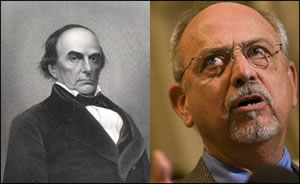 In one very telling – and a little funny – example, Hastings submitted an op-ed to The Hill in February. In his essay, he cited the words of Daniel Webster: