March 23rd, 2020 · Comments Off on Principles to Stimulate By (or, @SpeakerPelosi/@HouseDems: time for adults to take charge)
Amid the Coronavirus pandemic, governments around the world are struggling with dealing with the medical crisis and economic impacts at the same time. Clearly, some are leading by impressive example (Singapore, South Korea, Taiwan, to name a few) and, well, some are less than impressive in action.
In the United States, the combined anti-science and corruption of Trump (and his Republican enablers) is providing glaring examples, on both fronts, of just how not to do things. Exemplifying this, when Trump opens his mount and lies about actions and contradicts leading medical advice, markets crash. In Congress, Mitch McConnell seems more intent on leveraging the crisis to provide a piggy-bank for Republican-supporting Corporations and donors than in actually saving lives, keeping Americans afloat amid economic shutdown, and fostering a better functioning society into the future.
While a believer that Democracy is about checks and balances, about compromising, about …, the situation is too urgent for those seeking to save lives, keep Americans afloat, and work for a better tomorrow to engage in pre-compromising and allowing McConnell to set the agenda.
The disagreement isn’t over how much—it’s over *who* benefits. Senate Democrats want to help hourly workers, service industry employees and small businesses. Senator McConnell wants to bail out corporate executives and Donald Trump himself.
The power of the purse resides with Congress. And, in this, the House has the primary role, with responsibility for all legislation that raises revenue to originate in the House. Considering the Corporate-friendly, average American-hating legislation that the Senate Republicans under Mitch McConnell are trying to drive through, House Speaker Nancy Pelosi should call Secretary of the Treasury Mnuchin and Senator McConnell with a three word message:
“We’ve got it”.
Then, come up with a series of 3-5 bills (or so) that are based on a three-bullet, five-word set of principles: Main Street; Clean; Future Building.
Here, in bullet form, are some basic thoughts about how and where resources should go.
Main Street
not Wall Street
eg.
Support (ASAP and continuing) medical responsiveness and society sustaining
Resources for hospitals, first responders
Sustain/support essential services (from water works to grocery clerks, from remote educators to postal/delivery services)
get money into people’s hands in both ASAP & sustained
Some money to ‘everyone’ right away to ‘shock’ system and keep people afloat
Perhaps initial check of $750/adult, $250/child
then a month of $250/$100 per week
Do it via credit cards that enable/foster rapid spending
Expansion/extension of unemployment/food stamps/medicaid support
figure out how to keep communities, families, small businesses afloat
A month’s moratorium on loan / rental / etc payments nation wide (for renters, home owners, businesses), penalties for late payment on any bills / contracts within the United States, etc …
with path for rapid infusion of cash to ‘unable to function without money flow’
including some share of ‘salaries’ for firms that are putting workers (especially small businesses) so that ‘salaries’ are paid (even if, let’s say: 100% to 25k/year, 75% to $96k/year) amid shutdowns & workforce going back to work when/if firms/businesses restart
Offer low-interest loans/refinancing for businesses, home mortgages (let’s say a 2% 15-year loan from the Fed for first mortgages up to $150k, 2.5% up to $350k), etc
for the moment, let Fed deal with Corporations & Wall Street
Clean
not dirty
E.g.,
No financing for coal, oil & natural gas
especially not dirty deals like exempting coal industry from black lung obligations, any fossil fuel from clean-up responsibilities, etc …
Leverage 0% loans for clean-energy investments/projects
from solar on roof to offshore wind — low-interest rates drive down delivered electricity projects
Clean infrastructure
Future building
rather than past recreating
E.g.,
Don’t throw money at sectors unlikely to come back for an extended period at anything close to pre-crisis levels (cruise ships) nor at sectors that shouldn’t come back no matter what (coal)
From climate to boosting health care infrastructure to fostering/enabling changed education/work to … leverage crisis as opportunity to enable a better functioning society & economy
Democracy: Vote By Mail improves Democracy while protecting health
Etc …
Notes
The above are ‘thoughts’, seeking to articulate how ‘we’ might respond to the current crises in (more) productive ways. For overlapping concepts, for example, see:
A green stimulus to rebuild our economy lays down examples and principles for a multi-$trillion, multi-year stimulus path to dig our way out of the Coronavirus pandemic (and worsened by Trump) economic devastation while addressing climate risks and economic/environmental injustices.
The United States confronts the danger of an economic stimulus that restores?-?or even deepens?-?our reliance on fossil fuels. This danger comes from explicit proposals to bail out the fossil fuel sector and roll back workers’ rights, and also from generic general stimulus policies that do not take climate into account. Indeed, infrastructure spending as usual?-?e.g. highway expansion?-?will lock in more carbon pollution for decades. We can avoid these problems by crafting a recovery that accelerates the creation of a 21st century green economy.
call for COVID-19 relief and stimulus packages to contribute to a just recovery by upholding these five principles:
(1) HEALTH IS THE TOP PRIORITY, FOR ALL PEOPLE, WITH NO EXCEPTIONS (2) PROVIDE ECONOMIC RELIEF DIRECTLY TO THE PEOPLE (3) RESCUE WORKERS AND COMMUNITIES, NOT CORPORATE EXECUTIVES (4) MAKE A DOWN PAYMENT ON A REGENERATIVE ECONOMY, WHILE PREVENTING FUTURE CRISES (5) PROTECT OUR DEMOCRATIC PROCESS WHILE PROTECTING EACH OTHER
Comments Off on Principles to Stimulate By (or, @SpeakerPelosi/@HouseDems: time for adults to take charge)Tags:Energy
March 16th, 2020 · Comments Off on #FFS #Trump: #Coronavirus + #Climate Science Denial in one Tweet
While every day of the Trump presidency has been painful and with life-threatening implications (from climate change to reduced medical care to children freezing in cages), the Coronavirus pandemic has accelerated the pace and expanded the nature of that pain. It is hard to see anything in public discourse without being reminded of the pain that Trump and the rest of the GOP Anti-Science SyndromE Sufferers (hint: ASSES) are inflicting on America and the world. From disinformation about coronavirus risks, to false statements about preparedness and responses, to poorly thought through actions that create coronavirus petri dishes, Trump is literally putting more lives at risk with every passing second. And, in doing so, blatantly demonstrating his ignorance and disdain for experts, science, and, well, basic human common sense.
This afternoon, however, Trump did an impressive two-fer in just one sentence: with a celebratory combination of coronavirus science denial and climate science denial in one 14 word sentence.
When every expert says avoid crowds & practice social distancing, Trump packs them in …
Coronavirus science denialism
Amid growing restrictions on gatherings (with CDC guidance to not have gatherings above 50 people, shared out just yesterday in a Trump tweet) and clear evidence that social distancing is the most effective know weapon in the arsenal to reduce coronavirus deaths, Team Trump gathered a large crowd in the Rose Garden Friday to listen to a devotional crowd-given pat-on-the-back for a job poorly done.
Thank, I guess, for that declaration of a national emergency but a basic expectation of a “leader” is leadership. And, that includes modeling the sorts of behaviors and actions expected of all of U.S.
Climate science denialism
Trump tweets that
“the Rose garden” is “just coming out of a cold Winter!”
Seriously, WTF? Other than Trump being one of those elderly who flock to Miami for the winter and so divorced from the real world that weather is irrelevant, with essentially zero snow through the winter here, it is hard to see how anyone in the DC area (and, well, most of the world) could think that 2019-2020 has been a “cold winter”.
Some snippets from the #FakeNews Washington Post provide a window on this
Looking globally, “Across much of the Northern Hemisphere this year, winter was a shadow of its former self … Europe’s average temperature for December through February was 6.1 degrees Fahrenheit above the 40-year average, shattering the previous record by more than two degrees. In the United States, temperatures were above average for every state but Alaska.”
FFS Trump
Trump’s anti-science syndrome threaten lives and, well, is quite literally leading to lost lives.
March 16th, 2020 · Comments Off on Frack Fracking, But You Can’t Just Ban It Outright
While the climate crisis is urgent and requires urgent, serious action, it is also a massively complex systems-of-systems challenge, with massively complicated and innumerous interactions, that will require decades (actually, centuries) of action to mitigate, adapt, and redress the impacts that we already face and will face for generations to come.
For the past decade, the world energy system has had numerous ‘revolutions’ underway.
A clean energy revolution (with expanded deployment of solar, wind, batteries, electric vehicles, and otherwise with plunging prices) offers real silver bb pathways for the climate crisis.
The “Fracking Revolution” radically transformed the fossil fuel landscape, massively boosting U.S. production of oil and fossil gas along with lowered prices, changed industrial manufacturing patterns, and shifts in international security. While there were many benefits from that Fracking, those have come at a high cost of significantly boosted methane emissions along with undermining the speed of renewable energy deployment (due to entrenched political and economic interests and falsely perceived (due to excluding externalities) low costs).
To take serious climate action, we must address fracking: the methane leakages are too serious; the falsely low prices undermine moves to clean energy; and, even with zero methane leakages, fossil gas still emits significant carbon when burned (even if 50% of coal’s emissions) .
However, moves to Act On Climate ( whether a Green New Deal, moving to a Virginia Clean Economy, or …) should recognize the complexity of the energy system, the reality of a complex system of system, and the need for charting pathways that do not create highly dangerous shocks that could undermine the potential for moving to a prosperous, climate friendly society.
Repeated calls for any sort of immediate end to fracking seem to ignore this. We can’t just ban it without sending shockwaves through the energy system and creating not just economic risks and repercussions.
Within the United States, fracked fossil fuels play a serious role in oil and fossil gas production.
If there were a stroke of a pen to “ban fracking”, there would be massive impacts through the economy — rapid, lasting, and utterly unnecessary damages.
Yet, to be quite clear, Frack Fracking: while securing, traditional energy resiliency and economic concepts, fracking creates too many risks and damages to be expanded or even maintained at continued levels. In other words, Fracking has been a miracle at too high a cost.
We must chart and navigate a course to drive down existing fracking’s negative externalities while deploying clean economy elements to lower, with every passing day, our need to rely on fracked oil and fracked fossil gas.
A basic policy portfolio
Methane leakagedetection, control regulation, and enforcement of regulation — from the fracked well to the end usage.
Reducing leakage means more fossil gas being used, rather than simply wasted.
Pricing GHG emissions (not just carbon — also methane, super GHGs, etc …)
to further incentivize both reduced leakage and accelerate moves to clean economy options.
Invest in rapid deployment of clean economy options
to lower the need for fracked fossil fuels with every passing moment.
With these three elements, working together, the climate impacts of fracking would fall dramatically and rapidly. And, we might be able to (essentially) eliminate fracking from the US energy system over roughly the coming 10-15 years while boosting economic performance, creating jobs, enhancing energy resiliency, and reducing US and global emissions.
In other words, Frack Fracking even though we shouldn’t ban it outright.
March 11th, 2020 · Comments Off on “Shall the bill pass?” Regretfully, the answer should be: NO! (Dominion’s Electric School Bus (ESB) bill)
To address climate change, boost economic performance, and increase energy resiliency, we must electrify everything. As part of this, electrifying U.S. school buses is a particularly beneficial move that can and should occur rapidly.
With Dominion Energy and Governor Northam announcements of electric school bus (ESB) demonstration projects last year, Virginia seemed truly on the cusp of being the national leader in ESBs with the real potential to radically change the industry while bringing huge benefits to the Commonwealth and its citizens (improved student health and performance; reduced pollution; better service; improved grid resiliency; reduced costs; job creation).
Entering Virginia’s legislative session, with multiple (sigh, troubled, all meriting improvement) bills, it appeared likely that there would be some form of reasonable compromise that would create a legal structure for Virginia to set off a path to electrifying school transportation at a reasonable (even if not as fast as appropriate pace). Regrettably, this is not how the session progressed.
Restricts regulatory oversight authorities on Dominion’s decision-making about buses and charges to the ratepayer for the program through defining it as “in the public interest”. (paragraph E)
Prioritizes, above all else, Dominion’s interests in decision-making about which school districts will get ESBs by solely identifying “locational benefits that the school buses’ storage batteries are expected to bring“. (B.4) [Note: this is an example of how this bill weakens the situation. HB75, for example, had this language when originally introduced but with engagement with the sponsor from concerned groups and individuals, this was deleted. The original version of SB1096, from 5 March, didn’t have it but for some reason the clause was added back in.]
Has uncertain (left open for future negotiation) safeguards against Dominion mismanaging ESB batteries and leaving school systems’ stranded without student transportation. (B.5)
Creates a structure that will enable Dominion to dictate terms for electrifying all 17,000 of Virginia’s school buses — even if actual ‘well-regulated’ market capitalism could provide (far) better solutions.
Does not have
a mandate for analysis and assessment of ESB cost-benefit streams nor of ESB program deployment;
prioritization of societal benefit streams (such as public health, environmental justice, …) in deployment decision-making;
safeguards against excess Dominion profiteering;
provide for real public entity visibility over Dominion’s cost structures and internal decision-making related to what will, eventually, be $Bs of public-entity investment streams.
Prior to and amid the legislative session, ESB proponents (including me) saw real potential for working with Dominion to come out with win-win-win legislation that make this more of a public-private partnership, potentially secure greater benefits for the Commonwealth (such as ESB manufacturing), open paths for accelerating ESB deployment even faster than Dominion called for and outside Dominion’s service area, and all while providing for Dominion making reasonable (rather excess) profits through a market-driving Virginia ESB deployment.
Sigh, that is not the case.
Instead, in its waning hours, the Legislature will be left with an epitome of The Virginia Way: a Dominion Energy written bill that will subordinate public and ratepayer interest to enabling excess profiteering and a private entity to dictate on issues (like school bus restraints) that truly should be made by informed public servants (elected and otherwise) working on behalf of public interest, not private shareholders.
I am pained. To tackle the climate crisis, we must electrify everything — fast. As an energy/climate/business issues analyst, a concerned citizen, and a parent, I am very well aware that electric school buses represent an extremely high-payoff ‘electrify everything’ opportunity. As a Virginian, I was excited about the potential not just for Virginia to be a real leader in making this a reality but for the Commonwealth to leverage the choice to be a leader for creating 1,000s of high-quality manufacturing jobs (potentially as economic development in coal-industry dependent communities). I was enthused. And, now I am despondent.
When it comes to SB1096, when the Speaker asks the Delegates “Shall the bill pass“, regrettably, the answer should be a resounding NO!
While not wanting to suggest that a global pandemic is a ‘good’, this crisis does create opportunity for action (and not just for unethical Amazon vendor price gouging). Clean energy investing, across all economy, is a prime example of this.
Interest rates are plummeting and, with the world economy taking significant hits already from the coronavirus (such as empty airports, canceled meetings, and reduced frequenting of restaurants), there is no window in sight for their going back up.
Now, turn the conversation to Virginia. One of the major legislative achievements (amid a huge number of bills) was the passage of the Virginia Clean Economy Act (VCEA), which includes a mandate for 100 clean power (electricity) by 2045 with significant requirements for a major ramping up of renewable (wind and solar) resources over the coming decades.
As an aside, regretfully, Virginia’s legislators (seemingly to a person) have been working with a false assumption: that going clean will cost more than remaining with a polluting energy system. That has long been a fossil foolish operating assumption that totally ignored real costs (e.g., the impacts negative externalities from burning fossil fuels) Plunging renewable prices over the past decade make this a less accurate belief even within the most-stove-piped look solely at ‘ratepayer costs’. (For example, Mayflower wind has now come in lower than expected, 5.8 cents per kilowatt hour (kWh) which is below the targeted 6.5 cents per kWh. With a reverse auctioning process, Virginia’s offshore wind (with the exact same financing structures) should come in below that.) The significant decrease in interest rates make claims that ‘going clean costs more’ even less truthful.
For a perspective on how interest rates can impact clean energy options, consider this five-year-old look from the Center on Economic Policies. (To be clear, “five-year-old” matters: renewable investment costs have fallen significantly in the intervening time period while polluting energy options have, writ large increased in price.) All things being equal, as interest rates fall, “green energy technologies” become more competitive.
As interest rates fall, more likely to make green by going Green
And, even back in 2015 with much higher renewable energy investment costs, ‘going green’ was cost advantaged by about a two-percent interest rate. Where are those interest rates now?
Hmm, the govt can borrow money ridiculously cheaply for 10 years. Is there anything we have to build within 10 years* that would cost lots of money? Maybe now would be the time to start? *Please, instead of @‘ing me re: 10 yrs, read this, then get to work https://t.co/9zmJw5mjCphttps://t.co/V5KPVubBIR
All of this, however, was before Coronavirus impacts with collapsing interest rates and reduced business/economic activity. We have very clear indications that the global economy will require significant stimulus activity in the coming months and years. Turning to the opportunity of the crisis, extremely low interest rates mean borrowing for infrastructure (including clean energy) is incredibly affordable and that infrastructure investments are highly stimulative.
A rough (plus-or-minus, dependent on the situation) rule of thumb: a one percent change in interest rates translates into about one cent per kilowatt cost for renewable energy. Drop the cost of money by a percent, reduce the cost of electricity by 1 cent per kilowatt hour.
Using these sort of rough rule of thumb guidance, consider just one arena: offshore wind. The VCEA envisions 5.2 gigawatts of offshore wind. This easily $10-$15 billion project will lead to 10,000s of jobs and significant amounts of clean electrons into the economy. Perhaps looking too far back into the history of offshore wind prices, legislators have acted as if this would drive increased costs to consumers. Putting aside the significant benefit from reducing peak pricing impacts, the plunging price of offshore wind projects around the world and the low prices emerging for other U.S. East Coast offshore wind projects, a reasonable price (LCOE) for a large-scale Virginia offshore wind project should have been in the range of 5.5 to 6 cents per kilowatt hour. “Should have been” with interest rates of 1 February 2020. With the interest rates we are now seeing, it might be reasonable to expect that a well-managed (with an open reverse auction and some leveraging of Commonwealth’s AAA Bond rating) Virginia Offshore Wind project should be able to deliver clean electricity at below 5 cents per kilowatt hour.
Our economy needs stimulus in the face of coronavirus impacts.
The necessity to move to a clean economy is clear and Virginia now has a legislative mandate to transition to a clean economy.
Low interest rates have made it even cheaper and fiscally advantageous to accelerate that transition.
Virginia shouldn’t let a good crisis go to waste:
save money by
leveraging low interest rates to
create good jobs and substantial economic activity by
accelerating moves to a clean economy.
Comments Off on CoronaVirus Crisis-Opportunity: Virginia Clean Economy EditionTags:Energy · virginia
This bill will make Virginia’s clean energy standard reach 60% by 2036 and 100% soon after. It will also create 11,000 new clean energy jobs. We did it! #VCEA#VALegpic.twitter.com/QMFIpornSM
This is a huge change in a state that has been essentially ruled by the primary regulated utility, Dominion (which is now ‘just’ a very (if the most) powerful player on the table), who has concentrated, with laser-like focus, on profitability before efficiency, addressing climate change, and otherwise serving the public interest.
And, to be clear, this was made possible due to #BlueWaveVA2019 and Virginia Democrats having the trifecta: majorities in the House and Senate along with Governorship. Elections have consequences.
Now, let’s be clear, the VCEA is far from perfect and far from comprehensive. It has many clauses favorable to polluters; could be more aggressive in timing; and does not cover the entire economy (just the electricity sector). It is an epitome of ‘progress — not perfection’. As Lowell Feld put it at Blue Virginia,
let me just emphasize that passing VCEA has to be only the start, NOT the end, of Virginia’s efforts at transitioning to a 100% clean energy economy and doing our part to fight the climate crisis. Thus, while VCEA addresses the power sector, it’s still not aggressive enough. Nor is it comprehensive enough, as it doesn’t really address the transportation sector, building sector, etc, etc. In other words, this is a great start, but there’s a LOT more work left to do. And let’s not forget that.
Today is a day to celebrate progress.
Tomorrow, we turn from celebration to figuring how to leverage this achievement for more progress in the days, months, and years to come.
To be clear, Virginia Democrats are making progress in many, many arenas
The 2020 legislative session might just be the busiest (most bills) and most significant legislative session in the Commonwealth’s history. The bill count is huge and there has been legislative action on a broad swath of issues that will impact people’s lives in quite tangible ways. This isn’t ‘just’ about energy. Amid the 1000s of pieces of legislation considered and 100s passed already, a moment to appreciate just one:
Elections have consequences—very real ones. Here is example of @vademocrats acting to enable people to take care of their basic medical needs without going bankrupt. Perfect? No. Real PROGRESS? Absolutely. https://t.co/QXp8g4l2KR
And, for just a taste (from weeks ago) of what Virginia’s elected Democrats are working on and getting done:
With two days left before crossover, here’s just the *highlights* of the epic bills (most long-overdue reforms) that @VAHouseDems are sending over to the Senate side! https://t.co/KN94IjAJgA
Within the Dominion Electric School Bus (ESB) program is a requirement that all participating school systems accept seat belts if they want to participate in the ESB program. As far as can be seen, Dominion has provided no analytical basis for this requirement other than it aligns with their safety culture (even as Dominion’s work trucks and other vehicles have essentially nothing in common with school bus design, usage, and safety characteristics).
ESB legislation (HB75 and SB1096), being considered at this last minute in the Virginia legislature’s last hours, would put into law this restraint requirement.
F. Any school bus associated with an electric school bus project shall be equipped with an active lap-and-shoulder belt occupant restraint system for each designated passenger seating position.
While any parent (count me in on this) has an immediate ‘why aren’t there seat belts for my kids on the school bus’ gut reaction, there is — at best — very unclear analytical basis for this sort of mandate.
And, this is not a minor issue. Adding “an active lap-and-shoulder belt occupant restraint system” will be in range of $10,000 more per each bus, will reduce the number of passengers per bus (thus perhaps increasing the numbers of buses), increase maintenance costs, and reduce bus usage efficiency. With all those costs, at the end of the day, due to the complex set of interactions, the introduction of such restraints might not even save lives.
With about 17,000 buses for Virginia’s public K-12 schools plus thousands of private school buses, the ESB demonstration program’s two sentence line requiring restraint systems could end up creating a 200 million bill for Virginia’s public schools. Again, a $200M requirement that might not serve the interest of providing safer transportation for Virginia’s children.
To summarize:
Neither the US Department of Transportation nor the Commonwealth of Virginia have a requirement for school bus seat belts/passenger restraints.
Dominion is requiring them as part of the ESB program without a public policy analysis to justify this.
This Dominion requirement would create roughly a $200 million (if not greater) additional acquisition cost for school buses across the Commonwealth.
The Legislature faces a question: should a private entity drive its decision-making about public investments.
Rather than mandating restraints within the ESB demonstration program, the legislature should mandate a Virginia Department of Education and Department of Transportation study to assess available school bus seat belt cost-benefit analyses so that legislators can consider the issue in the 2021 session.
To be clear, the assessment and cost-benefit analysis might well find the $200M investment to be fully justified. Amid the reality that school system resources are stretched, creating such a mandate without basic due diligence should not happen.
Comments Off on Restraints on School Buses: Don’t mandate without public policy/cost-benefit analysis (Virginia ESB edition)Tags:transportation · virginia
March 5th, 2020 · Comments Off on Progress (not perfection): Electric School Bus (ESB) in Virginia legislature
The legislative session is about to close in Richmond. Lawmakers are working late hours. Deals are being cut. Good bills are being left on the table amid the end of season rush. And …
Virginia is on the cusp of becoming a national leader in electric school buses (ESBs). Dominion has announced plans for a major program, en route to providing 100% ESBs in its service area, and has already initiated the first 50 ESBs with participating school districts. Governor Northam has taken portions of the VW diesel settlement fund for a small ESB demonstration program. The legislative session had multiple ESB bills in play.
At this time, the last one standing seems to be HB75 with Senate and House conferees announced earlier today.
Upfront, to be clear, even as it has weaknesses, this legislation should be supported. It helps move Virginia down a better path with multiple benefit streams. It is progress, not perfection
Delegate Kory’s original HB75 might best be described as having been a legislating of Dominion’s desired program. Since then it has been amended in ways that could enable local school districts to wrest some power away from Dominion but which likely will leave Dominion in the driver’s seat.
In short, HB75 would enable Dominion (the Commonwealth’s sole “Phase II Utility”) to move forward with an ESB demonstration project as “in the public interest”. Defining it, in law, as “in the public interest” limits the State Corporation Commission’s ability to provide oversight and restrict Dominion’s charging of ratepayers for the program’s costs. The bill will enable Dominion to ask for rate adjustments relative to ESB program costs.
Let’s be clear, ESBs have tremendous benefits for the public across multiple domains from improved student health to reduce noise on the streets. For ratepayers, the ESBs will help foster a more resilient and better operating grid. Thus, ‘charging back’ to the ratepayers isn’t necessarily a bad thing and reducing the SCC’s ability to do a stove-piped analysis that only considers ratepayer interests is probably in the general interest of all Virginians.
Looking at this legislation, there are several oddities that merit questioning and at least one merits change even at the last moment by conferees:
40 Percent: The program is limited to a maximum of forty percent of school buses procured by involved school districts in any specific year. There is, well, simply no good justification for this. Consider some scenarios:
This is a structure mandating, in essence, that school districts can’t determine that they want to go 100% electric school buses and do so via this program.
What if the most sensible set of projects, one year, is a set of smaller school districts which are each buying a small number (10? 15?) of buses. The 40% would, it seems, preclude these smaller school districts from buying in reasonable scale.
Thus, conferees — cross out lines 46-49 creating a percentage limitation on any year’s projects.
2025 Sunset: The legislation (section [G]) sunsets the program as of 31 December 2025.
Sigh, when we should be mandating an accelerating path toward 100% ESBs, we are going mandate an end to the program? Really?
Honestly, what this really ties to is Dominion’s poorly structured plan for 200 ESBs per year through 2025 to then move to perhaps 1000 ESBs per year starting in 2026. That structure, honestly, is far from ideal nor is a legislating an end to the program.
However, 2025 is a long way away in electric vehicle years. The 2025 Sunset really is relatively meaningless as expanding and accelerating ESBs should (will) be part of the 2021, 2022, 2023, 2024, … legislative cycles. Thus, conferees, please ignore any complaints about this sunsetting provision. ESB proponents will, in any event, be back again and again and …
Absence of evaluation and reporting
HB75, as amended, has no provisions for assessing, evaluating, and reporting on ESB demonstration projects.
A simply reality, while it is clear that ESBs will provide significant (co)benefits, there is not truly robust understanding as to what these are and how significant they might be. As put in another discussion:
There are a wide range of issues surrounding ESB deployment and operations. Understandably, a ‘Facilities’ assessment will be stove-piped assessment of direct ‘facilities costs’ streams (acquisition (purchase), operations, and maintenance costs). However, ESB benefit streams go far beyond lowered fuel costs and reduced maintenance. They include reduced student exposure to diesel fumes (and thus reduced asthma and cancer rates), reduced absenteeism due to illnesses, reduced noise, reduced CO2 levels inside the bus, improved bus performance and safety, and other impacts with real implications for improved educational performance.
A simple truth: we don’t have a meaningful handle on these value streams. Without such an understanding, how can we determine whether and how fast to go electric?
It is possible that ESB educational performance implications, alone, could be significant enough to justify a significant acceleration of any ESB program.
The absence of an assessment requirement is a serious gap in the legislation. We don’t know what we don’t know. And, the legislation doesn’t provide guidance for filling the gaps in knowledge. As per above, the 2020 legislative session is far from the last time legislators will be dealing with ESBs. Created a learning process, to enabled more informed decision-making in the years to come, almost certainly would have tremendous value.
Conferees, if you can, consider adding in a statement requiring regular public reporting by involved entities (both the “Phase II Utility” and the involved school districts) with a requirement for the Virginia Department of Education to provide a consolidated ‘summary’ analytical report well prior (perhaps 1 October of each year) to the legislative session.
Is HB75 the electric school bus bill that the Virginia legislature could and should have fostered and passed? No.
Does HB75 merit passage as ‘progress’ (even as not perfection) toward safer, healthier, better performing, less polluting, and more user-friendly public school transportation? Absolutely.
March 5th, 2020 · Comments Off on “Cranky Uncle vs. Climate Change”: Advice from GMU’’s Center for Climate Communication
Since November 2016, election after election has made clear that Democratic voters will crawl over broken glass to get to the polls to defeat Trump and #Cult45-enabling Republicans. Massive turnout and voters waiting up to seven hours to vote in many Super Tuesday primary states is the latest tangible sign of that.
One of the reasons for this is that Donald Trump is the epitome, a real-life version of the stereotype of the rather lunatic, self-centered, loud, and arrogantly ignorant Cranky Uncle to be put in a corner by himself at family events in hopes that his rantings and rudeness don’t blow the event.
George Mason University’s Center for Climate Communication research Assistant Professor John Cook has just published a book that should be useful in putting that Cranky Uncle into the corner — at least when it comes to the issue of climate science denialism (which is one of the (perhaps too numerous to mention) spaces of Trump’s worst Cranky Uncle ravings).
Now, for some quick background …
When it comes to climate and GMU, many are well aware of the Koch Brothers uber-funding of George Mason and the fostering of climate-science denialism and confusion within portions of the University. (A tip of the hat to UnKoch My Campus and Transparent GMU (T-GMU twitter) for their efforts to expose and fight this.) At the same time that there is part of GMU that is a center for climate confusion fostering, the GMU Center for Climate Communication is a font of wisdom about key climate communication challenges and has done truly stellar work in some domains to foster improvements in how climate issues are communicated to the broad public. For example, this group has been central to and had some real success in a decade-long effort to engage and educate TV meteorologists about climate.
Cook is an Australian academic brought to GMU a few years ago. Perhaps without realizing it, you know of his work. He did (okay, was a key player in) the analytical work to show that at least (and, more recent work shows more than) 97% of the relevant world’s scientists agree with the consensus that (a) climate change is happening and (b) human actions are the primary cause of the global warming.
>97% of scientists agree: Its real, us, serious, and addressable
Less visible to most, Cook also is a key player in the website Skeptical Science, which seeks to identify, dissect, and provide the actual science to refute climate science denialism talking points. (For some of us, that work has provided a “Science Denialism by the Numbers” shorthand for summarizing inane comments from scientific luminaries like Cranky Uncle Donald.) John is also the author of the Debunking Handbook. While focused on climate science issues, this short and thoughtful piece is extremely useful for dealing with ‘myth’ and falsehood busting. (I highly recommend it.) Unknowingly to me, until recently, Cook is also a cartoonist. He has now combined his specialization in tackling climate science denialism with that skill set.
With Cranky Uncle vs Climate Change, Cook has provided an extremely digestible illustrated guide to the climate science denier tactics and arguments, how one can think about them, and how to engage with (or against) them. (Or, well, how to engage them to influence and educate onlookers because that Cranky Uncle is unlikely to be convinced they are wrong and best kept in the corner.)
This book gives us the whole ball of wax that is the science of climate science denial in a very funny, really well produced, and compelling wrapping. It will amuse you, and it will advise you. Your cranky uncle is done for.
Last evening, Cook held a book-release event at GMU’s Arlington Campus. Cook’s talk and the following question and answer session provided some richness as to how John became a foremost expert about dealing with (climate science) denial, the purpose and potential impact of the book, and the forthcoming Cranky Uncle app.
A “Cranky Uncle” actually sparked John’s focus on refuting climate-science denialism. John got a BS in physics and then, quite naturally, became a cartoonist. This cartoonist’s father-in-law regularly spouted climate science talking points and, as per “what any nerdy, competitive son-in-law” would do, John pushed backed. And, to prove the “nerdy”, Cook put together a spreadsheet with the denialist truthiness-laden arguments and the debunking, with sourcing, of them. The father-in-law eventually gave John a book by a US Senator to ‘prove’ that global warming was a made up hoax. This led Cook to realize that he wasn’t alone and that others might benefit from his debunking spreadsheet. That realization led to creating the valuable Skeptical Science site (which is, to be clear, far from just Dr. Cook but involves numerous climate scientists).
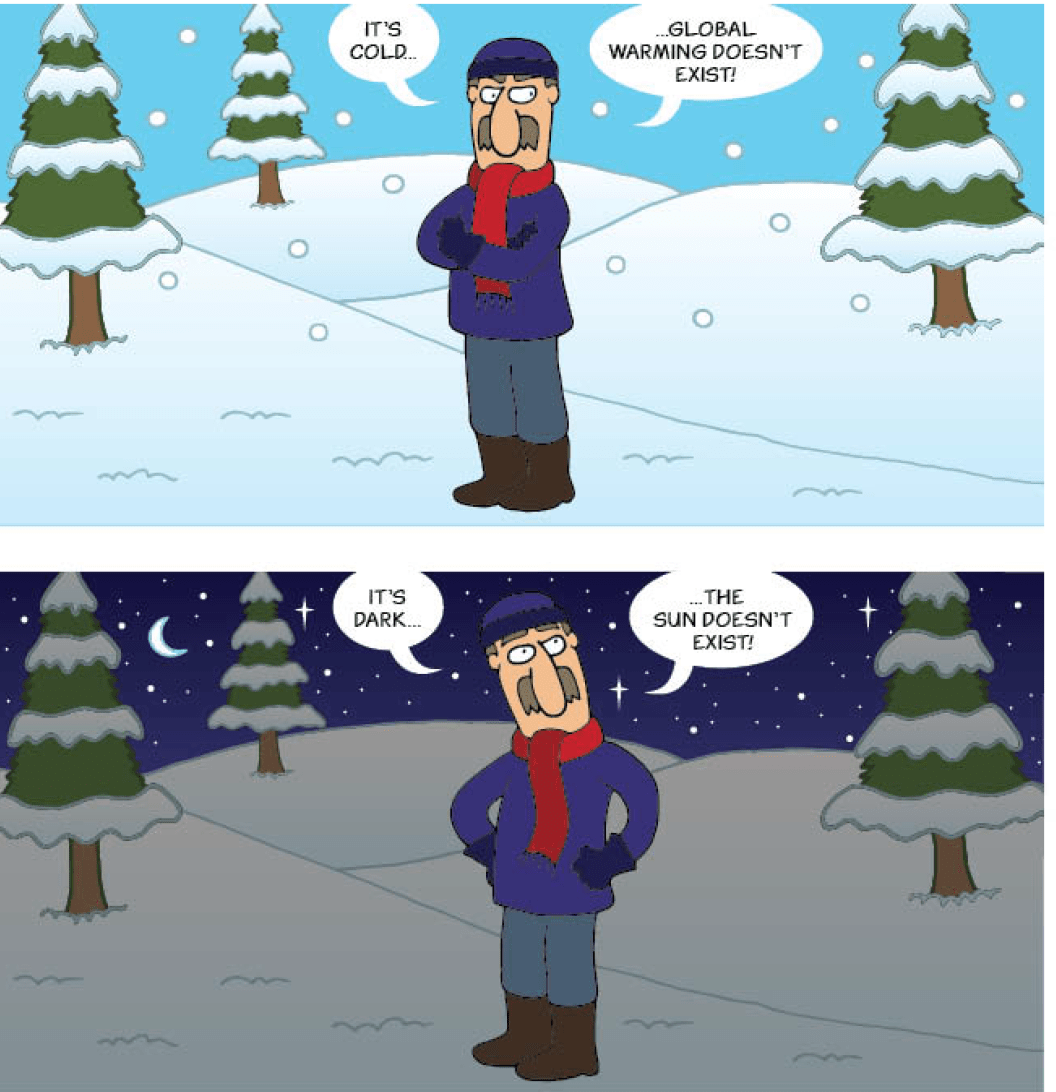
Inoculation is the point. Cognitive science research has shown that, like with a biological disease, the mind can be inoculated against illogical disinformation viruses. An exposure to mild versions of the disinformation — along with making clear, in humorous ways the absurdity — can improve ‘resistance’ to the disinformation. Amid a major cold snap, denialists will spout off jokes about ‘where’s global warming when you need it?’ The analogy to show it’s absurdity: nighttime proves that daylight doesn’t exist.
Night proves day doesn’t exist
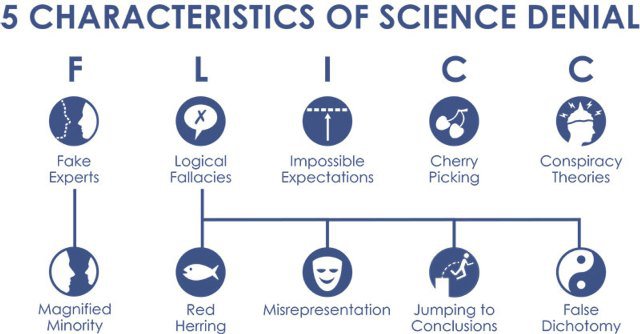
Deniers FLICC us off. Cook’s shorthand support of science deniers’ illogical is FLICC. They promote Fake experts; use Logical fallacies; create Impossible expectations; incessantly Cherry pick; and are tin-foil hat wearing Conspiracy theorists. John hopes to educate about and inoculate against FLICC methods. And, recognize that this is far from just climate science denial at play — these are all among gaslighting techniques. Cranky Uncle Trump and his co-conspiracists use FLICC about coronavirus, industrial pollution, (Trump campaign collusion with) Russian interference in U.S. elections, and so much more in their efforts to gaslight America.
The developing Cranky Uncle app (should be available in June) will take this to a new level. A book and a lecture like last night’s are ‘passive’ inoculation paths. Studies of gaming experiences show that they are active. Cook and collaborators are developing (with testing going on in university and high school classrooms) a Cranky Uncle app that rewards players for being a Cranky Uncle while educating them about the illogic of their argumentation. Testing, to date, indicates that this is providing some degree of inoculation against FLICC techniques that perhaps will extend well past an ability to fend off climate science denialism but to Cranky Uncle rantings and ravings across so many other issues.
A key takeaway is the necessity to speak about climate change. A large majority of Americans recognize and are concerned about climate change. Due to the noise that Cranky Uncle climate denialists make and ‘climate silence’ (in the media, by political elite, by ‘us’), too many don’t recognize this and, in many cases, even those who are deeply concerned about climate change are too often silent (whether in social circles, work, or engaging with politicians). Ending that climate silence is, in itself, a virtuous cycle path to fostering greater public understanding of climate issues and support for action to address the climate crisis.