In this guest post, scientist FishOutOfWater lays out how the massively increased nature disruptive weather patterns, which are in accord with climate science work lays out will happen in a warming globe, is at odds with the significant fall in serious examination of climate change in the American “traditional” media. One has to wonder whether climate change / chaos will go unmentioned when rising seas begin to shrink Manhattan.
U.S. weather in 2011 shattered records for extreme wet, extreme dry and the number of storms causing property damage over one billion inflation adjusted dollars. NOAA reported 12 billion dollar or greater weather disasters, swamping the previous record of 8. Record and near record rain and flooding swamped the Ohio and upper Mississippi river valleys while Texas suffered through the hottest and driest year on record. New York, New Jersey, Pennsylvania and Connecticut all broke previous records for the wettest year. Twenty major cities broke extreme precipitation records, doubling the previous record of 10.
Figure 1.Wettest, driest, and warmest year records set during 2011 for major U.S. cities. No major cities had their coldest year on record during 2011. Image credit: NOAA’s National Climatic Data Center. Figure 2. Percentage of the contiguous U.S. either in severe or greater drought (top 10% dryness) or extremely wet (top 10% wetness) during 2011, as computed using NOAA’s Climate Extremes Index. Remarkably, more than half of the country (58%) experienced either a top-ten driest or top-ten wettest year, a new record. Image credit: NOAA/NCDC.
To date, the United States set a record with 12 separate billion dollar weather/climate disasters in 2011, with an aggregate damage total of approximately $52 billion. This record year breaks the previous record of nine billion-dollar weather/climate disasters in one year, which occurred in 2008.
These twelve disasters alone resulted in the tragic loss of 646 lives, with the National Weather Service reporting over 1,000 deaths across all weather categories for the year.
Previously only 10 events were reported; the two new billion-dollar weather and climate events added to the 2011 total include:
The Texas, New Mexico, Arizona wildfires event, now exceeding $1 billion, had been previously accounted for in the larger Southern Plains drought and heatwave event. This is in line with how NOAA has traditionally accounted for large wildfire events as separate events.
The June 18-22 Midwest/Southeast Tornadoes and Severe Weather event, which just recently exceeded the $1 billion threshold
NOAA continues to collect and assess data regarding several other extreme events that occurred this year including the pre-Halloween winter storm that impacted the Northeast and the wind/flood damage from Tropical Storm Lee. Currently, these events are not over the $1B threshold using the available data.
While every journalist knows that weather is not climate, increasingly extreme weather is a predicted hallmark of climate change caused by increasing levels of greenhouse gases from human activities. Journalists typically failed to ask questions about the links between the extreme weather and climate change. In fact, media coverage of climate change plummeted in a year of record smashing weather.
Last year at least 7,140 journalists and opinion writers published some 19,000 stories on climate change, compared to more than 11,100 reporters who filed 32,400 stories in 2009, according to DailyClimate.org.The decline was seen across almost all benchmarks measured by the news service: 20 percent fewer reporters covered the issue in 2011 than in 2010, 20 percent fewer outlets published stories, and the most prolific reporters on the climate change beat published 20 percent fewer stories.
Particularly noticeable was the silence from the nation’s editorial boards: In 2009, newspapers published 1,229 editorials on the topic. Last year, they published less than 580 – half as many, according to DailyClimate.org’s archives.
Robert Brulle, a professor of sociology and environmental science at Drexel University in Philadelphia, put together similarly stunning data on the coverage in the past 15 years by NBC, ABC, and CBS on the night news.Brulle explained in an email (to Joe Romm of Climate Progress @ Think Progress) what he has to say on what happened and why:
As far as coverage of climate change on the evening broadcast news (NBC, CBS, and ABC), this year there were a total of 14 stories, for a total of 32 minutes and 20 seconds of coverage on the three evening news broadcasts. This is down from 32 stories with 90 minutes and 28 seconds of coverage last year, and way off from the peak in 2007, with 147 stories and over 386 minutes of coverage. The nearest year with this low of TV coverage of climate change was 2003, with only 10 stories and 29 minutes and 30 seconds of coverage.
If last year was titled the year coverage fell off the map — then the headline this year might be WHAT COVERAGE?
What drove this? We know that media coverage reacts to political events and elite cues. So from that perspective, we can identify three factors:
1) Failure of the political elite to focus on this issue (Elite Cues) The Obama administration has not discussed this issue at all, as you have previously blogged.
2) Crowding out by other issues (unemployment and economic issue – i.e. macro-economic factors), and
3) No significant change in political equation (no big political events).
The source of the term is a quotation in an October 17, 2004, The New York Times Magazine article by writer Ron Suskind, quoting an unnamed aide to George W. Bush (later attributed to Karl Rove[1]): The aide said that guys like me were “in what we call the reality-based community,” which he defined as people who “believe that solutions emerge from your judicious study of discernible reality.” … “That’s not the way the world really works anymore,” he continued. “We’re an empire now, and when we act, we create our own reality. And while you’re studying that reality—judiciously, as you will—we’ll act again, creating other new realities, which you can study too, and that’s how things will sort out. We’re history’s actors…and you, all of you, will be left to just study what we do.”[2]
The news media no longer covers objective reality. TV news has gone beyond reporting false equivalence of the “two sides” in stories. If there isn’t a battle between two sides there is no story.
Climate change has gone away because no one in power in Washington, DC is talking about it or acting on it.
And because it doesn’t involve celebrities or a sex scandal.
January 6th, 2012 · Comments Off on Santorum … The pick and choose from Catholic values candidate?
Many are, it seems, agag about Rick Santorum due to the devout nature of his Catholicism. While JFK assured America that Rome wouldn’t rule him, Rick seems determined to put into people’s minds the reverse.
Here is commentary with the doyen of Republican thought leaders, Rush Limbaugh
I believe the earth gets warmer and I also believe the earth gets cooler, and I think history points out that it does that and that the idea that man, through the production of CO2 — which is a trace gas in the atmosphere, and the manmade part of that trace gas is itself a trace gas — is somehow responsible for climate change is, I think, just patently absurd.
Santorum continued that the idea of man-made climate change may be part of a liberal conspiracy: “To me this is an opportunity for the left to create — it’s really a beautifully concocted scheme because they know that the earth is gonna cool and warm. It’s been on a warming trend so they said, ‘Oh, let’s take advantage of that and say that we need the government to come in and regulate your life some more because it’s getting warmer.’”
“It’s just an excuse for more government control of your life,” he added, “and I’ve never been for any scheme or even accepted the junk science behind the whole narrative.”
Santorum not only denies that manmade global warming is a growing concern, he denies its very existence. “There is no such thing as global warming,” he once said on Glenn Beck’s show [clip above …], adding that it’s “patently absurd” to think a naturally occurring substance like CO2 – “a trace gas in the atmosphere, and the man-made part of that trace gas is itself a trace gas “ – is warming the planet. (Well, not if you understand the greenhouse effect.) He told Rush Limbaugh: “I’ve never . . . accepted the junk science behind that narrative.”
But it’s not really about “junk” science. Santorum simply doesn’t accept science. A devout evangelical Catholic, Santorum also rejects evolution and tried to amend federal law to require the teaching of “intelligent design” in public schools
From the bleachers, one would think that a “devout … Catholic” would take seriously the Pope’s opinions and statements. On closer look, it seems, Santorum seems to be a pick and choose Catholic.
It’s easy to see why Santorum might appeal to some culturally conservative Catholics and moderate evangelicals who are wary of Democrats but also turned off by the Republican Party’s cozy embrace of economic libertarianism and tireless defense of struggling millionaires. Santorum is more comfortable with communitarian language, has been a strong supporter of foreign aid to impoverished countries and connects with personal stories of his blue-collar upbringing.
But it’s a political delusion to think Rick Santorum is a standard-bearer of authentic Catholic values in politics. In fact, on several issues central to Catholic social teaching – torture, war, immigration, climate change, the widening gap between rich and poor and workers’ rights – Santorum is radically out of step with his faith’s teachings as articulated by Catholic bishops and several popes over the centuries.
Contrast Santorum’s perspective on the “junk science” work of 1000s of scientists with the Papal perspective on what should happen.
Can we remain indifferent before the problems associated with such realities as climate change,
Rick Santorum clearly does not believe that the Pope merits listening to, rather than lampooning with commentary about “junk science”.
desertification, the deterioration and loss of productivity in vast agricultural areas, the pollution of rivers and aquifers, the loss of biodiversity, the increase of natural catastrophes and the deforestation of equatorial and tropical regions? Can we disregard the growing phenomenon of “environmental refugees”, people who are forced by the degradation of their natural habitat to forsake it – and often their possessions as well – in order to face the dangers and uncertainties of forced displacement? Can we remain impassive in the face of actual and potential conflicts involving access to natural resources? All these are issues with a profound impact on the exercise of human rights, such as the right to life, food, health and development.
…
Environmental degradation is often due to the lack of far-sighted official policies or to the pursuit of myopic economic interests, which then, tragically, become a serious threat to creation. … When making use of natural resources, we should be concerned for their protection and consider the cost entailed – environmentally and socially – as an essential part of the overall expenses incurred. The international community and national governments are responsible for sending the right signals in order to combat effectively the misuse of the environment. To protect the environment, and to safeguard natural resources and the climate, there is a need to act in accordance with clearly-defined rules,
…
Consider Rick Santorum’s cashing in on his connections when he left Congress, working diligently to promote polluting coal with reckless disregard for “cost entailed — environmentally and socially …”
Less than two months ago,
Speaking to the faithful gathered in St Peter’s Square for the Sunday Angelus prayer, Pope Benedict expressed the hope that “all members of the international community might reach agreement on a responsible, credible response,” to the phenomenon of climate change, which he described as “complex” and “disturbing”.
To be fair for a moment, everyone is hypocritical to one degree or another. An important point about maturity is to recognize one’s own contradictions and be willing to discuss them with others. Will Rick Santorum engage, openly, about his pick-and-choose Catholicism? Will reporters challenge him if he doesn’t?
We can put millions back to work, strengthen the economy, and (at least over a 10-year period and probably sooner) strongly improve the budget situation while improving U.S. national security and reducing climate chaos risks.
While we all ‘know’ that the R House will do nothing on this agenda and the pseudo-D Senate little more, this are the right things to be doing and the President should put some truth before the American public.
The President has not taken the bully pulpit in a serious way to lay out climate science to the American people and the very real / serious threats it creates for the Union — already today and certainly into the future. The Republican Party is, well, simply at odds with science (and scientists know it). How at odds they are from reality will not be a serious part of the media conversation unless someone (hint, Mr President) makes it so. The President needs to speak truthfully and forcefully about climate to make the stark contrast between him (and the rest of the Democratic Party) and climate zombies clear for all to see.
[*B.S. means “Bad Science.” What did you think it meant?]
Peter H. Gleick
The Earth’s climate continued to change during 2011 – a year in which unprecedented combinations of extreme weather events killed people and damaged property around the world. The scientific evidence for the accelerating human influence on climate further strengthened, as it has for decades now. Yet on the policy front, once again, national leaders did little to stem the growing emissions of greenhouse gases or to help societies prepare for increasingly severe consequences of climate changes, including rising temperatures, changing rainfall patterns, rising sea-levels, loss of snowpack and glaciers, disappearance of Arctic sea ice, and much more.
Why the failure to act? In part because climate change is a truly difficult challenge. But in part because of a concerted, well-funded, and aggressive anti-science campaign by climate change deniers and contrarians. These are mostly groups focused on protecting narrow financial interests, ideologues fearful of any government regulation, or scientific contrarians who cling to outdated, long-refuted interpretations of science. While much of the opposition to addressing the issue of climate change is political, it often hides behind pseudo-scientific claims, with persistent efforts to intentionally mislead the public and policymakers with bad science about climate change. Much of this effort is based on intentional falsehoods, misrepresentations, inflated uncertainties, or pure and utter B.S. – the same tactics that delayed efforts to tackle tobacco’s health risks long after the science was understood (as documented in Naomi Oreskes and Erik Conway’s book, Merchants of Doubt).
Last year, we issued the first ever “Climate B.S.* of the Year Awards.” I am now pleased to present the 2nd Annual (2011) Climate B.S.* of the Year Awards. In preparing the 2011 list of nominees, suggestions were received from around the world and a panel of reviewers — all climate scientists or climate communicators — waded through them. We present here the top nominees and the winner of the 2011 Climate B.S.* of the Year Awards.
The 2011 Winner:
Climate B.S.* from all of the Republican candidates for President of the United States
Is it really necessary to be anti-science in general, and anti-climate science in particular, in order to be nominated to lead the Republican Party in the United States? Apparently, yes, at least in the minds of the Republican presidential candidates or their advisors. These candidates can be split into three groups: those ignorant or uninterested in science and its role in informing policy; those who intentionally distort science because it conflicts with deeply held political or religious ideology; and those who blow with the wind, giving their allegiance to whatever ideology seems most expedient at any given moment. There is some overlap, of course: some candidates, such as Rick Perry, have been in all three groups at various times. The third group includes candidates who have at one time or another held positions more or less consistent with scientific understanding but who in 2011 adopted anti-scientific positions during their primary campaigns. For example, Gingrich, Romney, and Huntsman, at some point in the past, all expressed at least a partial understanding about the reality and seriousness of human-caused climate change. Yet all three have now retreated from the scientific evidence to faulty but ideological safe positions demanded by the conservative wing of the Republican Party. In October, Romney caved in to conservative pressure and changed his stance on the issue. Just days ago, after pressure from anti-climate-science activists, Gingrich cut a chapter on climate science from a book of environmental essays he had agreed to produce. Ironically, that chapter was to have been written by an atmospheric scientist (Katharine Hayhoe, director of the Climate Science Center at Texas Tech University) who happens to be a Republican and evangelical. She was also targeted by these activists for personal abuse – a tactic often pursued by climate deniers and contrarians. (For a few of the craziest things the top GOP candidates have said on climate change, see Joe Romm’s recent essay at Think Progress.)
In short, the choice among the Republican candidates on the issue of climate change is scientific ignorance, disdain for science, blatant misrepresentation of facts, or naked political expediency, any one of which would make the Republican candidates strong contenders for the 2011 Climate B.S. Award. Combined? They win hands down.
[For comparison, while the Obama Administration has made little progress (and some would argue insufficient effort) on climate change, the President’s stated position on climate change is clear and in line with scientific evidence. And here is his unequivocal comment on scientific integrity:
“Today, more than ever before, science holds the key to our survival as a planet and our security and prosperity as a nation. It’s time we once again put science at the top of our agenda and worked to restore America’s place as the world’s leader in science and technology…the truth is that promoting science isn’t just about providing resources. It’s about protecting free and open inquiry. It’s about ensuring that facts and evidence are never twisted or obscured by politics or ideology. It’s about listening to what our scientists have to say, even when it’s inconvenient. Especially when it’s inconvenient. Because the highest purpose of science is the search for knowledge, truth, and a greater understanding of the world around us…” http://www.youtube.com/watch?v=kFsB1Jk1OQ0]
Go to your mortgage broker: Ed Mazria/Architecture 2030?s concept of buying down total mortgages (both commercial and residential) based on investing to improve energy efficiency. Perhaps $200 billion in investment cost over a 3-year period that would generate >$2 trillion in activity in some of the most depressed parts of the economy (construction workers) across essentially all of the country … perhaps in the range of 10 million jobs through those 3 years (and, then, likely many continuing) … and, remember the word investment? Likely that Federal government would recoup more than that $200 billion in costs due to improved tax revenues and reduced social costs (such as reduced unemployment payments). See
Go to the Laboratory: Robustly funding the Advanced Research Projects Agency – Energy (ARPA-E) to the tune of $4 billion / year would support 60,000 jobs in the near term while providing resources to speed the development of technologies that will serve as the underpinning of a 21st century clean energy economy.
Go to school: America’s public schools are, in some cases all too literally, falling apart. Analyses of maintenance requirements have suggested perhaps more than $250 billion in backlogs for America’s K-12 infrastructure and that backlog is only worsening as school system after school system cuts employees and cuts investment plans to deal with dismal financial books. there are tremendous values associated with greening school space that include improved student health, reduced energy (and other resource bills), reduced pollution loads, improved national capacity for ‘greening’ and ‘energy efficiency’, improved student performance, and substantive job growth. Considering the $250 billion backlog, the dearth of investment today, and the value streams to come from greening schools, a jobs program could fruitfully invest $100 billion in America’s public schools (split between maintenance (& renovation) and greening/energy efficiency). This investment would create easily one million jobs throughout America.
Go to school on the PHE-Bus: Perhaps more than any road vehicle, school buses are ripe for explosive introduction of plug-in hybrid electric technology. All it requires is a spark of investment and this energy efficient, pollution reducing, health and security improving market place will see explosive growth. $100 million per year would support over 2000 jobs.
Go to the Market: Grocery stores, nationwide, are ripe for cleaning up with Clean Energy Jobs. Not only are the requirements clear, the solutions are straightforward, the financial return is tremendous, and this has the potential for kickstarting some jobs quickly while enabling stores to make more profits even while giving them the opportunity (which we can hope they’ll seize) to pass on some of the savings to their customers. $4 billion year would create 80,000 jobs.
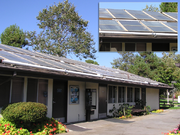
Go Swimming for Jobs: The nation’s swimming pools are notorious energy hogs and ripe for efficiency investment — in better pumps, solar hot water, etc … Looking solely to public pools, which eat up community resources, $300 million per year could create some 10,000 jobs while providing payback periods for local communities and public institutions (universities) of five years or less reducing costs while enhancing the community building resource of public pools.
Go to the train station: Electrification of rail would cut U.S. oil demand, with improved intermodal transit, by some 2.5 million barrels per day after a ten-year program. That, at today’s prices, would reduce America’s trade deficit by over $90 billion dollars — per year. To achieve this program would require roughly $10 billion, per year, in public investment to spark private funding. The electrification program would foster roughly 400,000 jobs
Go to the local park: Greening cities improves urban habitability and reduces pollution loads (including strain on the water systems with storm runoff). And, someone has to plant those flowers and trim those trees. $10 billion per year would foster over 200,000 jobs, with many of these in very high unemployment areas.
Invest in infrastructure: The nation’s infrastructure (roads, bridges, buildings, sewers, …) is, politely, failing apart. The American Society of Civil Engineers sees a $1 trillion+ shortfall between required resources and what is budgeted (and those budgets for repairs/modernization are being cut, not expanded). Addressing these shortfalls and modernizing our infrastructure won’t come cheap, but not addressing the shortfalls will carry a much (MUCH) higher price. Putting in $2 trillion, over a decade, to repair and modernize public infrastructure would support over 5 million jobs while enabling a functioning society. (Double the resources and we now have a clean-energy system powering that society.)
Note that these paths, which in aggregate would put over 10 million Americans back to work, likely would not represent a “cost to bear” but “an investment to profit from” as the improved infrastructure would ease economic activity, the employed people would pay taxes, and so on …
These are, of course, just ten added to the CAP list. In addition to links above, see JOB! JOBS! JOBS! for a generalized discussion (with some more specific examples) of the power of clean-energy and climate-mitigation focused job creation paths for strengthening the economy while addressing our climate challenges.
Republican presidential candidate Newt Gingrich has canceled the climate change chapter in his upcoming book of environmental essays after Rush Limbaugh and other commentators targeted its author, atmospheric scientist Katharine Hayhoe.
For those who don’t recall, Hayhoe is an evangelical Christian scientist who has proven an effective communicator with that segment of religious Americans. After an LA Times feature mentioned her, the denialosphere began to go after her — including putting her contact information in posts that, well, encouraged people to harass her. Limbaugh then weighed in
“Newt’s new book has a chapter written by a babe named Hayhoe,” who “believes in man-made global warming.”
Aren’t you buoyed by the thought that Rush Limbaugh’s articulate, thoughtful, and educated commentary about a PhD-holding scientist carries such weight within the Republican party?
True Energy Voters will look beyond the price at the pump and consider the full implications of our energy system with the potential payoff for pursuing Energy Smart policies. A rather simple example? Why not a Five Percent Plan. The 5p2 concept is pretty straightforward: target five percent reduction in oil and coal use (with five percent reduction of carbon emissions) every year, indefinitely. And, target five-percent unemployment as part of this within no less than five years with remaining at that level (or below) indefinitely after that. The Five Percent Plan‘s targets might seem outrageously ambitious yet they actually are quite achievable and would foster a more secure and prosperous nation — even if it would threaten API’s concept of Voting For Energy. If we follow API’s Energy Voters concepts, our nation will continue to be roiled by international oil markets (with increasing demand bumping against constrained supplies with other nations (other nations’ growing wealthy and middle classes) able to bid higher to fill their McSUVs than what the average American can afford), will continue to have to deploy our military services to protect oil supplies/supply lines, and will continue to dig the hole deeper when it comes to climate change. Americans, however, can vote for energy smart policies. Laying before Americans something like the Five Percent Plan would provide a real choice. Rather than the economic doldrums and environmental disasters (E2D2) that API’s advocated policies would foster, The Five Percent Plan would mean that by 2030 the United States will:
End, 100%, oil imports.
End, 100%, the burning of coal for electricity
Reduce climate emissions by 60+ percent from 1990 levels
Improve the US trade balance by five percent of gross domestic product (due to eliminating oil imports)
Cut health care impacts from fossil fuel use by 50%
In 2008, one of the little acknowledged political subtexts was how significantly global warming played in the Republican primary process. Both independently and as part of organizational efforts, individuals asked questions at events (and on street corners) and many events had signs about voters’ concerns over the need for climate change action. John McCain stood alone in discussing climate change forthrightly. In terms of impact, John McCain might just have won in New Hampshire (setting him on the path for the nomination) due to statements like these:
“I will clean up the planet,” McCain said. “I will make global warming a priority.” …
Speaking outside the statehouse, McCain was cheered by a group of sign-wielding environmentalists. McCain cheered them back: “Way to go, global warming folks!”
A hoarse-sounding McCain told the crowd: “I want to assure you I will make this planet clean … we will hand to you a cleaner planet than the one you were living in before I became president of the United States, I promise you that.”
Moments later, as if on cue, a chunk of melting snow from the statehouse roof landed near McCain. Momentarily surprised, McCain assured the crowd he was OK.
“It’s just snow, thank you,” McCain said. “That’s that climate change there.”
In 2012, as in 2008, individuals and groups are seeking to inject science and reality into the New Hampshire political discussions.
A group of 50 New Hampshire put out this open letter (see there for signatories). It deserves reading and is thus presented without any editorializing.
Science and Public Policy in New Hampshire December, 2011
Back in 1876, Mark Twain aptly remarked “One of the brightest gems in the New England weather is the dazzling uncertainty of it.” Our location halfway between the equator and the North Pole and sandwiched between the Appalachian Mountains and the Atlantic Ocean makes our weather more variable than most other places on Earth. New Hampshire’s culture, environment, and economy are fundamentally integrated with our seasonal climate that traditionally and reliably served up resplendent summers, crisp autumns with spectacular fall foliage, a white Christmas and winter sports, and the eternal hope of spring. Our citizens have adapted to changing economic and climatic conditions to keep New Hampshire consistently ranked near or at the top as a state with the best quality of life.
New Hampshire’s climate has experienced substantial changes over the past half century. Over this period, the northeastern United States has experienced a region-wide winter warming trend of almost 4oF. The number of days with snow on the ground has decreased an average of one week. Pond hockey and ice fishing have taken a hit as ice breaks up on our lakes more than a week earlier than it used to. Peak snowmelt runoff in the spring now occurs 7–10 days earlier in northern New England rivers. Increasing extreme rainfall events and flooding, rising seas, and an influx of pests (Lyme-disease-bearing ticks at the top of the list) have emerged as the latest and potentially most serious challenges to our health and our quality of life. (Additional information at Carbon Solutions New England.)
We have also endured a significant increase in severe storms. This has resulted in flooding and power outages across the region, including major events in 2005, 2006, 2007, 2010 and 2011. From 1986 to 2004, presidentially declared disasters in the state of New Hampshire cost the federal government on average $3.5 million per year; from 2005 to 2008, they cost an average of $25 million per year ($2009). In addition, power outages that used to last a day or two now commonly extend over a week or two. Perhaps the most insidious change has been relative sea level, which has risen seven inches during the past century. This means more coastal flooding as storms move onshore, especially when a nor’easter occurs at high tide.
These shifts in New Hampshire’s climate are clearly connected to changes in global climate.
Unfortunately much of the change is accelerating.
Given the inertia of the climate system, the most we can do now is decrease the rate of climate change. As the global climate continues to evolve, we will face new challenges to maintain our health, the prosperity of our state, and our quality of life. The US National Academy of Sciences together with all major scientific societies has affirmed that most of the observed increase in global temperatures over the past six decades is due to increases in anthropogenic greenhouse gas emissions. In its recent Quadrennial Defense Review, the Pentagon stated that “climate change, energy security, and economic stability are inextricably linked.”
We urge all candidates for public office at national, state, and local levels, and all New Hampshire citizens, to acknowledge the overwhelming balance of evidence for the underlying causes of climate change, to support appropriate responses to reduce the emissions of greenhouse gases, and to develop local and statewide strategies to adapt to near-term changes in climate. (Details of mitigation and adaptation options provided in NH’s Climate Action Plan.) Ignoring the issue of climate change places our health, our quality of life, our economic vitality, and our children’s future at risk.
This is a tough time for many in this nation and around the globe.
And, our local, national, and global challenges are hard to overstate.
My household, due to luck and good fortune with some hard work and effort thrown into the mix is not as troubled as too many others when it comes to finances even as we are greatly concerned about others challenges and the larger challenges in front of us all.
Even as we have done a reasonable noticeable amount of donations and charity (along with a range of volunteer work, such as both myself and my better 95+% serving on non-profit boards, serving as volunteer in government advisory boards, and …), the end of year provides a reflective (along with tax-driven) moment to up our charitable ante.
Join me after the fold for a note about some of those end-of-year checks and join the conversation in the comments about your donation preferences, gaps in my donation cycle (some money reserved to see if comments drive me to places that I haven’t considered), what (issues/etc …) merit focus and prioritization, etc … [Read more →]



 Billion-Dollar Disaster Update, from NOAA news.


 coup more than that $200 billion in costs due to improved tax revenues and reduced social costs (such as reduced unemployment payments). See
 The nation’s swimming pools are notorious energy hogs and ripe for efficiency investment — in better pumps, solar hot water, etc … Looking solely to public pools, which eat up community resources, $300 million per year could create some 10,000 jobs while providing payback periods for local communities and public institutions (universities) of five years or less reducing costs while enhancing the community building resource of public pools.
 Both independently and as part of organizational efforts, individuals asked questions at events (and on street corners) and many events had signs about voters’ concerns over the need for climate change action. John