For some reason (hint: Sandy), The New York Times has become a powerful voice in the traditional U.S. media scene when it comes to climate change issues. Worthwhile opinion pieces, over this past weekend, included Rising Seas, Vanishing Coastlines and Is this the end? Associated with these articles is a powerful graphical tool that shows, for key American coastal areas, the impact of sea-level rise. Entitled What could disappear, this interactive tool always us to assess rapidly the impact of varying amounts of sea-level rise in the Baltimore, Boston, Charleston, Houston, Jacksonsville, Los Angeles, Long Island, Mobile, New Jersey, New Orleans, New York, … areas. The list is daunting to consider. This tool allows one to peg the sea level rise anywhere between 0 and 25 feet.
Looking at what this map projects for what would happen in 100 to 300 years, a 5 foot sea-level rise, it is rather sobering to see how much land — how much high-value urban infrastructure — ‘disappears’ beneath the waves. Take a look at, for example, New Orleans to the right. With a five-foot rise, New Orleans will be “88% flooded”. That’s New Orleans, of course we know that it as risk. Looking elsewhere, Atlantic City will be 62% flooded, Huntington Beach (CA) will be 27% flooded, Galveston (TX) 68% flooded, Cambridge (MA) will be 26% flooded, and so on. That, of course, is only a 5 foot rise. Want a truly shocking image, look to the future of America’s coastal areas in face of a 25 foot rise which is “the potential level in coming centuries, based on historical climate data.” Taking the moment to ‘play’ with What could disappear provides a depressing projection on the challenges ahead when it comes to managing coastal areas in the face of climate-change driven sea-level rise.
That ‘depression’, however, derives from what is actually a rather conservative projection that — due to its conservatism — actually represents a rather optimistic scenario.
What are some (potential) issues with these representations?
A five-foot rise is listed as the “probable level in 100-300 years”. If, as projected from current business-as-usual practices, there is a seven degree (or so) increase in global temperatures by the end of the century, a five-foot rise seems likely by 2100 (or within the 100 year window). The worst-case scenarios might have a 12 degree rise by 2200 which seems likely to be accompanied by a sea-level rise much more significant than 5 feet, perhaps approaching the 12 feet that the New York Times projects for 2300 (in a scenario where nations do only “moderate pollution cuts”).
This does not address ‘underground’ issues, such as saltwater intrusion on acquifers (which create serious problems for Eastern Shore agriculture well before land goes under the ocean) or the threat to infrastructure like sewer systems in port areas.
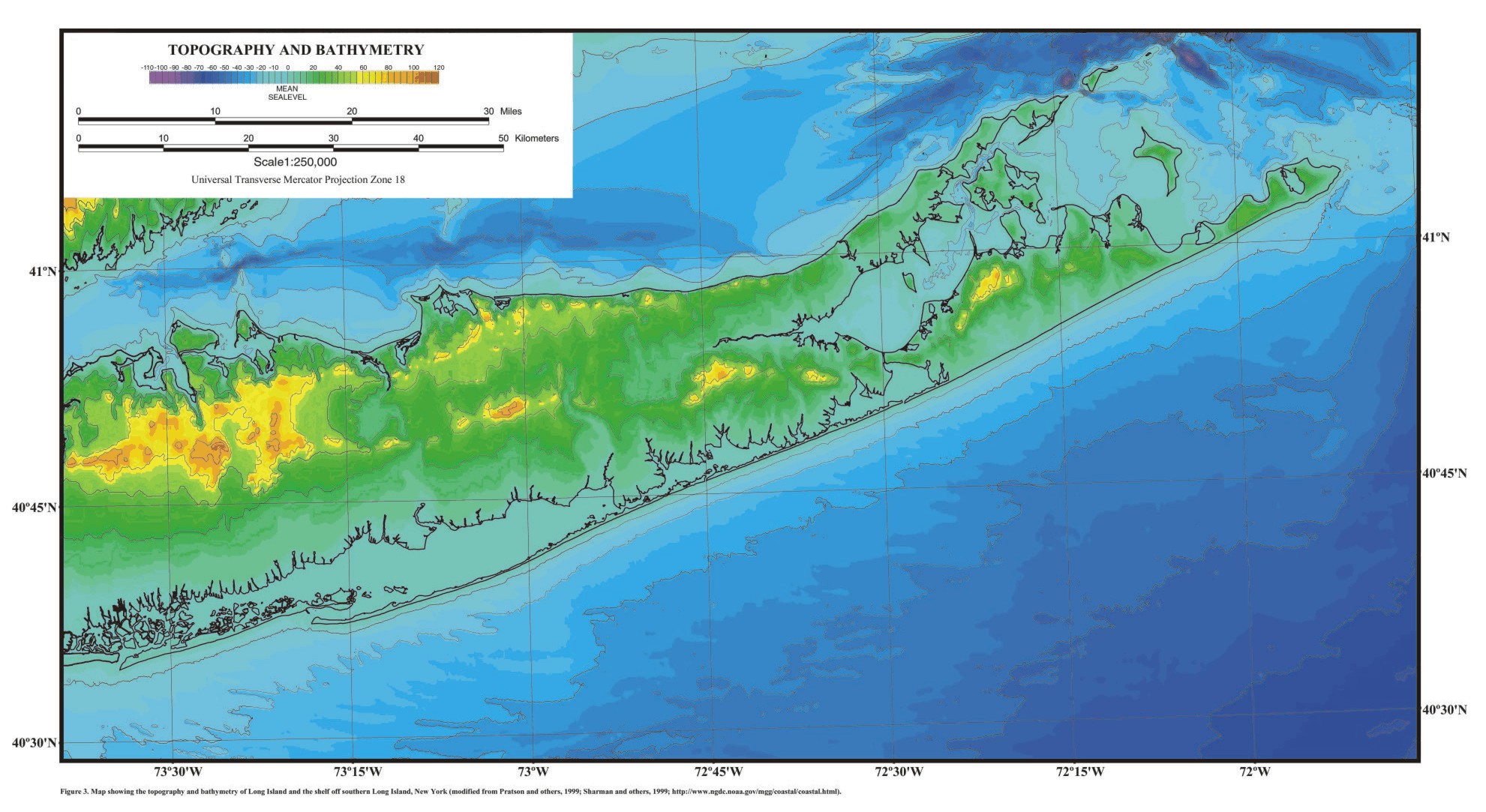
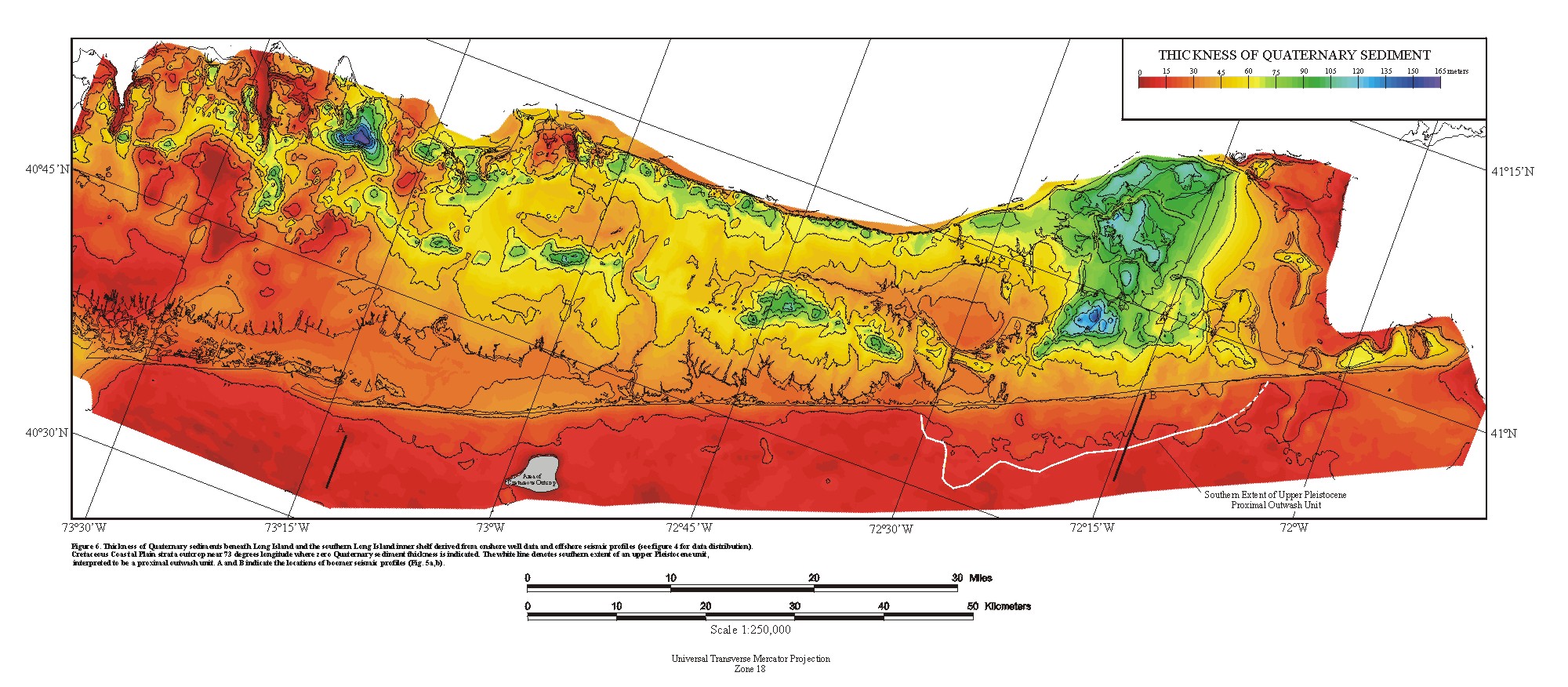
Greg Laden provided me an example of another ‘and’. What could disappear shows us what gets covered by rising seas but doesn’t deal with how rising seas will erode land that theoretically would remain above the new sea level. When it comes to transgression, consider the Boston map. From about Cambridge north, the inundation depicted is pretty close to what will likely happen given the because the land has hard hard basement rock near the surface. South of Boston, however, the substrate is glacial till at depth. Rising seas almost certainly would erode away at this and thus rising sea levels would likely mean fewer and far smaller islands than shown with these interactive maps. The many little islands shown as still sticking above the sea would all be sea mounts except in the occasional spot where a core of bedrock would be still visible, to produce islands much smaller than shown. Long Island is an even more striking example. With the 25 foot sea level rise, the Long Island map shows 21% flooded (to the right). However, the only thing that would be left of Long Island is its rocky core. The moraine would eventually turn into cobbles and rocks in situ and mostly be shifted to sea as a sand sheet. The highest elevations on Long Island are ca 120 meters as based on the topo map. The thickness of quaternary sediments in those areas is between 90 and 105 meters in those areas. Those small patches would be islands if the ocean had its way with Long Island. Long Island will, in a few thousand years, become a large clam flat surrounded by some nice fishing grounds without sea level rise. With sea level rise, currently unaffected by the sea land faces would become exposed to strand line erosion. Looking back at the topo map, most of the area that is about 20-40 meters above sea level (blue to dark green would be eroded very quickly with just a few meters of sea level rise.
There is another issue here — the timing challenge and getting attention from citizens, organizations, politicians. In an environment where ‘long term strategic planning’, especially for the business community, rarely goes past 5-10 years, speaking about impacts three centuries from now has a hard time eliciting a yawn from most. With an economics profession ready to apply ‘discount rates’, a Starbucks coffee (okay, a Starbucks specialty drink) today might have a greater ‘net present value’ than a 25 foot sea level rise in the year 2500. The reality is, as per the increased impact (reach) of Hurricane Sandy’s storm surge and the regular full moon high tide floods in Miami, we are already seeing real impacts from climate-change driven sea-level rise and those impacts will continue to grow — our societal choice is how bad we are willing to allow these impacts to become because we value that specialty drink today more than climate impacts tomorrow.
The New York Times‘ increased focus on climate change issues, sadly sparked by Hurricane Sandy’s damage to the New York area, could prove a valued contribution to fostering a better national discussion about and, hopefully, more serious national action when it comes to climate change issues. As part of climate change impacts and risks, What could disappear is a useful tool for understanding sea-level rise. When using it, however, we should remember that its conservative representation is almost certainly an optimistic look at what will happen in coming decades and centuries.
This guest post from Veritas Curatprovides a valuable look at how the science of economics drives answers that undermine humanity’s prospects.
Economics is so fundamentally disconnected from the real world it is destructive.
If you take an introductory course in economics, the professor, in the first lecture, will show a slide of the economy, and it looks very impressive, you know, raw materials, extraction process, manufacturer, wholesale, retail, with arrows going back and forth…
But if you ask the economist: in that equation, where do you put the ozone layer, where do you put the deep underground aquifer as fossil water, where do you put topsoil, or biodiversity? Their answer is, ‘Oh, those are externalities’.
Well, then you might as well be on Mars: that economy is not based in anything like the real world.
If this is true of economics, as David Suzuki says, and if “The Economy” is “not based in anything like the real world” – as in the planet we live on, the air we breathe, the water we drink; basically the web of life that sustains us – then, there must be some disturbing conclusions drawn regarding “The Economy.”In human psychology a “fundamental disconnection from the real world” is a good description of the deep states of suffering that psychologists and psychiatrists call by names such as “psychosis” or “schizophrenia.” It is difficult to heal from such conditions.
To apply these terms to “The Economy” is not acceptable within current political discourse. But that admission then suggests that current political discourse is fundamentally disconnected from the real world. If so, then how are the changes that our planet is telling us need to be made going to be made? The more we learn about the physical and chemical changes that “The Economy” is making to our planet the more frightened we should be about this fundamental disconnect.
To be clear, I’m not talking about problems with basic first-year economics theory (I don’t believe that’s David Suzuki’s intention either). I’m talking about a mass psychosis that must be healed for us to survive. It is a kind of radical healing that seems beyond the capabilities of our present system of oligarchical economics. It’s going to have to happen with a grassroots community-based revolution if it is to happen at all.
To call our economy “psychotic” or “schizophrenic” is, without a doubt, ambitious criticism. Without this economy, which I criticize so ambitiously, we believe we would be left without the things that make life worth living – and without basic necessities for survival for billions of people who don’t deserve to live in the kind of suffering that the destruction of the economy would cause.
But this is not about eliminating this thing we call “The Economy.” Not at all. It is about fundamental, paradigmatic changes that must turn it into something completely different from the psychotic failure it is now. Something along the lines of a fundamental shift in what we mean by value and what we measure and quantify to determine economic success. Something that includes Bhutan’s focus upon Gross National Happiness rather than Gross National Product.
To the extent that economic thinking is based on the market, it takes the sacredness out of life, because there can be nothing sacred in something that has a price. Not surprisingly, therefore, if economic thinking pervades the whole of society, even simple non-economic values like beauty, health, or cleanliness can survive only if they prove to be economic.–E. F. Schumacher (Small Is Beautiful)
What would it take to heal this disconnect The Economy has suffered, severing it from a planet that gives it life and upon which it depends utterly and entirely? How could we change it to a system that values completely and wholly that planet in it’s most basic equations – the ones it teaches to first year economics students?
Instead of “assuming away” the natural world it would begin with the natural world and place those considerations at the heart of its calculations. It would banish the economic concept of “externality.” For an “externality” is actually an impossibility. There is nothing external to the planetary system we reside within. To base a system of thought upon an impossible belief is to disconnect it from the real world.
November 25th, 2012 · Comments Off on Fox Affiliate Anchors Quit On Air due to political interference in their reporting: w/a climate science denial angle
Bangor’s longest running news team — on a combination ABC and FOX affiliate — quit their jobs to the surprise of colleagues and viewers.
Cindy Michaels and Tony Consiglio have been anchors at ABC affiliate WVII and Fox affiliate WFVX in Bangor for six years, but claimed that the owners and managers had been increasingly intervening in their newscasts over the last four
As for why they gave up a job that they evidently loved?
“I just wanted to know that I was doing the best job I could and was being honest and ethical as a journalist, and I thought there were times when I wasn’t able to do that,” said Consiglio …
Michaels said there were numerous things that contributed to their decisions.
“It’s a culmination of ongoing occurrences that took place the last several years and basically involved upper management practices that we both strongly disagreed with,” she explained. “It’s a little complicated, but we were expected to do somewhat unbalanced news, politically, in general.”
While this is simply an affiliate and, therefore, seemingly without editorial control from News Corp, hard to not think of this within the context of Faux News. And, when it comes to something affiliated with Faux News, a direction to do “unbalanced news, politically” seems so shocking and out-of-context that, well, sacre bleu!
Comments Off on Fox Affiliate Anchors Quit On Air due to political interference in their reporting: w/a climate science denial angleTags:climate zombies · global warming deniers · journalism
During a campaign season in which climate change featured most prominently as alaugh line at the Republican National Convention, the low point was when CNN’s Candy Crowley addressed “all you climate people” in her explanation of why climate didn’t come up during the presidential debates. Who knew that human disruption of the global climate had become such a narrow, provincial concern?
But there’s important information in the fact that a senior reporter for a major network could dismiss climate change as essentially a special interest issue. It’s evidence, if more were needed, that “all us climate people” got our butts kicked in the battle for the narrative in the 2012 election.
And like the Republican Party, which is now undergoing the usual soul searching that follows a big electoral defeat, those of us who believe that inaction on climate is the greatest threat facing our civilization (never mind the economy) have some serious soul searching to do about our own defeat, which occurred long before any votes were counted.
Crowley’s explanation was consistent with the conventional wisdom on why the president didn’t make climate an issue. Because it was an “Economy election” and everyone in the DC press must accept that government action on climate change could do serious harm to the economy (because “it’s become part of the culture,” even if it’s not true), any discussion of climate policy by the president would have been off-message and worked against his chances for re-election.
The unconventional wisdom, popular among “climate people,” is that the Obama campaign failed to recognize the high level of popular support for action on climate change and missed a golden opportunity to seize a winning wedge issue when they chose the more politically expedient route of ignoring it.
There’s probably some truth to both of these explanations, but here’s a third one that is particularly useful in the context of a presidential election: the campaigns avoided talking about climate policy because they believed that raising the issue would be harmful in a few swingy areas of key swing states that would likely decide the election.
November 21st, 2012 · Comments Off on “Climate change: it’s even worse than we think”
“Climate change: its even worse than we think” (than we thought) is an increasingly common conclusion from the scientific experts.
Often decried modeling is, as climate denying anti-science syndrome sufferers like Jim Inhofe like to state, truly proving to have been wrong. Inhofe/et al are simply getting the error bar wrong, the situation looks to be far worse than what the global scientific community has been saying about climate change. Consistently, the situation is worsening faster than the ‘consensus’ modeling predicted 20, 10, or even just 5 years ago. And, with an increasing understanding that events are moving faster in the real world than what modeling foresaw, this is creating an increased urgency to warn policy-makers about the consequences of blind continuation with business as usual policy.
The amount of greenhouse gases in the atmosphere reached a new record high in 2011, according to the World Meteorological Organization. Between 1990 and 2011 there was a 30% increase in radiative forcing – the warming effect on our climate – because of carbon dioxide (CO2) and other heat-trapping long-lived gases.
We, across the planet, are nowhere closer to reversing the tide on emissions.
most importantly, a 4°C world is so different from the current one that it comes with high uncertainty and new risks that threaten our ability to anticipate and plan for future adaptation needs.
Let’s be clear: we are on a path to a 4C temperature increase and preventing hitting that 4 degree increase is a rather minimalist target. The world community has committed, at least in paper terms, to avoiding a 2 degree increaseWe are already serious climate disruption impacts, measured in agricultural prices, disappearing glacier and Arctic ice, species going extinct, human deaths, and … And, this is just with a 1 degree C increase in temperatures. Thus, even a 2 degree C increase has massively painful and disruptive impacts. From this report, a key sentence:
It is clear that large regional as well as global scale damages and risks are very likely to occur well before this level of warming [4C] is reached.
Substitute “[2C]” and that sentence is still true. In other words, the risks are not being overstated and the urgency of moving to serious action is not being overstated.
Thus, the New Scientist article “climate change: it’s worse than we think” is yet another straw being thrown on the camel of climate policy inaction and waffling by too many policy-makers around the world. The introduction:
Five years ago, the last report of the Intergovernmental Panel on Climate Change painted a gloomy picture of our planet’s future. As climate scientists gather evidence for the next report, due in 2014, Michael Le Page gives seven reasons why things are looking even grimmer.
After the fold, a look at those seven reasons. [Read more →]
November 20th, 2012 · Comments Off on If your fuel isn’t dirty enough 4U, this hotline is 4U.
Ever had late night urges that your fuel simply isn’t dirty enough to penetrate into your darkest corners? If so, Canada has the fuel for you. And, recognizing the lure of dirty energy, there is now a number to call: the Tar Sands hotline.
Did you know that unextracted tar sands, just like unmarried single women, have an expiry date? According to noted gender studies expert Chen Weidong of CNOOC, the China National Offshore Oil Corporation, that’s exactly the fate we can expect for Alberta’s crude if we leave it undrilled and in the ground. An empty purposeless existence.
If you love the Tar Sands and don’t want to see them left behind, watch this video.
After all, unextracted tar sands oil is “like an unmarried woman”, don’t leave it in the ground with bountiful wildlife like an old maid collects cats.
November 19th, 2012 · Comments Off on Climate Reality to a catchy beat …
Last week, the Climate Reality Project (Al Gore) ran a 24 event on “Dirty Weather”. Here, in a few minutes, is a foot-tapping musical outline of why climate change is such a challenge and what we must do in the face of climate reality.
It is the only Earth that we’ll ever have …
This Earth is the one that we need to care about …
In the event that your nights are too tranquil, might I suggest some bedside reading from the (typically) staid World Bank? Turn Down the Heat‘s subtitle is tellingly revealing: “Why a 4 Degree C Warmer World Must Be Avoided”. Bankers — especially international bankers — and banker analysts don’t typically hyperventilate. This tendency underlines why we should take this so seriously:
This report spells out what the world would be like if it warmed by 4 degrees Celsius, which is what scientists are nearly unanimously predicting by the end of the century, without serious policy changes.
The 4°C scenarios are devastating: the inundation of coastal cities; increasing risks for food production potentially leading to higher malnutrition rates; many dry regions becoming dryer, wet regions wetter; unprecedented heat waves in many regions, especially in the tropics; substantially exacerbated water scarcity in many regions; increased frequency of high-intensity tropical cyclones; and irreversible loss of biodiversity, including coral reef systems.
And most importantly, a 4°C world is so different from the current one that it comes with high uncertainty and new risks that threaten our ability to anticipate and plan for future adaptation needs.
“scenarios are devastating … unprecedented heat waves … irreversible loss of biodiversity … ”
While the world is, in some theoretical paper signed way, committed to constraining global warming to 2 degrees Celsias, the business as usual (BAU) scenario puts us on a path toward something approaching 6 degrees (or even worse) by the next century. Without even going to that BAU scenario, Turn Down the Heat lays out in stark terms why we need to take climate change seriously and change the game to something that offers hope for sustaining modern human civilization.
Those of us who focus heavily on climate change issues were uncertain about the appointment of Dr. Jim Yong Kim as President of the World Bank.. There was no uncertainty of his brilliance, of his ability to understand complex problems, and of his passion for fostering real solutions. His career, however, has mainly been in the health world prior to his assumption of academe. Thus, how much would climate change play in the tenure of the first scientist to run the World Bank? This report seems to provide a meaningful answer to that question. In the forward, Dr. Kim concludes the forward with these powerful paragraphs:
We are well aware of the uncertainty that surrounds these scenarios and we know that different scholars and studies sometimes disagree on the degree of risk. But the fact that such scenarios cannot be discarded is sufficient to justify strengthening current climate change policies. Finding ways to avoid that scenario is vital for the health and welfare of communities around the world. While every region of the world will be affected, the poor and most vulnerable would be hit hardest.
A 4°C world can, and must, be avoided.
The World Bank Group will continue to be a strong advocate for international and regional agreements and increasing climate financing. We will redouble our efforts to support fast growing national initiatives to mitigate carbon emissions and build adaptive capacity as well as support inclusive green growth and climate smart development. Our work on inclusive green growth has shown that—through more efficiency and smarter use of energy and natural resources—many opportunities exist to drastically reduce the climate impact of development, without slowing down poverty alleviation and economic growth.
This report is a stark reminder that climate change affects everything. The solutions don’t lie only in climate finance or climate projects. The solutions lie in effective risk management and ensuring all our work, all our thinking, is designed with the threat of a 4°C degree world in mind. The World Bank Group will step up to the challenge.
To have the President of the World Bank write that “climate change affects everything” is, not just to me, a meaningful step forward in the global discussion space.
November 18th, 2012 · Comments Off on Climate Change is Evaporating the Things we Love – Great Lakes at Historic Lows
This is another excellent guest post by Muskegon Critic …
Lake Michigan and Huron are within a couple inches of breaking all time low water levels on record, and now climate change is emerging as the leading cause. It works like this:
warmer weather –> less ice cover in the winter –> more evaporation
[We’re are seeing this, real time, in the Great Lakes … see after the fold.]
November 18th, 2012 · Comments Off on Ken Burns’ Prequel to the Dust-Bowlification of America’s Southwest
This evening, PBS will start broadcasting the latest of film documentarian Ken Burns’ treatises on significant periods and issues of American history.
THE DUST BOWL chronicles the worst man-made ecological disaster in American history, in which the frenzied wheat boom of the “Great Plow-Up,” followed by a decade-long drought during the 1930s nearly swept away the breadbasket of the nation. Vivid interviews with twenty-six survivors of those hard times, combined with dramatic photographs and seldom seen movie footage, bring to life stories of incredible human suffering and equally incredible human perseverance. It is also a morality tale about our relationship to the land that sustains us—a lesson we ignore at our peril.
This “morality tale” and “peril” cannot be understated, as this documentary is like a laser pointer at one of the major impacts of catastrophic climate chaos, a all-too likely scenario for the American southwest for the near, mid, and long-term future that Joe Romm christened in a Nature article as Dust-Bowlification.
Which impact of anthropogenic global warming will harm the most people in the coming decades? I believe that the answer is extended or permanent drought over large parts of currently habitable or arable land — a drastic change in climate that will threaten food security and may be irreversible over centuries. …
I used to call the confluence of these processes ‘desertification’ on my blog, ClimateProgress.org, until some readers pointed out that many deserts are high in biodiversity, which isn’t where we’re heading. ‘Dust- bowlification’ is perhaps a more accurate and vivid term, particularly for Americans — many of whom still believe that climate change will only affect far-away places in far-distant times.
Prolonged drought will strike around the globe, but it is surprising to many that it would hit the US heartland so strongly and so soon.
The coming droughts ought to be a major driver — if not the major driver — of climate policies. Yet few policy-makers and journalists seem to be aware of dust-bowlification and its potentially devastating impact on food security. That’s partly understandable, because much of the key research cited in this article post-dates the 2007 Fourth Assessment Report of the Intergovernmental Panel on Climate Change (IPCC). Raising public awareness of, and scientific focus on, the likelihood of severe effects of drought is the first step in prompting action.
One path, it seems, to such “raising public awareness” is (as per the post) making the linkage — the appropriate, legitimate, defensible — between Burns’ searing documentation of the historical Dust Bowl experience to what is already occurring the Southwest and what scientific work shows will occur in coming years, decades, centuries. While, due to the accumulated impact, the situation will get worse, we have a choice. We can continue with business as usual, assuring that we will only be worsening the situation with each passing moment, or we can do the math and decide to take action to mitigate our climate impacts and seek to reduce the likelihood of irrevocably hurtling over the climate cliff (or, more accurately, the C4: the catastrophic climate chaos cliff). Leveraging the power of communicators like Burns, helping Americans connect the dots between historical experience and the future we are creating, is one tool to help galvanise Americans to work together to turn the tide on Global Warming’s rising seas.
“It was an incredible and heartbreaking story,” said Duncan. “And it’s amazing how they – now in their late 80s and 90s – told the story as if it happened the day before. That’s how raw and vivid the memory was for them.”
It is a raw and vivid and extraordinarily well executed documentary that makes viewers marvel at the overpowering strength of nature unleashed, the arrogance and folly of crafting policies designed to tame the environment rather than live with it, and the resilience of those live through such a preventable disaster and rebuild their lives.
Much of the destruction wrought by Superstorm Sandy resulted from years of over development in low-lying areas without provisions for inevitable floods, and political posturing that ignores ongoing climate change.
Comments Off on Ken Burns’ Prequel to the Dust-Bowlification of America’s SouthwestTags:Energy


 in the traditional U.S. media scene when it comes to climate change issues. Worthwhile opinion pieces, over this past weekend, included Rising Seas, Vanishing Coastlines and Is this the end? Associated with these articles is a powerful graphical tool that shows, for key American coastal areas, the impact of sea-level rise. Entitled What could disappear, this interactive tool always us to assess rapidly the impact of varying amounts of sea-level rise in the Baltimore, Boston, Charleston, Houston, Jacksonsville, Los Angeles, Long Island, Mobile, New Jersey, New Orleans, New York, … areas. The list is daunting to consider. This tool allows one to peg the sea level rise anywhere between 0 and 25 feet.
 Looking at what this map projects for what would happen in 100 to 300 years, a 5 foot sea-level rise, it is rather sobering to see how much land — how much high-value urban infrastructure — ‘disappears’ beneath the waves. Take a look at, for example, New Orleans to the right. With a five-foot rise, New Orleans will be “88% flooded”. That’s New Orleans, of course we know that it as risk. Looking elsewhere, Atlantic City will be 62% flooded, Huntington Beach (CA) will be 27% flooded, Galveston (TX) 68% flooded, Cambridge (MA) will be 26% flooded, and so on. That, of course, is only a 5 foot rise. Want a truly shocking image, look to the future of America’s coastal areas in face of a 25 foot rise which is “the potential level in coming centuries, based on historical climate data.” Taking the moment to ‘play’ with What could disappear provides a depressing projection on the challenges ahead when it comes to managing coastal areas in the face of climate-change driven sea-level rise.
 ‘and’. What could disappear shows us what gets covered by rising seas but doesn’t deal with how rising seas will erode land that theoretically would remain above the new sea level. When it comes to transgression, consider the Boston map. From about Cambridge north, the inundation depicted is pretty close to what will likely happen given the because the land has hard hard basement rock near the surface. South of Boston, however, the substrate is glacial till at depth. Rising seas almost certainly would erode away at this and thus rising sea levels would likely mean fewer and far smaller islands than shown with these interactive maps. The many little islands shown as still sticking above the sea would all be sea mounts except in the occasional spot where a core of bedrock would be still visible, to produce islands much smaller than shown. Long Island is an even more striking example. With the 25 foot sea level rise, the Long Island map shows 21% flooded (to the right). However, the only thing that would be left of Long Island is its rocky core. The moraine would eventually turn into cobbles and rocks in situ and mostly be shifted to sea as a sand sheet. The highest elevations on Long Island are ca 120 meters as based on the topo map. The thickness of quaternary sediments in those areas is between 90 and 105 meters in those areas. Those small patches would be islands if the ocean had its way with Long Island. Long Island will, in a few thousand years, become a large clam flat surrounded by some nice fishing grounds without sea level rise. With sea level rise, currently unaffected by the sea land faces would become exposed to strand line erosion. Looking back at the topo map, most of the area that is about 20-40 meters above sea level (blue to dark green would be eroded very quickly with just a few meters of sea level rise.