Richard Clarke served the United States in multiple roles, gaining his greatest fame due to his harsh criticism of the Bush White House for ignoring/down-playing his urgent calls for attention to Al Qaeda in the months leading to the 9/11 attacks. Clarke has served the nation in other ways, including a series of thoughtful, illuminating and (extremely well-written) books on terrorism, intelligence, cyber-warfare and, the latest to be released in a few weeks, on learning how to bring to the fore Warnings from experts before catastrophe hits.
Millions of lives lost to catastrophes – natural and man-made – could have been saved by the advance warnings of experts. Can we find those prescient people before the next catastrophe strikes? …
In Greek mythology Cassandra foresaw calamities, but was cursed by the gods to be ignored. Modern-day Cassandras clearly predicted the disasters of Katrina, Fukushima, the Great Recession, the rise of ISIS, and many others. Like her, they were ignored. There are others right now warning of impending disasters, but how do we know which warnings are true?
This is the story of the future of national security, threatening technologies, the US economy, and possibly the fate of civilization.
Certainly, there are many Cassandras when it comes to climate change’s realities and threats. Cassandras routinely ignored by the American mass media (to a greater rather than lesser extent) and ridiculed by Trump and his GOP supporting cast.
This Energy BOOKSHELF moment, however, is not about the power of Clarke’s recounting of the realities of what he faced (and learned from) government service nor the insights in his non-fiction analytical works but another aspect of his work: his fiction. Clarke is, again, an eloquent writer who knows how to communicate. He has turned his attention, at times, to fictional works which, occasionally, I’ve taken the time to read. At the library, the other day, I bumped into Pinnacle Event and grabbed it for a week-end ‘escapism’ read. Little did I know, when leaving the library, that I was carrying what might be the most powerful and insightful CliFi (Climate Fiction) book that I have read to date.
NOTE:
SPOILER ALERT: after the fold details that reveal key plot elements.
Pinnacle Event is an excellent ‘thriller’ … reading ‘after the fold’ will lessen the book’s dramatic impact.
A watched pot never boils is a truism that speaks to a reality: Humans have a difficult mentally registering slow change (how do you register your child’s growth day to day) even as the change impacts our lives in tangible manner (buying clothing to replace that they grew out of).
Sea-level rise is one of the most predictable of climate change impacts. We know the seas are rising and we know that there will be more sea-level rise. Yet too many seem oblivious to the obvious. Around the world, too many in the private sector, government, and the public are failing to plan for sea-level rise’s foreseeable consequences. We need to leverage communication tools, of all sorts, to change this equation: to motivate action to mitigate climate change (to slow/reduce the future sea-level rise in the decades/centuries to come) while sparking investment to adapt to the inevitable rise in the years and decades ahead. And, art has a role to play — from the subtle to the in-your-face signal. This Venice sculpture is just that sort of messaging:
According to Halcyon Gallery, “The hands symbolise tools that can both destroy the world, but also have the capacity to save it. At once, the sculpture has both a noble air as well as an alarming one – the gesture being both gallant in appearing to hold up the building whilst also creating a sense of fear in highlighting the fragility of the building surrounded by water and the ebbing tide.”
Venice is a floating art city that has inspired cultures for centuries, but to continue to do so it needs the support of our generation and future ones, because it is threatened by climate change and time decay,’
For Virginians aware of the Commonwealth’s tremendous risks from climate change and (potentially even more) tremendous opportunities for prosperity through climate action, the past few days had some real buzz. Governor Terry McAuliffe was going to make a climate-related announcement at Alexandria ReNew?. That event has come and past.
Okay, I’ve read … and reread … and reread Executive Directive 11 and return to Wendy’s question: Where’s the beef?
A year ago, well into his third year, Governor McAuliffe issued Executive Order 57 which, well, kicked the can down the pike on climate change directing a year-long study to figure out what Viriginia should do to address climate change. The study count rises even as sea level increases. Yes, worthwhile to have study but substantive action is urgently required. At the end of that year process, what did McAuliffe order: some more study and (potential) regulation development. Here is the substantive directive material:
1. Develop a proposed regulation for the State Air Pollution Control Board’s consideration to abate, control, or limit carbon dioxide emissions from electric power facilities that:
a. Includes provisions to ensure that Virginia’s regulation is “trading-ready” to allow for the use of market-based mechanisms and the trading of carbon dioxide allowances through a multi-state trading program; and
b. Establishes abatement mechanisms providing for a corresponding level of stringency to limits on carbon dioxide emissions imposed in other states with such limits.
2. By no later than December 31, 2017, present the proposed regulation to the State Air Pollution Control Board for consideration for approval for public comment in accordance with the Board’s authority pursuant to Virginia Code § 10.1-1308.
Okay, yes, it is worthwhile for Virginia government officials to develop draft regulations that would enable Virginia to participate in carbon trading that can be put forward for public comment.
Hmmm … read that previous sentence … are you asking “where’s the beef”, too? This legitimately merited ‘buzz’ and a special signing announcement?
No, this isn’t Governor McAuliffe announcing
A deal with Dominion Virginia Power for constructing a 500 megawatt offshore wind farm along with the infrastructure in the Tidewater area to support the construction and operations of projects not just off Virginia but along the Atlantic coast — that would create economic activity, jobs, reduce electricity costs, improve energy resiliency, and, by the way, reduce (climate and other) pollution.
A green schools program that would boost Virginia educational achievement, improve the health of Virginians, create jobs, save money, and, by the way, reduce (climate and other) pollution.
The leveraging of the Volkswagen settlement money for sparking a transition to plug-hybrid electric and electric school and transportation buses throughout the Commonwealth that would dramatically reduce health-risks to students, improve educational performance, save money, and, by the way, reduce (climate and other) pollution.
Something … well … something tangible.
So I'm signing this directive to build a better future for our children, create good paying jobs for families & keep Va #1 on climate issues pic.twitter.com/rROvSmBSjM
With all due respect, Governor McAuliffe, Virginia is far from “#1 on climate issues” and, although I hoped your announcement this morning would move the ball forward in a tangible manner toward #1, Executive Order 11 won’t do much to move it in that direction.
Sometimes the jaw dropping moments break through the floor. For U.S. national security professionals (and, well, anyone associated with intelligence in the United States or any allies), Donald Trump’s blustering blabbering of extremely sensitive material to the Russians is causing lots of jaws to break lots of flooring. (Perhaps a good time to be in the floor repair business??) But, while he is really good at it, it is isn’t only Trump who causes jaws to drop.
Shared with me this morning was a paper ‘published’ by Omics Online (for a perspective re Omics and here) by its newly created (Dec 2016 first issue) “Environment Pollution and Climate Change” ‘journal’. This paper, “The Refutation of the Climate Greenhouse Theory and a Proposal for a Hopeful Alternative,” led to multiple jaw breaking floor events in just a few moments. (Anyone know a good floor repair team?) With this item in a (claimed to be) ‘peer-reviewed’ journal, we have an excellent example of the proliferation of nonsense and the very sad reality of the need for thoughtful people to take the time and energy to refute that nonsense. To provide a perspective, someone just sent me this note:
Truth is at a disadvantage
Ok, I just looked at the paper. It is a joke right?
And, the ‘refutation’ challenge doesn’t only eat up time and energy … but creates the chasing the lie challenge. (Churchill’s adage, “a lie gets halfway around the world before the the truth has a chance to get its pants on.”) The lie remains there, to be counted in ‘peer-reviewed’ material, to be used/abused by unknowing knaves and deceivers alike, with the truth missed by the knave and knowlingly ignored by the deceiver.
The ‘duck and cover’ is rather popular, as the citizenry is enraged. Whether Trump’s corruption, the despicable approach to refugees and immigrants, Trump Care, #TrumpRussia, and/or … issue after issue is motivating ever more Americans toward outrage at the GOP’s outrageous malfeasance as exemplified by Donald Trump. Trump’s firing of FBI Director Comey is likely to lower further Trump and the GOP’s approval rating and make town halls even more toxic for Republican politicians.
The following video provides a snapshot of how climate change discussions are playing out in Republican townhalls across the country, with a very eloquent articulation of the issue at hand by the videographer, Peter Sinclair, as its conclusion.
Comments Off on Townhalls getting hot for @GOP PoliticiansTags:Energy
May 10th, 2017 · Comments Off on Three @GOP Senators put taxpayers, citizens, common sense, nation before Party: #Methane vote
Amid these very tense and troubled times — with the Arctic potentially passing a climate tipping point and U.S. Democracy at (hopefully not past) a tipping point — it is valuable to recognize and even celebrate hopeful signs.
Today, in something that surprised many, three GOP Senators (Collins, McCain, and Graham) voted with Senate Democrats to turn back a Republican Party priority to rip off the taxpayers and worsen our pollution situation.
Effort to overturn Obama’s methane rule fails in senate
WASHINGTON – Senate Republicans were dealt a blow Wednesday in their bid to overturn a controversial Obama-era regulation limiting the amount of methane that can be vented and flared from oil and g…
fuelfix.com
The Congressional Review Act (CRA) is a rather dastardly piece of law which has been rarely used prior to the Trump-ista Kakistocracy*. The CRA, in essence, is that Congress can reject an Administration regulation … and, in doing so, makes it essentially impossible for future regulation to be imposed in that arena. The Republicans have been going hog wild with the CRA, primarily on Obama Administration environmental-related regulations, in ways that will worsen our ability to tackle energy, environmental, health, fiscal, and climate challenges.
The Methane rule that this vote relates to, in short, tackles the reality that oil and natural gas exploiters have been allowing significant releases of methane in their projects on Federal land.
On federal and tribal lands alone, oil and gas companies waste more than $330 million of natural gas annually that could heat homes, power vehicles or generate electricity.
As Methane is, in the near (20-year time frame), about 80 times worse than carbon dioxide for global warming, that leakage is pretty bad from a climate change perspective. It also is a bad deal for the taxpayer: the rules around the leasing didn’t count that leakage for royalty purposes. By addressing that gap, the Obama methane rule created a serious financial and legal incentive for those operating on Federal lands to reduce their methane leakage and flaring. This will lead to increased payments into the Federal treasury and reduced climate impacts from these projects. All in all, a reasonably good deal for American citizens.
Of course, what oil company wants to pay more in royalty payments? And, of course, that put killing the Obama methane rule on the top of the agenda for Pruitt, Zienke, and other GOP eminences.
But after some key defections from Republicans ranks, including Sen. John McCain, R-Ariz., and Sen. Lindsey Graham, R-S.C., [and Susan Collins, R-ME] the vote was 51-49 to block the repeal from moving ahead.
In these troubled times, we should recognize and celebrate good news items … and, well, make the effort to recognize and thank GOP politicians when they do act in the public interest.
VP came to Capitol in hopes of casting tie-breaking vote on methane rule, but it failed 49-51 in huge win for our health & climate! #Resistpic.twitter.com/uZtnsn1MVM
Facing criticism for the hiring of Bret Stephens (who, during his time at the Wall Street Journal, established a long track record of attacking climate science and scientists along with other rather egregious statements/writings on other issues), The New York Times editorial page editor James Bennet of the NYT said: “I have no doubt he crosses our bar for intellectual honesty and fairness.”
Stephens chose, out-of-the-box, to write his first column on ‘uncertainty’ related to climate science and solutions. Knowledgeable people — including numerous experts … including top scientists — found error and distortion and misdirection after error and distortion and misdirection in that column. As one dissection concluded,
This bloke was touted by the NYT as a recipient of a Pulitzer, which was meant to justify their purchase. His first NYT article showed no sign of that. His article looked to have been dashed off in about five minutes with no thought, no research, no facts, and logical fallacy from woe to go. Is this really and truly why the NYT pays him the big bucks?
As to that bar …
Today’s article shows that NYT editorial page editor James Bennet of the NYT was wrong when he said: “I have no doubt he crosses our bar for intellectual honesty and fairness.” The only way Bret Stephens can cross the bar is if the NYT lowers the bar.
So many surprising things with what is morphing into The Stephens Affair. Like many established institutions, insiders rally to defend the (pretty much) indefensible and their spines go up in the face of further criticism. They will attack those questioning them, question motives, avoid dealing with the substance of challenge, and — all too often — dig the hole deeper and deeper. In the process, they can wreak ever more havoc than if there had been swift and serious action up front.
While many critics (okay, including me) might have wanted to see Gray Lady decide not to bring in Stephens, I had a seemingly reasonable expectation: that the New York Times editors would recognize the criticism as having some substance and spend serious effort in the editing process to avoid having Stephens spew distortions and nonsense related to climate change from the pretty huge soap box that a NY Times OPED position provides. As the first column showed, they utterly failed to do this. As Dave Roberts put it a few days ago:
It’s time for the opinion page to take climate change as seriously as the paper’s reporters do.
In the face of substantive, fact-based, expert criticism of Stephens’ ‘work’, the Times editors aren’t showing any signs — when it comes to Stephens ‘ that they plan “to take climate change as seriously as the paper’s reporters do.”
Today, Stephens published Climate of Unintended Consequences. This piece attacks corn ethanol as not achieving its objectives and hurting climate efforts. Okay, many of us never were too enthused about claims that this pork barrel system enriching the farm belt was a climate measure of merit. (There is some basis to lay down that it helped in ‘energy independence’, but that is a different subject than Stephens really focuses on.)
As one interlocuter put it to me,
You mean a pork-barrel policy turned out to not be so great after all?
STOP THE PRESSES!!
No seriously NYT, stop it.
With this OPED attacking corn ethanol, Stephens target isn’t corn ethanol but to (pretty explicitly) attack and undermine climate science as a basis for policy making. He opens this piece with a quote from a 1990s National Renewable Energy Laboratory pamphlet.
Converting biomass feedstocks to biofuels is an environmentally friendly process. So is using biofuels for transportation. When we use bioethanol instead of gasoline, we help reduce atmospheric CO2.
Stephens then — in a few short words of an OPED — takes us on a voyage from Brazil’s sugar cane ethanol to the upper Midwest’s corn ethanol to demonstrate the (seeming) fallacy of these words and that summary pamphlet.
Why ‘seeming’ … Stephens’ focus is on crops grown for biofuel production while that pamphlet, really, focuses on the potential from leveraging agricultural waste for fuel production. As per
Our nation’s biomass resource base is extensive (about 200 million dry tons of various waste feedstocks are available annually). Using a fraction of this resource could probably supply the equivalent of 350,000 barrels of oil in 2010, or 3.6% of the projected light-duty vehicle energy demand.
and …
working to improve government/industry cooperation with efforts to facilitate industry access to the Biofuels Program’s technologies, resources, and facilities. For example, it is working with BC International to construct a biomass-to-ethanol plant in Jennings, Louisiana. The primary feedstock will be bagasse, the waste product of sugar production from sugarcane. Also, OFD is working with Arkenol, which plans to produce ethanol by converting rice straw in California’s Sacramento Valley, and with Masada Resources Group, which is planning a municipal solid waste-to-ethanol plant in New York state.
and … well, you get the drift.
Stephens highlights in his OPED one study (of the many studies) that concluded that CORN ethanol actually leads to increased greenhouse gas emissions. Corn appeared once in the DOE report:
A CORNerstone of the program …
At best, charitably, this was a sloppy linkage — to peg an overview report focused on biomass waste conversion into fuel as the strawman for attacking sugar cane and corn ethanol to undermine climate science — that serious editing, concerned to assure honest engagement with its readership, would have caught and stopped. That it didn’t is yet another indication that The New York Times opinion editors are comfortable “lowering the bar for intellectual honesty and fairness.”
Of course, to be clear, that one OPED is filled with deceptive playing with ‘facts’ that are true but not truthful. Take a look at this paragraph:
There’s also been some acknowledgment that Germany’s Energiewende — the uber-ambitious “energy turn” embarked upon by Angela Merkel in 2010 — has been less than a model for others. The country is producing record levels of energy from wind and solar power, but emissions are almost exactly what they were in 2009. Meanwhile, German households pay nearly the highest electricity bills in Europe, all for what amounts to an illusion of ecological virtue.
So much packed in there, but lets point out several items:
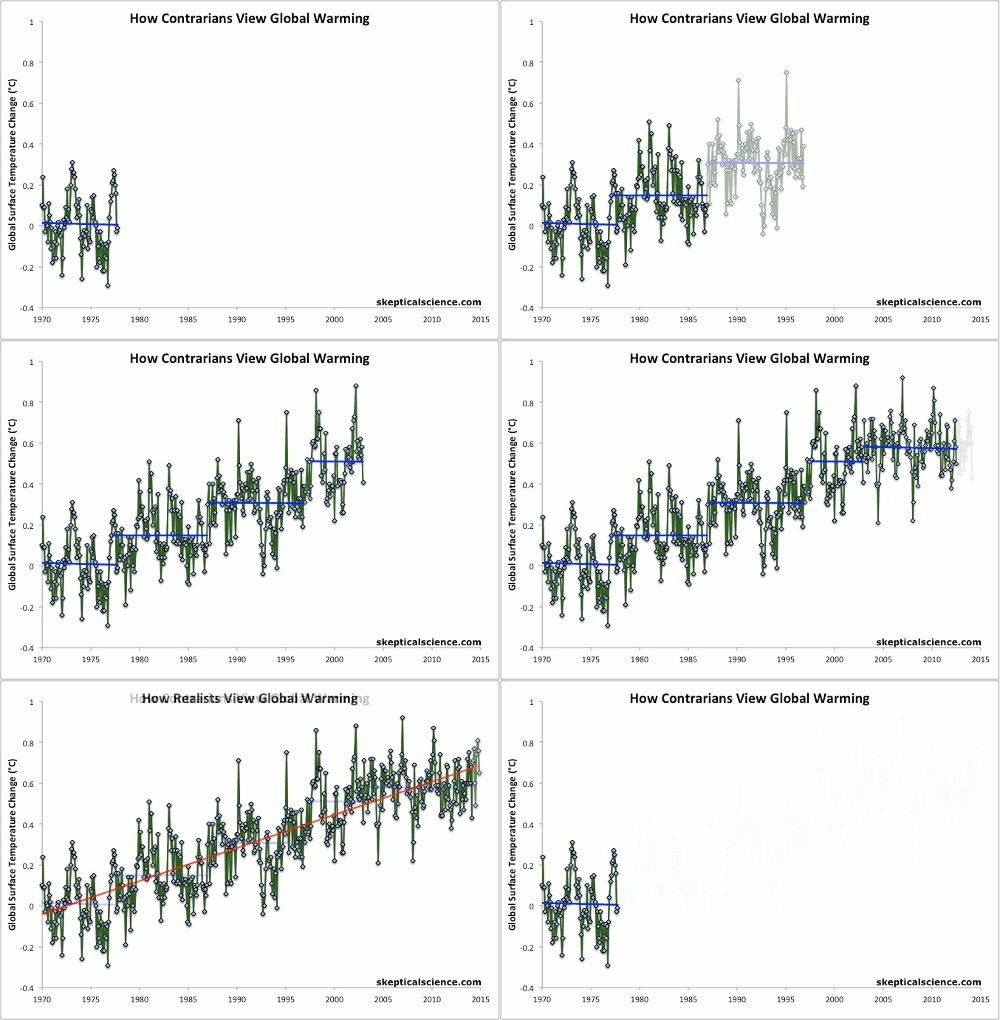
Choosing 2009 for German emissions is like choosing 1998 for temperature comparisons. A ‘fact’ that is not truthful in use. 2009 was a low year in emissions (almost 8% lower than 2008, perhaps due to the 2008 financial crisis/economic crash, and 4% less than 2010) and there hasn’t been huge progress since … due, primarily, to one pesky little word: Fukushima. Fukushima drove a German decision to accelerate nuclear
Stephens carefully selected 1998 …
power plant retirements. Impressive that Germany, with retiring half its nuclear fleet in a short period, actually managed to continue to reduce emissions (even if at a slower pace). Yes, sort of flat fall since 2009 … because 2009 was low. Just like the cherry picking from climate science deniers focus on 1998, which is one of the hottest years in history, to falsely assert a ‘pause’ when 1998 was an outlier year by far.
Yes, Germans do pay somewhat high electricity bills. However, these are (a) right in line with average US bills, (b) roughly 1/4th of the bill is general taxes having nothing to do — per se — with energy nor with the Energiewende, (c) with subsidization for clean energy and energy efficiency, the bills somewhat cover real costs (externalities like cancer-causing pollution from coal plants) that are ignored in the United States and by ‘thinkers’ like Stephens, (d) etc …..
— @huntercutting.bsky.social (@HunterCutting) May 2, 2017
Monographs could be written on the direct and implicit of that one Stephens’ paragraph. And, well, for pretty much every other one he has published as a New York Times employee.
Not sure how The New York Times‘ judges its ‘bar for intellectual honesty and fairness’ but, when it comes to Bret Stephens, it sure seems pretty close to the ground.
Virginia Democrats face a real choice in the primary as to who will be the Democratic nominee for (and next) Governor of the Commonwealth of Virginia: current Lt. Gov. Ralph Northam or former Congressman Tom Perriello. For those with an understanding of climate change’s challenges, risks, and opportunities, the choice is quite clear:
CRITICAL NOTE: While I expect to be helping get Tom Perriello elected as the next Governor of Virginia come November, I — and would hope this is true for all those concerned about climate change, clean energy, reality-based policy-making (as opposed to #AlternativeFacts’ dystopias) — will work just as passionately to get Ralph Northam elected if he is the nominee. While there is a meaningful difference between Perriello and Northam, as discussed after the fold, both of them are the light of day across a swath of policy/moral/ethical arenas compared to the dark dystopia and hatred that dominate the potential GOP nominees.
April 13th, 2017 · Comments Off on Earth Day and a t-shirt challenge
Searching for silver linings … the Trump regime has sparked a remarkably inventive t-shirt industry. Whether proclaiming support for immigrants rights, decrying Team Trump’s fascist sympathies, mocking Trump lies, or … well, a myriad of other issues and approaches, one could fill multiple wardrobes with political commentary and seemingly not even scratch the surface. Whether walking on the street (okay, too rarely), opening up blogs, ads next to my email (or forwarded in emails), or twitter items, it is hard to miss them …
With Earth Day nigh — and the March for Science the activity (okay, post coaching volleyball in the morning) for the day — the temptation is there to spend $s for some relevant sartorial splendor.
Temptation …
But, those three Rs …
Reduce,
Reuse,
Recycle …
So, come 22 April 2017, I will fight that temptation, reduce that purchasing stream by a few threads, and reuse a shirt from a previous Earth Day whose message, all too sadly, is recyclable to relevance today.
Comments Off on Earth Day and a t-shirt challengeTags:Energy
April 12th, 2017 · Comments Off on Townhalls unpleasant for @HouseGOP as constituents challenge them on #climate #science
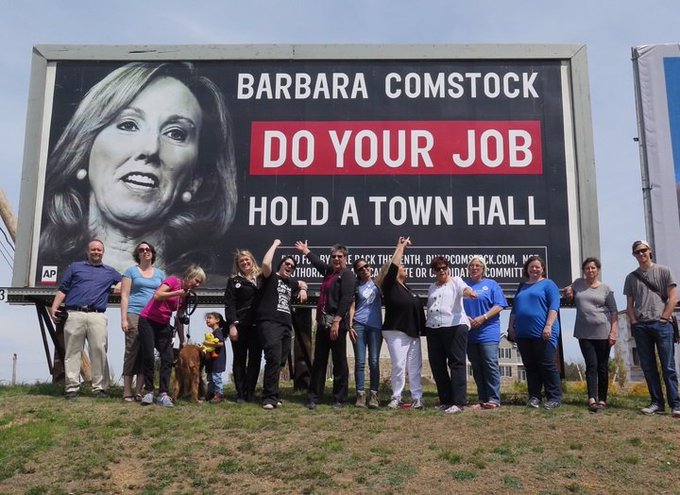
Much has been made of how Republicans, writ large (not universally, but a very large share) have been avoiding face-to-face encounters with their constituents — their massively frustrated, angry, scared constituents. In many places in the country, billboards have gone up questioning whether their Representative will ever show up to have an honest engagement with their constituents.
Missing members of Congress are even showing up up milk cartons.
A large share (a majority) of Americans
fear that @TeamTrump will cause damage to their lives — whether due to undermining health insurance, removing governmental services, hurting the economy …
Those few Republican Representatives showing up to speak in front of (semi-)unscripted town halls open to all citizens (rather than limited to core supporters) are being confronted with demands for truthful engagement on issues like these.
Jason Chaffetz had, several months ago, a very contentious town hall — not surprising considering that the GOP House Government Oversight Committee Chair is steadfast in his refusal to guide actual oversight of and investigation into the myriad of almost certain Constitutional and ethical violations by Donald Trump and all-too-many members of Team Trump. One of those moments, when a young girl questioned Chaffetz’s science denial. Her simple — evasively (at best) responded to — questions:
What are you doing to help protect our water and air for our generations and my kids’ generations?
Do you believe in science? I do.
Chaffetz isn’t alone in being ridiculed and roundly booed for his recklessly dangerous climate-science denial.
Rep. Mike Coffman faced angry liberals from his suburban district right outside of Denver on Wednesday night, asking about everything from climate change to single-payer health care.
On at least two occasions, [NJ Republican Leonard Lance] was drowned out by standing ovations for speakers urging Lance to fight climate change and GOP healthcare plans.
Much has been made of how Republicans, writ large (not universally, but a very large share) have been avoiding face-to-face encounters with their constituents — their massively frustrated, angry, scared constituents. In many places in the country, billboards have gone up questioning whether their Representative will ever show up to have an honest engagement with their constituents.
Have you seen Representative Barbara Comstock?
If so, please call her constituents who would like to talk with her.
Missing members of Congress are even showing up up milk cartons.
A large share (a majority) of Americans
fear that @TeamTrump will cause damage to their lives — whether due to undermining health insurance, removing governmental services, hurting the economy …
Those few Republican Representatives showing up to speak in front of (semi-)unscripted town halls open to all citizens (rather than limited to core supporters) are being confronted with demands for truthful engagement on issues like these.
Jason Chaffetz had, several months ago, a very contentious town hall — not surprising considering that the GOP House Government Oversight Committee Chair is steadfast in his refusal to guide actual oversight of and investigation into the myriad of almost certain Constitutional and ethical violations by Donald Trump and all-too-many members of Team Trump. One of those moments, when a young girl questioned Chaffetz’s science denial. Her simple — evasively (at best) responded to — questions:
What are you doing to help protect our water and air for our generations and my kids’ generations?Do you believe in science? I do.
Chaffetz isn’t alone in being ridiculed and roundly booed for his recklessly dangerous climate-science denial.
Rep. Mike Coffman faced angry liberals from his suburban district right outside of Denver on Wednesday night, asking about everything from climate change to single-payer health care.