“Almost heaven, West Virginia …” An anthem immediately recognizable to millions. Yet, an anthem under ever mounting threat. West Virginia, as with much of the world, faces a clear choice between an ever-dirtier fossil fuel path and moving toward a prosperous, climate friendly economy.
While this is a global challenge, in West Virginia the choices are quite stark and, well, quite immediate:
* Mountaintop removal (MTR)or
* Wind farms on the tops of mountain ridges and within valleys
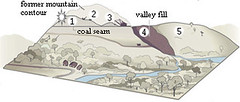
What is Mountain Top Removal?
MTR “has been called strip mining on steroids.” MTR is a path for getting at coal veins with the greatest ‘efficiency’ and cost-effectiveness. (That is, from the perspective of the company and totally ignoring ‘external’ costs not paid by the company.) MTR changes the very topography of the land and “should be more accurately named: mountain range removal. ”
That is, within a definition of “cost” that externalizes tremendous costs to others than the mining MTR “annihilates ecosystems, transforming some of the most biologically diverse temperate forests in the world into biologically barren moonscapes.” And, of course, in the pursuit of perpetuating a polluting energy system that is the major contributor to CO2 emissions and the poisoning of the planet.
Wind farms, however, seek to use those very mountain tops (and the valleys: in many cases, the best wind is actually within a valley/gap, as the wind rushes down what is, in essence, a funnel) to produce CO2 free energy. Pursue MTR and you are left not just with a devastated ecosystem that is less able to support future economic activity and not just with ever more coal pollution, but you have a terrain that is less conducive to renewable energy use.
We often hear about how coal mining is critical due to jobs. Well, West Virginia has seen coal-mining jobs fall from 120,000 to 15,000 due to automation. ANd, well, mountaintop removal really is designed quite specifically to take the miner out of the mine. You could say that it does the same thing to the job market that it does to the mountains.
The employment benefits of wind development as compared to coal mining are substantial for nearby communities. Development of a 229 turbine wind site on Coal River Mountain would directly create between 200 and 250 jobs per year for the first 2 years of construction and would support more than 50 permanent jobs in the area – potentially in perpetuity. Surface mining would directly create between 50 and 150 jobs per year for about 14 years while the mines were active, after which the land would be unsightly, unstable, and of little use for economic development in the forseeable future.
Clean energy … Cleaner air … more jobs … local revenue … and less impact on the natural environment …
At this time, there is a battle under way for defining West Virginia’s future. The Coal River Valley remains relatively pristine in the face of all of the MTR throughout West Virginia. Traditional fossil-fuel energy community and coal companies look at that pristine terrain and see “opportunity”. (Think, I must say, Once-Ler from Dr Seuss’ book The Lorax.) Yet, others look to this situation and see an opportunity to carve a new future for West Virginia and its citizens.
Rather than extracting coal and leaving behind devastated environment and devastated communities, these people see the opportunities for wind farms that will provide clean energy and a revenue stream for local communities for the indefinite future (both in terms of jobs building/maintaining the wind turbines and from royalties/payments for the generated electricity).
West Virginia, it citizens, its leaders seem to face a clear choice:
Quick, ‘easy’ profits to leave behind a devastated and flattened West Virginia that John Denver would never recognize;
An investment for the long-term that will enrich West Virginians, protect the environment (both local and global), and leave behind a terrain that would remain Almost Heaven …
From time-to-time, this is an item that merits reposting. Not because of my writing, but because of the importance of this one article andthe insights that Richard Smalley provides in it.
As we consider our energy future, figuring out a path through the stormy seas of Peak Oil, Peak Natural Gas, and, not least, Global Warming, there are ways to capture our challenges, to think about the problems ahead that are (at least to me) compelling.
Smalley, in just six short (okay, dense, single space) pages lays out the challenges and potential paths forward toward “future global energy prosperity”. Interesting, very interesting, even compelling material.
But, perhaps the most important part of this discussion is captured in just a few, short paragraphs.
September 5th, 2009 · Comments Off on Neanderthal or Cro-Magnon
When considering those fighting against a clean energy future, you have to wonder whether they are Neanderthal or have advanced to the stage meriting description as Cro-Magnon.
Meet Your Own Caveman, which might include Rep Frank Wolf (R-VA-11) or Rep John Shimkus (R-IL) or …
September 4th, 2009 · Comments Off on Playing with a hydrogen stockpile
A guest post from bklynarch highlighting the extent of the ‘worst case’ risk from frozen carbon.
It turns out we haven’t been playing with fire in regards to climate change, or even atom bombs…we’re playing with a hydrogen bomb stockpile. Because as we’re about to get serious about climate change, Earth is set to be still far less forgiving:
The vast amount of carbon stored in the arctic and boreal regions of the world is more than double that previously estimated…
These attacks have only the slightest veneer separating them from the ugliest racism which has already emerged in the same circles’ discussions of President Obama.
What is sad, when it comes to Van Jones, is that a huge percentage of Beck’s listeners might actually agree with a huge share of what Van says, would be able to find common ground, if Beck / Fox would actually provide an honest presentation of Jones … but honesty seems to have little association with their desires and their intent. Jones is actually a man interested in and capable of building bridges, interested in and capable of finding common ground for win-win solutions. Sadly, Glenn Beck and Fox News seem to have little concern for finding “win” solutions for Americans and America.
When confronting and seeing these foaming at the mouth attacks on Van Jones, I have a simple question to ask:
Would my children’s and my nation’s future be stronger with Van Jones having more authority or with Van disappearing from the scene?
The clear — the very clear — answer is that we would be better off if what Van has discussed and written about were actually executed. Green Jobs as a path to heal multiple challenges in society while increasing overall wealth while helping to reduce global warming challenges. There are few who have the ability to understand technical, social, legal, policy, and other challenges to achieving solutions and then to be able to communicate them eloquently. Van Jones is one of those few …
If we are lucky, if we are very lucky, Van Jones will go down as the Martin Luther King, Jr, of the 21st century. We can only hope that will be the case without the assassination and violence that the Becks and those of his ilk are inciting.
The question now is not if climate change will happen, but how much of a change do we want to allow and how quickly will those changes come? “Our destiny is really in our hands,” Karl explained. “The size of those impacts is significantly smaller with appropriate controls.”
September 2nd, 2009 · Comments Off on France to impose a carbon tax … and a debate explodes
The news in France: a 14 Euro (about $19.90 at current exchange rates) tax per ton of carbon to go into effect in 2010. While discussion of a carbon tax has been an item of debate within French society, Prime Minister Fillon’s announcement of the actual amount and the parameters of the coming have created what might be an explosive discussion.
In short, the parameters:
Tax on carbon sources, including oil (gasoline, diesel), natural gas, and coal.
Electricity is not included (considering that France is almost entirely ‘carbon light’ (nuclear 80+%, hydro, and some (growing) wind/solar), this is not surprising)
This is a revenue-neutral program, with reductions in other taxes to balance this revenue source.
Many details yet to be worked out/announced, such as how to deal with helping those less fortunate deal with the additional costs.
This is the first step of a tax that will be gradually increased and spread throughout the economy to help achieve French goals for a 75+% reduction in CO2 emissions by 2050.
On first glance, writ large, this looks to be a positive move, the type of revenue source rebalancing that should be pursued around the globe to help drive moves toward a low-carbon future.
Even so, while “positive”, this is causing debate with criticism coming from all directions.
A repost, with some minor changes, from something published a few years ago as I sip my way toward Labor Day …
Global Warming … some people, when praising the positive impact of Global Warming or by arguing that the warming is not out of line with history, will begin speaking about English wine production in the 12th Century. Others speak, with great concern, about how their favorite vintage is threatened. And, well, even though I love a great bottle of wine, it is has been hard to take this discussion seriously. Considering all the threats the globe faces, all the terrifying potential implications from Global Warming/the Climate Crisis, should we really care all that much about what goes into wine cellars? Maybe, however, there are other ways to look at the wine industry and Global Warming. Perhaps it isn’t just about swirling glasses in the Lives of the Rich and Famous, with chatting about ‘nose’ and ‘legs’ and …
Can the wine industry tell us something more about Global Warming?
We live in a “time of consequences.” We, as individuals and collectively, are setting the path which will determine the living conditions for millenia to come. This time of consequences is both long term and quite immediate.
This is true for the individual. Do you invest in an energy efficient future life? Will you unplug the computer before going to sleep?
And, it is true for society. What is the transportation infrastructure we want 30 years from now? And, what is the legislation that will emerge in coming weeks and months related to energy, farming, and Global Warming?
We live in a Time of Consequences. And, we can chose to live through this time, buffeted by the consequences, or we can seek to act to drive change in a positive direction.
September 1st, 2009 · Comments Off on The Most Deadly and Destructive Change
A Fish Out of Water struggles to survive, finding a path toward a safer environment. FishOutofWater is a thoughtful, engaged scientist, passionately struggling to help us find our way toward a prosperous, climate-friendly future. Here is a guest post focusing on what is happening with glaciers.
In climate change, drought, reduced water supplies and famine will affect billions of people. The global catastrophe is beginning on the high plateaus of the Andes, Tibet, and western north America. Disappearing alpine glaciers are threatening global water supplies. The “Water People” of the high antiplano of Bolivia are at ground zero of the drying. Rivers have slowed to a trickle and pastures have turned to dust bowls. Bolivia’s glaciers, the source of their rivers have melted to remnants.


 mounting threat. West Virginia, as with much of the world, faces a clear choice between an ever-dirtier fossil fuel path and moving toward a prosperous, climate friendly economy.
substantial for nearby communities. Development of a 229 turbine wind site on Coal River Mountain would directly create between 200 and 250 jobs per year for the first 2 years of construction and would support more than 50 permanent jobs in the area – potentially in perpetuity. Surface mining would directly create between 50 and 150 jobs per year for about 14 years while the mines were active, after which the land would be unsightly, unstable, and of little use for economic development in the forseeable future.
 out of line with history, will begin speaking about English wine production in the 12th Century. Others speak, with great concern, about how their favorite vintage is threatened. And, well, even though I love a great bottle of wine, it is has been hard to take this discussion seriously. Considering all the threats the globe faces, all the terrifying potential implications from Global Warming/the Climate Crisis, should we really care all that much about what goes into wine cellars?
 Maybe, however, there are other ways to look at the wine industry and Global Warming. Perhaps it isn’t just about swirling glasses in the Lives of the Rich and Famous, with chatting about ‘nose’ and ‘legs’ and …
 consequences is both long term and quite immediate.