November 18th, 2009 · Comments Off on “Me too! Me too! ME TOO!” Climate problem, climate solution
1 minute to save the world is a short film competition about climate change that has aimed to create a platform for people all over the world, particularly young people, to get their messages out about climate change and to put those messages directly to the global leaders and decision makers in Copenhagen in December. There were some 200 entrants from 40 different countries. These have been whittled down to 30 with award winners to be announced next Monday. Have to imagine that Me too will rank up there. This really resonates with, well, me.
I’ve played the above for a variety of kids and all of them have thought it great as a way to show how each, on our own, can help create big problems and that each of us, on our own, can help solve them. This suggest to me that this is a great public service item for TV networks around the globe.
The videos (well, at least winners) will be screened during the during the COP15 in Copenhagen next month as well as in the House of Commons in the UK. (And, there is rumored potential that the White House might do a viewing.)
“Cash for Caulkers” might just be the next talk of the nation as President Obama has heard, from multiple paths, proposals for another CfC program to help spark economic activity, create jobs, and help shift America’s energy patterns and practices toward a more sustainable future.
While off-and-on, there have been many programs for tax credits for home energy efficiency (right now, 30% of the bill up to $5000). These tax credits seem to work on the margins and still leave us with the reality that the average home is energy inefficient and that there are viable paths toward making significant dents in that inefficiency. Cash for Caulkers would seek to change this in a dramatic fashion.
And, it is something that President Obama is considering.
In the face of the reality that those percentages, the huge numbers represent very real trauma for far too many people, I applaud Senator Reid’s desire to focus on job creation.
The American Clean Energy & Security (ACES) Act, passed by the House earlier this year, contains energy efficiency and other investment elements that would drive job creation. The Kerry-Boxer bill, passed out of the Senate Environment & Public Works (EPW) Committee is entitled the Clean Energy Jobs and American Power Act for a reason: provision after provision would drive employment opportunities for American’s throughout the country.
Let us be clear, neither ACES nor CEJAP represent the best paths forward to seize the economic opportunities from tackling climate mitigation challenges. Even with their substantial (and real) flaws, they would help drive job creation while helping to turn the American economy away from its fossil-foolish ways.
The “political” reality seems clear: there is little prospect for a meaningful climate bill in the near (next few months) future to be passed by the US Congress.
In the face of soaring (and searing) unemployment numbers, the Congress will turn to some form of a jobs program.
Senator Reid, Representative Pelosi, and President Obama have smart and sound job creation options staring them in the face. Let us seize the very real opportunities that energy efficiency, clean energy, sustainable agriculture, and environmental remediation research and implementation have for sparking wide-spread, sizable, and sustainable employment. Let us, the US, move forward with a “jobs program” that doesn’t only put cash in wallets but helps foster a stronger and safer America via reducing our fossil-foolish addictions.
NOTE: There are many sizable opportunities out there. A meaningful green economy stimulus would include significantly increased funding for ‘greening America’s public schools’, a financing program for buying down mortgages based on building energy efficiency, electrification of America’s rail, and greatly expandied funding for energy research & development.
For example, financing Net Zero (& Lower Energy Demand) Building (see here) could be done on the basis of the Architecture 2030 developed The 2030 Challenge Stimulus Plan to create roughly nine million (yes, 9,000,000) jobs and several trillion dollars of building activity through a two-year, $192.47 billion program focused on using financial instruments to spark investment in energy efficiency in private buildings throughout the nation. Buildings account for roughly 40 percent of America’s greenhouse gas (GHG) emissions. This program would put a serious dent into that figure while skyrocketing the United States in a global leadership position in building energy efficiency.
Global warming deniers (self-proclaimed “skeptics”) are enthralled with cherry-picking data and screaming to high heaven every time there is a record cold temperature or some weather event that provides a good photo op for pimping falsehoods about global warming. Where’s my Global Warming, Dude?, for example, could be called a check-up spot for the weirdest COLD weather. Reading deceiving sites like that, one could believe that everywhere you turn, all the time, your most serious concern should be to make sure you have your winter parka firmly closed before you venture out into an-ever cooling planet. This systematic drumbeat of specific factual information (about a snowstorm here or a record cold temperature there or …) that totals up to less than truthiness is one of the angles of deception that undermine the general population’s ability to understand actual science and actual truth about what is going on with climate change.
A rough balance, between highs and lows, with perhaps some ‘see-sawing’ with colder and warmer periods.
A (slow?) decline in total records as it should, with more years of data, become harder to set either record highs or lows.
The data, as shown in the graph, throws these two expected results aside. There is no rough balance, with the data showing increasingly significant movement toward more record highs and fewer record lows.
The study also found that the two-to-one ratio across the country as a whole could be attributed more to a comparatively small number of record lows than to a large number of record highs. This indicates that much of the nation’s warming is occurring at night, when temperatures are dipping less often to record lows. This finding is consistent with years of climate model research showing that higher overnight lows should be expected with climate change.
Even amid the escalating trend of record high temperatures, there will be lots of events for cherry-picking deceivers to choose from to create a false impression a cooling globe.
Even in the first nine months of this year, when the United States cooled somewhat after a string of unusually warm years, the ratio of record daily high to record daily low temperatures was more than three to two.
Despite the increasing number of record highs, there will still be occasional periods of record cold, says Gerald Meehl, the lead author and a senior scientist at the National Center for Atmospheric Research (NCAR) notes.
“One of the messages of this study is that you still get cold days,” Meehl says. “Winter still comes. Even in a much warmer climate, we’re setting record low minimum temperatures on a few days each year. But the odds are shifting so there’s a much better chance of daily record highs instead of lows.”
With our ever mounting trade and budget deficits, unemployment above 10 percent (and, dependent on counting, un- and under-employment above 20 percent), looming peak oil and other resource (water, for example) limitations, enviornmental challenges, and ever-mounting climate chaos , we are in a very serious situation. Our serious challenges are, as the previous sentence suggests, a networked system-of-systems that interact and reinforce each other.
As we strive to stop digging the holes deeper and climb our way out, we can seek to deal with these challenges in a stove-piped manner or address them with W6 solutions that have wins across multiple arenas:
Support energy independence
Create and protect jobs
Foster economic activity (cost effectively)
Strengthen long-term economic prospects
Address negative environmental impacts (from local pollution to acidification of the oceans)
Help mitigate climate change
As some are wont to say, crises create opportunities. One good piece of news, amid all the serious concerns that that list above should create for all of us, is the reality that many Win-Win-Win-Win-Win-Win (Win to the Sixth) opportunities lie before us, if we choose to seize them.
We should acknowledge benefits to Sarah Palin’s continued prominence in American society and political discussion. If nothing else, Palin opening her mouth is a jobs program to keep fact checkers busy at work. Her truthiness-laden Going Rogue should have us all going rouge (red) faced with frustration at the her page-after-page liberties with truth and fact.
Let’s focus, for a brief moment, on some examples where Sarah “Energy Expert” Palin has played it fast and loose with issues related to energy and climate change.
Sarah has long championed Global Warming denial, even as her state is on the front lines of climate change and even though Palin’s hubby’s favorite activity is already facing negative impacts due to a warming globe. Thus, it is no surprise that Palin embraces false talking points on climate mitigation policies. On pages 390-391, Palin embraces debunked analysis to assert that climate legislation will hurt those lower on the economic spectrum even as analyses from such biased and partisan organizations like the Congressional Budget Office (CBO) have concluded that those lowest on the economic spectrum (the bottom 25%) will benefit economically from the (already too weak to gain all the potential benefits) Waxman-Markey American Clean Energy & Security Act that passed the House earlier this year.
Energy efficiency is perhaps the clearest no-brainer that should be embraced by all (except, perhaps, those who make their living selling as much energy (polluting or otherwise) as possible). “Negawatts” can provide additional power for a fraction of the cost of additional powerplants — not matter their type. Sadly, Alaskan buildings (especially private homes) have a deservedly atrocious reputation for energy inefficiency even in the face of the most brutal weather and with some of the highest energy prices Americans face. (There are many reasons for this, including an antiquated tax code that fosters foolish building practices: leaving siding (and thus insulation) off one side of a home can count it as ‘unfinished’ with lower real estate taxes for two years. At the end of two years, many owners don’t bother to then add that additional insulation/siding.) In rejecting $25 million in the stimulus package to help in energy efficiency, Palin falsely asserted that this money would drive national control of Alaska’s building code. Even though that error has been documented in the past, it is repeated yet again in Palin’s Going Rogue with the Truth.
PALIN: Describing her resistance to federal stimulus money, Palin describes Alaska as a practical, libertarian haven of independent Americans who don’t want ”help” from government busybodies.
THE FACTS: Alaska is also one of the states most dependent on federal subsidies, receiving much more assistance from Washington than it pays in federal taxes. A study for the nonpartisan Tax Foundation found that in 2005, the state received $1.84 for every dollar it sent to Washington.
So many in states heavily dependent on resources from the Federal government (e.g., from taxpayers in other states) scream anti-government rhetoric even while fattening themselves at the trough of federal assistance. And, in this case, the Tax Foundation actually understates the case significantly. Unlike elsewhere in the country, Alaskans are able to claim for themselves 100% of the revenue from resources extracted from federal lands in their state. The oil pumped in Alaska comes from wells on Federal, not state or private, lands for the most part. That $1500 or so annual royalty check distributed to Alaskans represents a huge additional subsidy. In fact, if done appropriately, on a per capita national basis, Alaskans would receive not $1500 or so but the same figure as all Americans, perhaps $2.50 to $3, depending on oil prices.
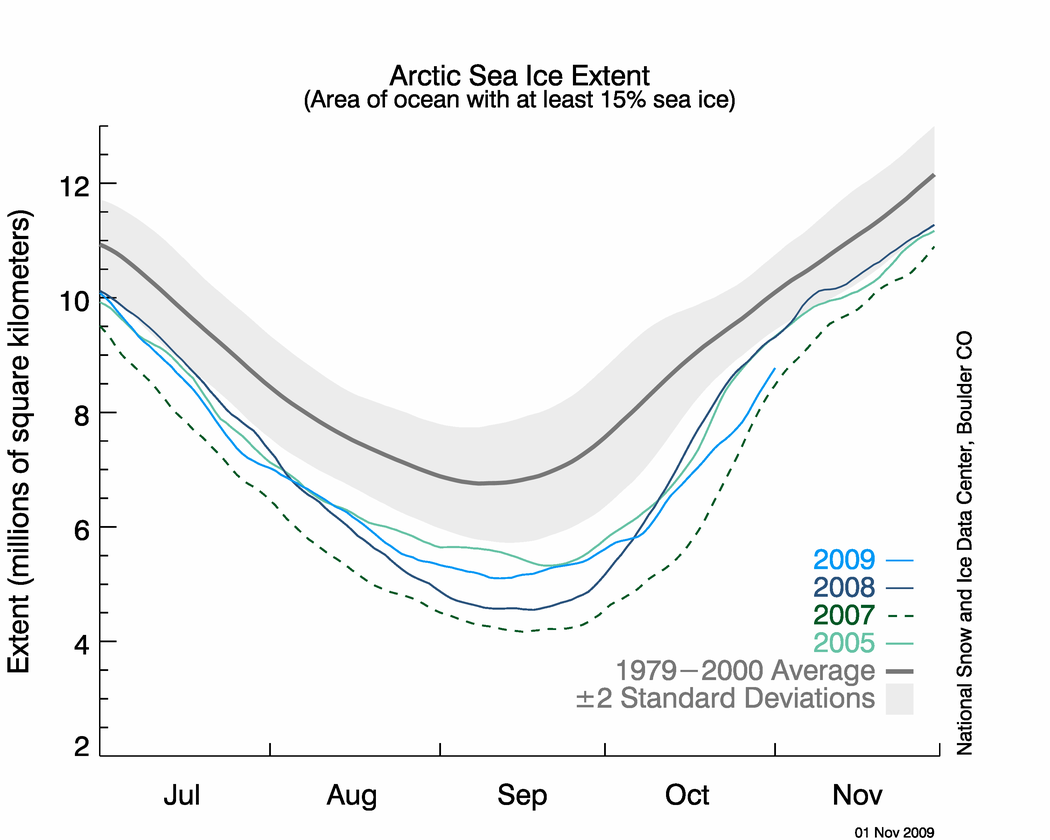
With his Will-ful Deceit, Will spun this distortion of scientific study on multiple levels: he wrote “now” with data tha was months old; the data did not show what he asserted; he wrote based on misreporting in a global warming denier site; the material was out-of-date when he wrote “now”; he wrote of area coverage but not total mass (it isn’t just the area coverage, but also how thick the ice is: what is the total ice) and he focused his points on global sea ice coverage (e.g., Arctic and Antarctic Ice) when the scientific community is prinicipally focused on Arctic ice as the ‘canary in the coal mine’ since Antarctic ice coverage is predicted to be more variable and disappear at a (far) slower rate than predicted with the Arctic.
Considering George’s deep fascination with reporting on ice coverage, should we expect a breathless Will reporting of the latest news from the Arctic?
Amid what Will (and too many other deniers) falsely state is an 11-year cooling period (due to 1998 being (perhaps) the hottest year on record for natural cycles coming on top of human-driven global warming), Arctic ice coverage (and mass) is now at a lower level than it was in the year of least ice coverage, 2007.
(See more robust chart, but without the November data, here.)
PS: In response to the title, the answer is certainly: NO! Will has no interest in engaging in truthful discussions to help educate the public and move the dialogue forward toward real solutions to real problems.
Since diving into the deep end when it comes to energy issues, almost every day sees new fascinating concepts, approaches, and technologies. Fascinating … exciting … even hope inspiring at times. And, as well, as the passion builds, so many of these are truly Energy COOL.
Now, there are many things to be done with existing school buildings (from putting in sky lights in gyms and making roofs high albedo (“cool roof”) or green roofs or renewable energy generation facilities (both solar thermal and solar electric) to better heating controls to …) even while it should be national policy that all new school structures should be on the leading (LEEDing?) edge of sustainable construction.
Amid all this is the reality that school systems around the country have become heavily dependent on temporary structures to handle students during renovations, fluctuating student populations, and/or provide a cheaper (up front) response to growing student populations than building new schools or expanding existing ones. Some 36 percent of America’s schools systems have nearly 400,000 “temporary” trailers deployed. Thus, it is far too typical to see ‘trailer parks’ eating up lawn space around American public schools. These trailers are, all too often, far from paragons of energy efficiency and environmental friendliness. Often poorly insulated, with inefficient heating/cooling systems, these trailers evidently have worse health care and student performance statistics than can be found with students sitting in regular classrooms just 10s of feet away.
Project FROG seeks to address this problem (or, perhaps more accurately, this opportunity for improvement). FROG stands for Flexible Response to Ongoing Growth.
There are several core elements to Project FROG’s approach:
Pre-Fab Manufacturing: Building elements are constructed basically via industrial lines, enabling greater productivity, less waste, and faster construction time on location.
Computer modeling: Whether of daylighting or water flow, upfront investment in understanding the entire site dynamics enables construction of a facility that will cost far less over time to maintain/operate while enabling better performance.
Integration of Sustainability and Performance: For example, daylighting is a core element for FROG projects. Whether in the office, factory, or school environment, study after study has shown improved performance and improved helath with increased daylighting and decreased artificial light.
Cost effectiveness: Due to the pre-fab approach, Project FROG facilities offer the opportunity for savings not just through operations but also (especially against construction) in the up-front acquisition costs.
Project FROG isn’t simply aimed at temporary facilities, as their basic philosophy of modular construction with high environmental and energy standards is applicable to a wide range of public construction requirements, from day care centers to bus stations to offices to …
“Better” buildings with energy efficiency, strong safety standards, and construction well above building code standards for safety and interior health.
“Greener” with recycled construction materials, near zero onsite waste, and 50% or lower life-cycle energy use compared to standard construction.
“Faster” due to computer aided design, module-based approach, and onsite assembly (rather than construction).
“Cheaper” to buy (asserting a 25-40% savings over traditional construction) with a 25-40% reduction in overall operating costs.
And, by the way, that is putting aside that students (and teachers) perform better in “green” schools, that greening buildings contributes to community health, and addressing building energy (and resource) inefficiency is an important tool for addressing our energy and climate challenges.
Right now, for students (and teachers) condemned to them, portable trailers are a blight on our educational landscape. Project FROG offers a path for cleaning up that blight and changing a social dynamic: rather than dreading assignment to a trailer, students (and teachers) might battle for the opportunity.
NOTE: This is a highly favorable discussion of Project FROG. Please recognize that I have not seen independent verification / auditing / verification of their claims. Project FROG was one of Building Green.com’s top 2009 products.
This guest post from B Amer provides one attendee’s perspective on a Bill McKibben speech.
As a part of a fundraiser for Ann Arbor’s Ecology Center at least 40,000 people (using Michelle Bachmann math) heard a great, sobering speech last night by the founder of 350.org, Bill McKibben.
I was fortunate enough to be there and have summarized the event below.
Having faced (almost literally) hellish conditions with record-breaking fires nearly beyond description, Australia’s first responders are organizing to help foster a stronger national response to Global Warming.


 NCAR scientists analyzed record high temperature and record low temperature data for the United States for the past60 years (using solely weather stations that have been active for the entire period). If the United States climate wasn’t changing in one direction, over time, writ large we should expect two things:
 , we are in a very serious situation. Our serious challenges are, as the previous sentence suggests, a networked system-of-systems that interact and reinforce each other.
 almost every day sees new fascinating concepts, approaches, and technologies. Fascinating … exciting … even hope inspiring at times. And, as well, as the passion builds, so many of these are truly
  to address this problem (or, perhaps more accurately, this opportunity for improvement). FROG stands for Flexible Response to Ongoing Growth.