January 15th, 2010 · Comments Off on The threat of an unknowing vote to destroy the planet …
Massachusetts voters face a stark choice this coming Tuesday when it comes to Cape Cod’s future viability and humanity’s future prospect. They face a stark choice that they, well, simply may not understand.
As the energy ratepayer advocate in Massachusetts, Martha Coakley has worked to keep energy prices down, including advocating for over $100 million dollars in savings, while promoting long-term policies designed for a cleaner, more efficient and less costly energy future.
Saved ratepayers over $100 million dollars and advocated for other ratepayer protections through litigation efforts at the state and federal level including successful opposition to numerous electric and gas rate increases for the customers of Bay State Gas, New England Gas, Fitchburg Electric, NSTAR and Western Massachusetts Electric and successful opposition to excessive incentives sought at FERC for interstate transmission projects over the life of these projects.
Reached a Settlement with NSTAR, the Union of Concerned Scientists and the Conservation Law Foundation for Long-Term Wind Contracts and Green Power that anchored the development of two 30 MW wind farms and provided an option for NSTAR’s customers to purchase renewable power for a portion or all of the energy portion of their bill.
Reached a Settlement with Western Massachusetts Electric Company for the development of the Commonwealth’s first utility grade solar project in the state that will result in the development of 6MW of solar power, developed at the least cost, in Western Massachusetts.
Pushed for reforms in New England’s multibillion dollar energy market and transmission planning process to ensure more transparency, more emphasis on costs and better access for ratepayer and consumer groups.
Forged a landmark agreement with the Patrick Administration establishing the most aggressive energy efficiency goals in the nation which will result in over a billion dollar investment in energy efficiency in the Commonwealth over the next three years with expected savings of over $4 billion.
Supported interstate transmission project to bring clean, cost effective hydro power from Quebec to Massachusetts customers that will be financed initially by private capital.
Secured important changes in state laws to provide for better oversight and regulation of utility companies including allowing the Attorney General to compel audits of utility books, closed loopholes in the state’s authority to review utility mergers and acquisitions and codified the Attorney General’s role in representing Massachusetts consumers before federal energy agencies.
Coakley has tangible and meaningful experience with using cap and trade activities for reducing carbon emissions, with her role in the northeast’s Regional Greenhouse Gas Initiative (RGGI).
Coakley’s white paper (Repowering America: A Comprehensive Energy Reform Plan (pdf)) is thoughtful, with a recognition that there is no single bullet solution. This Plan highlights the need for energy efficiency (aggressive/strict/strong standards/building codes), the need to incentivize renewable energy, and placing a price on carbon to foster an environment favoring “cost-effective long-term investments”.
On energy efficiency, for example, there is a solid page and half discussion that highlights Coakley’s role in Massachusett’s “three-year energy efficiency plan” that will reduce electricity demand by 2.4%, natural gas demand by 1.2%, and same consumers over $4 billion. As the plan, correctly, notes:
Investments in cost-effective energy efficiency represent the quickest and least expensive way to mitigate our country’s growing energy demand. Cost-effective energy efficiency measures are much less expensive than investments in new energy infrastructure – typically efficiency investments cost roughly 3 cents per kWh saved while electricity supply fluctuates but can cost up to 12 cents per kWh. For every dollar invested in energy efficiency, consumers can expect over three dollars in savings.
With this knowledge and experience, Coakley places energy efficiency at the core of her concepts, with tangible items as to how to make energy efficiency (which is so often ‘the right choice’ and should be ‘the first choice’) a more viable option for America and Americans in the creation of a more prosperous future.
Similar substantive discussions are there on renewable energy, electricity transmission, cleaner transportation, and how to help low-income Americans reduce their energy costs.
Substantive, sensible concepts that can enrich America (and Americans) while helping to turn the tide on Global Warming’s rising seas.
Republican candidate Scott Brown, on the other hand, should receive some sort of award for being a (serious?) candidate for Federal Office with a near absence of substantive statements as to policy issues. Here is Brown’s policy page, notable for its brevity, lack of substance, and use of code-words / deceptive information. Here is the entirety of the energy / environment discussion:
Energy and Environment
I support common-sense environment policy that will help to reduce pollution and preserve our precious open spaces. I realize that without action now, future generations will be left to clean up the mess we leave. In order to reduce our dependence on foreign oil, I support reasonable and appropriate development of alternative energy sources such as wind, solar, nuclear, geothermal and improved hydroelectric facilities. I oppose a national cap and trade program because of the higher costs that families and businesses would incur.
“common-sense …. reasonable and appropriate …” Wow, who can argue against such thoughtful position as this. However, from this paragraph, let us focus on one item for a moment:
In order to reduce our dependence on foreign oil, I support reasonable and appropriate development of alternative energy sources such as wind, solar, nuclear, geothermal and improved hydroelectric facilities.
What is notable about Brown’s statement? Every single one of these “alternative energy sources” is essentially irrelevant to efforts “to reduce our dependence on foreign oil”. Oil is used for transportation, not electricity generation. All of these renewables are electricity generation paths.
Thus, not only does Scott Brown provide the public an incredibly brief and shallow statement on policy, but that statement shows a fundamental lack of understanding of the arena (that oil and electricity, like oil and water, basically don’t mix) and a willingness to embrace falsehoods about core policy issues.
Mad as hell …
Massachusetts voters, as with many Americans, are frustrated, are “mad as hell”, seeing massive Wall Street bonuses while Main Street suffers, struggling to make mortgage payments, concerned about their and their children’s future. Into this space, into this frustration, waltz demagogues wrapping themselves in that emotional whirlwind, seeming to promise change while, fundamentally, providing a path embracing the policies that have dug the huge hole(s) we are struggling to emerge from.
When it comes to energy and environment, Martha Coakley has offered sensible substance that can help solve problems while Scott Brown has offered up mindless pablum that would help dig the hole deeper.
We have to wonder whether the voters of Massachusetts realize that they face such a stark choice when it comes to energy security (and the future habitability of Cape Cod).
This guest post from Matt Dernoga provides a perspective on how he and his colleagues / compatriots at UMD for Clean Energy took effective steps in the media/messaging world and how they leveraged student passion to change the community’s politics.
Who said anything about qualifications?
I never thought I’d be writing a piece on media and messaging.
I’m a government major at the University of Maryland going into my final semester as an undergraduate. I’m looking to further my education with a masters in public policy with a specialization in environmental policy. In the student activist group UMD for Clean Energy that I’ve been involved in since the spring semester of 2007, I’ve been the boots on the ground guy getting petition signatures and power vote pledges, the Political Liaison who handled the policy aspects of the campaign like organizing lobby meetings, and last fall I had my first stint as the Campaign Director for the group. Despite my responsibility never being media and messaging, it’s in this area that I feel I’ve learned some of the most valuable organizing lessons.
When applied to our group’s efforts last semester, our new approach to media became one of the most powerful engines for our local campaign on making green issues front and center in our College Park City Council elections, and complimented all of the other aspects of our campaign beautifully. At the end of the semester, core members of UMD for Clean Energy tried to put our finger on how and why media had been invaluable to our campaign, but usually our guesses didn’t go beyond “wow”. This is my imperfect yet necessary attempt to explain what happened, with the hope that other groups can gain from it, and at least so I can convey how important this aspect of the youth climate movement is. By the way, I’ve committed the cardinal sin of making this a longggg post, but it’s worth it so please read. [Read more →]
Alaska has been called the poster state for global warming. Winter temperatures have already risen 6 degrees. Sea ice that protects coastal villages from winter storms forms a week later than it used to. Forests are under siege from wildfires and insects. Melting permafrost is shifting foundations of homes and drying up lakes. And the state’s symbol, the polar bear, is seeing its habitat literally vanish from under its feet.
Which is why it’s so unbelievable that Sen. Lisa Murkowski (R-AK) would be leading an effort to block limits on global warming pollution
Vice President Al Gore sent out a message, via RePower America, highlighting the seriousness of this effort.
It’s an outrage. 2010 should start in a way that reflects our movement’s amazing accomplishments from last year — moving the ball forward to passage of comprehensive clean energy and climate legislation. Instead, our elected leaders are proposing policies that would set us back decades and let the worst polluters completely off the hook.
Despite the chorus of alarm bells sounding the need to address the climate crisis and stop polluting the air our families breathe and the water we drink, Alaska Senator Lisa Murkowski and her allies are attacking the Clean Air Act — for the second time in six months.
…
In 2010, our movement to solve the climate crisis will face its biggest test yet — passing comprehensive clean energy and climate legislation. But if Senator Murkowski‘s amendment passes, some in Congress will use it as an excuse to keep stalling — and the long overdue promise of progress toward a 21st century clean energy economy will be lost.
The Vice President called on people to contact their Senators, calling for defense of the Clean Air Act. My note to my Senators:
The Clean Air Act has been one of the most successful legislative achievements in protecting our health and our environment. I remember days where I could barely see across an Appalachia valley due to smog. The vistas are now much better. And, the CAA has successfully improved the health of Americans by reducing the risks of smog and other pollutants.
Excessive human CO2 emissions are perhaps the most serious threat to the future strength, security, and prosperity of America and Americans. Scientific research conclusively supports this conclusion. The Supreme Court, a conservative Supreme Court, has determined that the EPA is required to act on CO2 under the CAA. I urge you to support strengthening the CAA and to stand, firmly, in defense of the EPA’s ability to begin the control of harmful carbon pollution under CAA guidelines.
As part of the effort to highlight Murkowski’s effort to strip authorities from one of the nation’s most cost-effective laws protecting the nation’s health, message after message has been sent to Senator Murkowski via Twitter calling out her efforts to foster increased pollution and undermine our national ability to control our destiny outside the control of polluter-friendly financial interests. Some recent comments to Twit Lisa:
Only thing that is “totally bogus” is @LisaMurkowski’s questionable relationship with coal lobbyists http://bit.ly/7byUht (PolluterWatch)
Don’t let @lisamurkowski put our natural world in danger. Support the EPA: http://bit.ly/4rfX5o #cleanair (Ed Russell)
I just told my Senators to vote no on the @LisaMurkowski dirty air act. Join me: http://bit.ly/60gz7T (A Siegel and hundreds of others …)
There are many other groups and organizations mounting up efforts to bring visibility and pressure on this. For example, MoveOn
A new sneak attack in the Senate could block much of the progress President Obama’s made on global warming and force him to adopt President Bush’s climate policy. … an oil-state Republican senator has arranged a vote next week to block the Clean Air Act–and we could lose. That would be a crippling blow to progress on climate and clean energy. We can’t let that happen.
We can’t let polluting industries lock us in to several more years of dirty fossil fuels. We need to be moving forward with strong policies to stop global warming and kickstart an energy revolution. Write to your Senator now and urge them to vote against Murkowski’s big polluter amendment.
It seems somewhat odd that the Senate leadership allowed this amendment to move forward as
We will never know whether the $50,000 contributed to Sen. Murkowski’s campaign by two of Jeff Holmstead’s energy clients is the sole reason she allowed him to help craft legislation, but surely, the money helped smooth the way. This is the sort of pay-to-play politics that makes Americans so suspicious of our elected leaders.
Have to say that I thought that I’d heard the extreme end of coal ash disposal concepts with the desire to spread it on agricultural lands, but sprinkling on the morning Fruit Loops sets a new low bar.
It is cold in my backyard, therefore global warming isn’t real.
It is that sort of quite natural human (ego-centric) perspective that contributes to the difficulty that many face in comprehending climate change / Global Warming. Of course, this difficulty is exacerbated by those who actively distort, seeking to emphasize “cold” records while failing to discuss “hot” records.
Even honest and truthful reporting can lead to confusion, remembering that far too many people have a hard time looking past what they can see from their front porch (even if they can another country from that porch …). We find it hard, in part, to comprehend something as large (and, by human terms, gradual) as climate change for, among other reasons,
Our own eyes: we live in our spaces, our own ‘environments’. “We are not born with global vision or a sense of history.”
We tend to focus “on contemporary local concerns”. Our evolution works against the long time frame as “humans did not need to know what the local climate would be like a century into the future” as “they were much more concerned with the necessities of the here and now, and had little time or inclination to ponder the abstract world.”
This tendency for “its cold here” to lead to a raft of climate skepticism creates sensitivity. Thus, reading something like this raises hackles even as it is true and basically truthful information
By the end of the weekend, 180 million Americans may shiver through record-setting cold. Sixty percent of Americans will see and feel temperatures 15 to 30 degrees below normal.
The unyielding cold spell gripping much of the nation was expected to hang on tight over the weekend, though some areas that saw snowfall during the week were expected to have drier weather.
And the big picture? By the end of the weekend, 180 million Americans may shiver through record-setting cold. Sixty percent of Americans will see and feel temperatures 15 to 30 degrees below normal.
This accurate material and clearly of interest to those freezing their butts off with more snow and ice than normal.
This article, this description begs a question: What, however, is “the big picture”?
Again, there is a ‘framing’ problem in discussing Climate Change: the “its cold in my backyard, how can the globe be warming …” type discussions.
And, as we’re aware, US culture is incredibly inward-looking.
Thus, “record-setting cold” in the US has a subtext, for many Americans, “Global Warming is likely BS”.
It isn’t just that a location / area (the United States) or an isolated time period (today) isn’t necessarily representative of a global phenomena occuring over time (Global Warming / climate change).
Temperature records were seen across Bulgaria on the first day of the new year, marking the second day in a row with unusually warm weather, the National Institute of Meteorology and Hydrology (NIMH) announced on January 1.
Thermometers soared to 22,4 centigrade in the Northern town of Veliko Tarnovo, an absolute record for the season. It was also hot in Varna, Burgas, Ahtopol, Blagoevgrad, Dragoman, which saw temperatures ranging between 17-22 centigrade. In the capital Sofia the mercury zoomed to 17,3 centigrade, beating the record from 1971 when it reached 16 centigrade.
Another record high temperature was reached at the Luis Muñoz Marin International Airport in San Juan on January 5th, 2010. At 1:29 pm, the temperature reached 89F, which tied the record high temperature for January 5th, set back in 1980. This marks the third record high temperature of the new year in San Juan, PR.
The “bigger picture”, at least when it comes to climate change, doesn’t stop at the border and doesn’t encompass just one weekend.
Update: For another view at the current weather, see Lou Grinzo, Cost of Energy, The Artic Oscillation, Again. And, see the red zones in the graphic below: Greenland at 50 degrees in January with the rest of the Arctic ‘red’ while the US, Europe, and much of northern Asia are ‘blue’.
Economy versus the Environment. This is a slogan for many when they consider the challenges of dealing with Climate Change and the reduction of greenhouse gas (GHG) emissions.
In 2007, McKinsey issued Reducing US Greenhouse Gas Emissions: How Much at What Cost? that provided a a significant contribution to this discussion. McKinsey’s conclusion: at an “affordable” cost of well below $50 per ton, in aggregate, the United States can meet necessary 2030 targets for GHG emission reductions. All-in-all, this was quite good news for those advocating acting to deal with Climate Change.
There was (and is) reason why the original study and McKinsey’s continuing work in this arena have been widely discussed / cited over the past two years. And, variants of the graphic on cost abatement have shown up in briefing after briefing, article after article, book after book.
Good news. Or, well, is it?
McKinsey’s work provides significant data that addressing the Environment will have Economic cost. Even if a low number, with many actions providing economic benefit, the McKinsey work has a serious underlying thematic: it will cost to address climate change. Perhaps not a horribly painful cost, but a cost nonetheless.
While the McKinsey reports (and, again, the broadly used graphics) demonstrate that we can achieve a substantial portion of the necessary carbon reductions at a net positive for the economy, their discussions and representations leave this as a discussion of “cost” to take action, even if a far lower cost than self-proclaimed “climate skeptics” and others working to hinder a move toward a clean energy economy would claim.
Is this, that action on reducing carbon will “cost”, truly an accurate conclusion to draw from McKinsey report?
“The project … did not examine economy-wide effects … Did not attempt to address other societal benefits from abatement efforts, such as improved public health from reducing atmospheric pollution or improving national security. …”
In other words, this is a highly conservative and stove-piped analysis. The conservative approach almost certainly significantly overstates the costs for Global Warming abatement while potentially just as significantly understating the benefits of system-of-system interactions.
Lets take just a few examples of how this stove-piping might have distorted the end results:
Putting a white or green roof saves energy costs on a building, but it also reduces the urban heat island impact and has a multiplicative impact as it reduces cooling requirements in the surrounding area thus leading to lowered heat output from other buildings’ air conditioning systems driving down the demands on the ‘white roof’ building. And, this is a ‘positive feedback’: if a group of buildings ‘goes white’, every building owner gains even more due to the reduced ambient temperature lowering air conditioning demand and improving efficiency of cooling systems. Shouldn’t such ‘positive feedbacks’ be part of the equation for considering costs?
In other words, the national security and trade balance and health and jobs and other benefits that McKinsey seems to have excluded from the analysis likely make the net result from addressing Climate Change a positive benefit, rather than a negative cost, for the economy.
There is yet an even greater ‘uncounted’ element that tips the scale from “cost” to “benefit”: the ‘insurance’ value of mitigation efforts reducing the future impacts of catastrophic climate chaos. While humanity already faces real economic (and other) impacts from climate change and those will grow more significant in coming years, mitigation efforts offer the potential for reducing future impacts and future costs. This, however, is yet again explicitly not part of McKinsey work:
The project did not attempt to assess the benefits to society from reducing global warming.
When one begins to assess the myriad of direct and indirect benefits excluded from the McKinsey work, their conclusion that we can successfully take action to mitigate climate change for costs below $50 per ton of carbon begins to look quite pessimistic. Counting in that ‘insurance value’ and the benefits of reducing climate change impacts, the famous graphic begins to look like a dire doom & gloom scenario.
Farmer Cliff Etheredge provides his perspective on the community’s change with wind development.
It’s a 180-degree attitude change in our culture around here cause we’ve always cussed the wind. The wind had been so terrible, so hard on our crops, we’re now able to sell the wind. We don’t own the wind, we owned the rights to the wind and it costs nothing.
And, unlike oil and gas, we’ve got an endless supply.
A tangible example of the realities of how clean energy developments changed a community for the better.
Our horizons have changed.
The windmills aren’t only generating electricity and making money and doing all those green things, they’re a symbol of progress. An effort to clean up our act. … really the feeling that maybe we did something right.
The rapacious polluters in the coal industry are celebrating. The approval of a new permit for a mountaintop removal mine in West Virginia by the Environmental Protection Agency was music to their ears.
NEW YORK (MarketWatch) — Coal stocks have heated up this week as a big cold snap in the U.S. fueled hopes for greater demand and the U.S. government appeared to shift to a more accommodating regulatory stand on mountaintop mining.
The Dow Jones U.S. Coal Total Stock Market Index is up 13% so far this week, while coal futures touched 11-month highs.
“The scientific evidence of the severe environmental and human impacts from mountaintop mining is strong and irrefutable,” says lead author Dr. Margaret Palmer of the University of Maryland Center for Environmental Science. “Its impacts are pervasive and long lasting and there is no evidence that any mitigation practices successfully reverse the damage it causes.”
the most amazing part of all this—and clearly the scientists are amazed as well—is the fact that there’s never been a comprehensive assessment of MTR impacts before. We’re blowing up mountains and we have no idea what the consequences are! The mind boggles. It’s like the whole country is just discovering Appalachia.
Of course, just yesterday the EPA issued a permit for a MTR site.
It’s snowing in my backyard, the winter coats are out, and it is great to sit in front of the fireplace. Therefore, isolated looks at cold weather ‘proves’ that global warming is a hoax. Right … Of course not.
Senior climatologist Dean Collins said the average for the decade — about 22.3 degrees Celsius (72.1 Fahrenheit) — was 0.48 degrees Celsius (0.89 F) above Australia’s 1961-1990 benchmark average and an indication of man-made global warming.
“For the past six decades, each decade has been warmer than the preceding one,” Collins told AFP.
“To get six, seven decades in a row that are warmer than the previous one — it doesn’t happen by chance. It’s reflecting what’s happening at the global level.”
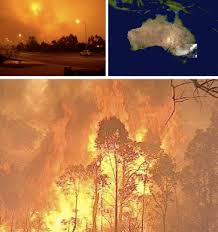
In 2009, Australia suffered three record setting heat waves, including massive firestorms described as Hell in all its Fury.
It looks, by the way, that Australian data is much like America’s when it comes to record temperatures over the decades:
“Based on the analysis of daily (maximum and minimum) temperature data above and below set thresholds, there are clear upward trends in the number of hot events and downward trends in the number of cold events (over the period 1960 to date), consistent with the background of global warming,”



 that
that 


 been warmer than the preceding one,” Collins told AFP.