January 31st, 2020 · Comments Off on Beware of shiny objects: Examples from (Dominion) Virginia Electric School Bus discussions
The Commonwealth is en route to what might well be a game-changing electric school bus (ESB) program. Through creation of a large and long term program (somewhere in the range of 10-15,000 school buses over a decade), Virginia’s ESB acquisition could be the key project to drive down acquisition costs and thus accelerate moves from diesel to electric buses across the country with serious health, educational performance, energy resiliency, environmental, and economic benefit streams.
Key points
Going electric with school buses is now a ‘no-brainer’ smart move
There are huge, complex, intertwined ESB value streams
ESB discussions can be caught up in (sometimes irrelevant) details which make focusing on the huge value streams harder.
“We’ poorly understand this complexity.
Virginia (the legislator, school systems, the Governor, Dominion Power) should
move forward with ESB deployment with
a structure that enables future ‘course corrections’
create a path for better defining and understand ESB value streams
to support improving ESB deployment to support and reward stakeholders in an equitable and effective manner.
January 24th, 2020 · Comments Off on Thinking about Virginia legislature and (Dominion) Electric School Bus legislation
Between a Dominion Power Electric School Bus (ESB) project and Governor Northam ESB demonstration programs, Virginia is on the cusp of becoming the national leader of ESB adoption and, through a major acquisition program, could change the game nationally when it comes ESBs and, potentially, government investment in electrifying large vehicle fleets. There are, at this time, at least two ESB bills in the Virginia legislature. One, from Delegate Kaye Kory, essentially legislates the Dominion program. The other (HB1140), from Delegate Mark Keam, would expand ESBs across the Commonwealth, foster prioritizing community (rather than solely utility) value streams in ESB investments, and mandate 100% ESBs by 2030. Considering that transitioning 15,000 or so diesel school buses to electricity will provide, perhaps, $10s of billions in return and value for Virginia, involve $2-$5B in investment along with $Bs in additional government expenditures, and literally have impacts on Virginia and Virginians for decades to come, it is understandable that people have questions and uncertainties about ESBs, these pieces of legislation, and how to move forward.
As someone with a long history interested in and promoting electrification of school buses (until a few years ago, Plug-In Hybrid Electric School Buses (PHESBs) and now, with a strong technological and business case, ESBs), I have received in questions from some trying to better understand and influence Virginia legislature ESB options and actions. Below is based on one such interaction.
About ESBs: Some things to remember/consider
A critical thing to keep in mind is that ESBs have / will have a huge range of benefit streams. And, calculating and understanding the systems-of-systems benefits and value streams of multi-solving paths is a complicated challenge and, I would assert, poorly understood as Virginia moves forward toward a market-leading, decade+-long, multi-billion dollar (set of) ESB program(s).
Trying to place a true “value” on an ESB program is hard because, when it comes to value and cost streams, some are
Relatively straightforward to monetize/calculate in spreadsheets
Savings/cash value streams:
significantly reduced fuel costs,
reduced maintenance costs,
arbitrage
using the batteries to shift time of electrons to enable using move cheap electrons to peak demand periods,
grid stabilization,
demand management
reducing peak energy demands by drawing down batteries rather than buying high-cost electricity
Costs
Additional capital cost for buying buses (key: battery) and V2G (vehicle-to-grid) equipment and costs to retrain maintenance staff.
Resilience/emergency power value to provide power amid grid disruptions;
Reduced diesel pollution
w/commensurate reductions in health impacts to children and larger community
environmental benefits
reduced impact on flora/fauna
reduced climate change pollution
Note: this is relatively straightforward to include in a cost-benefit equation but requires a choice to include a social cost of carbon (SCC) in decision-making and to agree on that SCC value.
Potentially major (potentially much higher than above) value streams that are difficult to calculate with confidence and even harder to get ‘green-eye shades’ to include in calculations
Such as better performing students
not just due to reduced asthma but also quieter, more comfortable rides on better performing buses
Improving student performance has an economic value in near, mid, and long terms
And, there are even more.
For example, a straight-forward to calculate and powerful in decision-making element doesn’t even seem to be on the table: economic development.
An Economic Development Opportunity
With establishment of a market-creating over 10,000 ESB program, Virginia would be in a strong position to require a significant portion of the manufacturing (and development) be located in Virginia. Consider, back-of-the-envelope, that this leads to 2,000 ESBs per year by 2025 (half for Virginia, the other half for other states/markets). That would be in the range of $300 million per year just in bus procurement that would mean, using basic manufacturing economic multiplier figures, about $700 million in total economic activity. Considering how many 1,000s of well-paying, quality jobs that would mean for Virginians if the legislature would require ESB manufacturing (in whole or large part) be located in Virginia.
To be clear, Dominion’s proposed project is large enough that it will be market creating and potentially shaping. As a major ‘ground-breaking’ project, potentially, that will introduce the first serious ‘economies of scale’ potential, the project will drive down prices (just as, for example, Germany did with solar) for others. This will be a multi-billion dollar purchase program where Virginia and Virginians will be paying more today to drive down the costs for others tomorrow. With that in mind, lease explain to me why Virginia shouldn’t require significant work content w/in the Commonwealth (such as in SW VA for manufacturing and investments in Virginia universities for R&D)? A back-of-the-envelope suggests that this well could lead to over 4000 good-paying manufacturing/engineering jobs that a well-structured program could secure over the next 3-5 years.
Thus, don’t let leaves (or even trees) make you lose sight of the forest
With the above in mind, something that I have been striving to get politicians (school board members, delegates, …) and activists to understand — the battery usage and value streams from electricity arbitrage are only one (and relatively small) portion of the overall value stream. It is critical to understand and seek to assess all the varying value streams as part of an overall ‘deal’ as to how the compensation structures can/should occur.
For example, many are hung up on whether Dominion ‘will profit’ by moving electrons to and from ESB batteries. While it appears that Dominion will own/control (with some constraints) the batteries and usage for the grid and secure the value from time arbitrage from time-shifting electrons, it is not as if (it should not be that) they will double-charge for electricity. They fill the battery, charging for the fill, draw it down, and then refill. If they gain the value from the draw down and, then, recharge for the refill: in essence double-charging for the electrons, this would seem to be a real problem (and near fraudulent). I can’t imagine that that is within the structure of the program in part because this is the ‘shiny object’ issue that too many are focused on.
Now, concerning is — of course — that Dominion will be allowed to include this in the ratepayer base with a guaranteed 9-10% ROI on their capital investment. That percentage guaranteed return simply is not justified, at this time, by market conditions. Consider, for example, Dominion’s cost of money. It appears to be less than 3%. Having an over 9% guarantee ROI when the price of money is less than 1/3rd that is not justifiable. Perhaps Dominion’s ESB investment would best be considered ‘an investment’ without such a guaranteed return or, well, perhaps generously (to Dominion) allowing Dominion to do a direct payback of its investment and investment costs. Think about the value streams/structures that Dominion is creating for itself via an ESB program:
Increased electricity sales
Time arbitrage using the battery
Peak/Demand shaving using batteries
Grid stability
Frequency stabilization
Capital investment (CAPEX) and program costs that will be added to ratepayer base (guaranteed >9% return on investment)
Considering the other profit/value streams, ‘explain to me’ why that addition to ratepayer base makes sense … or, well, at the full ROI. However, without calculating/having a window on all those value streams, it is hard to do a full/honest assessment.
Trying to Black Box Dominion Planning
What Dominion could well be doing is driving an ESB program that will lead to additional excess (or, well, extremely high) profitability:
Being inefficient in the procurement process to increase CAPEX
and thus having a higher CAPEX for a guaranteed return
Inserting itself as part owner/otherwise within the procurement structure to boost profitability
What I fear (and certainly expect) Dominion is / will be doing
Using the ‘pilot’ project as a wedge (with having lobbyist written legislation ) to create a reality that will be difficult/to impossible to change
Consider: The Fairfax County Public Schools (FCPS) has a huge bus fleet. If FCPS Facilities were signing a contract to replace all of their 1500 diesel school buses, there would (or, well, should) be significant attention to contract details with much ‘what if’ type thinking. FCPS is getting eight ESBs from the Dominion ESB pilot program. With getting eight buses in a ‘pilot’ program, will FCPS lawyers, staff, and leadership pay as much attention to contract negotiation ‘what if’ issues as they would with a 1500 bus program? And, if/when there is a large program, will the pilot program have created a ‘reality’ that shapes/structures the contract terms for that larger program?
Creating essentially unsurmountable barriers to competition (Dominion Power could ‘certify’, for example, a specific V2G (vehicle-to-grid) system and then make it extremely difficult for any entity to come in with an alternative / competing system that might, otherwise, be more economically attractive?).
Some questions/responses
Now, with all that in mind, below are four questions/concerns that were sent to me and first-order thoughts on them:
1. The schools wouldn’t own the buses. That’s a big problem, because Dominion could then change the parameters of the program or otherwise prevent schools from controlling the buses as they see fit.
While there are plenty of private firms that provide busing, on contract, for public school systems, that is not the case with the Virginia school systems. Why should Dominion own the buses unless they are doing the entire contract structure to take-over all of the transportation (or, well, all the maintenance/etc …).
But, a more simple approach: you want to own the buses, Dominion, you pay 100% (not just the electric cost increase) of bus acquisition costs. Re ‘change the parameters’/etc, that is the importance of writing good contracts and the problem of having the ‘pilot’ creating a reality that will be that much harder to modify contract conditions down the pike.
2. The buses will act like batteries during off-use, and Dominion can draw down that power as needed, but the schools aren’t compensated for that energy. Seems pretty unfair to me when it could be used to save schools money.
Again, this is just one of many value streams — and, well, far lower in value than improved student health/etc. The ESBs will be much lower operating costs (electricity and not diesel; more straightforward maintenance; etc ..). I strongly recommend that you/we do not focus on this in isolation of understanding/considering all value streams.
Honestly, if I were at Dominion, I would welcome having this as a ‘battle space’ and then, perhaps, come to some deal that ‘splits’ the value stream from time arbitrage of electrons since it draws attention from so many other issue spaces.
3. Schools would be charged for the difference between the cost of a regular bus and an electric bus. You may want to push for ratepayers to pick up the whole tab, or else the costs will be passed onto school districts.
First, see #1: if Dominion is going to own the buses, then Dominion should pay for them.
Second, the O&M savings (operations & maintenance) and other benefit streams are quite real. Dominion Power (or some financier or some Virginia government program) picking up this upfront cost difference makes it far easier for schools systems to go electric with new buses. Now, if we want to start retiring diesel buses early, having Dominion pay 100% of acquisition costs becomes very interesting.
4. Dominion would earn a profit on these buses. That’s up for debate whether that’s fair or not, but you could put those costs into the fuel factor cost so that Dominion isn’t making a profit on it. I recommend that to protect the other ratepayers who are picking up the tab for this program, but good people can disagree on that.
January 16th, 2020 · Comments Off on Dominion Energy ESB (Electric School Bus) Program advances: questions remain
Electrify Everything
Clean up the grid
These two bullets are a core mantra for those concerned with addressing climate change. Some simple truth:
The power (electricity) sector is, writ large, getting cleaner every day (with significant and potentially accelerating renewable energy growth) while liquid fossil fuels are, writ large, getting dirtier (as easy to get to deposits are an ever-lower share of production with every passing year).
Writ large, in the global energy system, there has been a stark separation between fixed infrastructure and transportation energy. The first has been open to multiple options and change, the second relative fixed to the burning of fossil fuels (from the introduction of coal into shipping through jet fuel today). This, however, is rapidly changing with electric vehicles of all sorts — cars, trucks, ships, aircraft — entering into the market.
Thus, the power (electricity) sector provides a clearer and easier path to lower pollution impacts than other, ‘tougher’ energy domains. And, if we can electrify sectors/areas of the economy that are dominated (today) by liquid fuels, we ease the path toward reducing the climate (and other pollution) impacts of those sectors.
Virginia — for political, economic, social reasons — is on the cusp of seeing this combination play out in a serious way.
The new Democratic-controlled legislature is considering a range of legislation to move Virginia toward a more resilient, cost-effective, and clean electricity system. While whatever measures pass will be unlikely to be ‘enough’ to address the climate challenge and less than what seems reasonably viable, there will be many steps forward and improvements that will likely include measures for increased distributed solar, greater energy efficiency, and the Commonwealth’s first-ever mandated renewable portfolio standard (RPS). From utility planning to businesses demanding clean electrons to legislating an RPS, Virginia is moving forward to “clean up the grid”.
As discussed elsewhere, Dominion’s ESB project could well be truly game-changing. ESBs have huge benefits (such as reduced cancer and asthma, V2G (vehicle to grid) enabling using the batteries to improve grid performance and ease leveraging of clean electrons, reduced operating costs, …) but the upfront investment cost have made it difficult for school systems to move forward with ESBs (a classic chase of CtB to CtO (cost to buy vs cost to own)). Dominion’s approach attacks — and solves — this problem head on by eliminating that upfront cost obstacle while providing (at least some) shared financial savings/benefits for school systems into the future.
BIG NEWS: Fairfax County Public Schools is getting EIGHT NEW ELECTRIC SCHOOL BUSES! Dominion Energy will cover difference in cost so we pay no more than we do for diesel models. They will also subsidize the charging infrastructure. More details to come. https://t.co/cNgJVpciKR
Virginia’s public K-12 schools have over 16,000 yellow diesel-fuming school buses, with over 13,000 in Dominion’s territory. Dominion is using its own funds (from excess profits/overcharges) to initiate a decade-long project to move all these 13,000 from diesel to electrons. Today’s announcement marks a tangible step forward as
Phase one will bring 50 electric school buses to 16 localities within Dominion Energy’s Virginia service area by the end of 2020.
By this time next year, some students in 16 localities will have more comfortable bus rides to school and lower exposure to dangerous diesel fumes due to Dominion Energy’s decision to move forward with what could be a truly game-changing Electric School Bus program that will, hopefully, move forward (in some manner) such that all Virginia school transportation is electric within the decade.
Caveating the situation
While truly exhilarated that there are tangible moves forward electrifying school transportation in a program that could open the door nationwide, due to speed and scale driving down acquisition costs, very serious concerns and questions remain about whether the Dominion Energy-controlled project is ‘the’ right path forward.
To be clear, as stated before, having Dominion making profits from doing the right thing is, well, something to applaud — even with a standing ovation.
At the same time, there are (quite serious) reasons for alarms bells and concerns.
These range from Dominion’s long history of delivering its own managed projects at higher cost what the competitive market would imply (Dominion’s solar price, for example, is roughly double what the independent market is providing today) to whether ‘grid’ concerns should drive the prioritization of when/where school buses are electrified to whether a Dominion Energy-controlled project will encroach on legitimate government decision-making domains.
January 7th, 2020 · Comments Off on Seeking a Goldilocks “100% clean power” solution in Virginia
The Legislature is about to open in Richmond. The Democratic majorities, in the House and Senate, clearly seem prepared to act on legislation to move Virginia on a path toward a clean power (e.g., low-to-no carbon electricity) system. Framing this discussion are two different approaches, the Virginia Green New Deal (GND-VA) and the Virginia Clean Economy Act (VCEA). (Also on the table is a bipartisan bill which would drive real restructuring of the electricity system but this does not have the same clean electrons focus.) Putting aside (quite) important issues of differences like equity, ownership, and worker protections, let us focus (again) for a moment on the bills’ differences when it comes to cleaning up Virginia’s electricity grid:
The Virginia Green New Deal Virginia‘s key legislation introduced by Rep. Sam Rasoul (HB77) “mandates … retail electric suppliers in Virginia to generate 80% of electricity from renewable resources by 2028 and 100% by 2036″.
The Virginia Clean Economy Act (VCEA) targets 60 percent renewable electrons by 2036 and 100% by 2050.
[UPDATE: that percentage is a complicated formula which makes these targets (far) less ambitious. See below.)
Like Goldilocks, asking: Which one is ‘just right’?
Very simply, Goldilocks’ search for the most comfortable furniture and food ready to eat seems appropriate for a situation. The GND-VA’s might be too ambitious for the political moment while the VCEA is not nearly ambitious enough considering business-case opportunities and climate reality.
While it seems technically possible to map out a path to the GND-VA’s 80 percent renewable electricity by 2028,
The GND-VA does not have not robust modeling and road-mapping of how to move from today’s under 10 percent renewables to 80 percent in this eight-year period. This is a significant undertaking that requires real planning to enable effective investments, identify (solve) key roadblocks, prioritize critical early steps, etc …
While it seems possible, as a real stretch goal, to achieve this sort of target, this sort of rapid shift will end up having inefficiencies, will create disruptions, will have unexpected impacts, will create demands … much as occurred across the United States during World War II as the “Homefront” played an essential part in enabling, eventual, victory over the Axis powers.
Although a “World War II-like mobilization” is often invoked to support climate action (even as the necessity for this might be abundantly clear to advocates as we (or at least some of us) watch Australia’s koalas and towns burn, Indonesian floods, California fires, Hurricane Maria ravaged Puerto Rico, rising seas, and too many climate impacts to even think of listing), it has to be recognized that the (vast) majority of Virginians simply are not on board (yet …) with mandating a WWII-like mobilization: there are not ‘climate victory gardens’, people are not collecting scrap metal, they are not …
When it comes to Goldilocks, her comment on the GND-VA might just be that it is ‘too hard’ (at least for now) to crawl into bed with.
On the other hand, the VCEA’s objective of 60% renewables by 2036 and 100% by 2050,
Does not appear to leverage very real (already announced + expanded plan) possibilities for significant offshore wind, incredible decreases in solar/wind/offshore wind/battery costs, and other real-world trends that could enable achieving far more, far earlier than the plan.
Does not tackle, in many ways, significant barriers (The Virginia Way!) to achieving a clean economy future nor does it seem inventive enough in creating solutions to enable surmounting (perceived) challenges.
Falls short of marrying ambition with climate realities, technical possibilities, and business(-model) opportunities.
Goldilocks might just try the VCEA and say that it is too just too soft for comfort.
In considering these two, while I applaud the GND-VA’s philosophy and appreciate that the VCEA would represent a significant shift for the better from the existing structure, I am a Goldilocks finding reasons for uncertainty and discomfort with both leading me to seek an appropriate middle-ground of comfort and appropriateness.
Seeking to find the ‘just right’ moment for 100% clean electrons
Writ large, legislation should set an “objective” (what we would like to see) and “threshold” (what is the minimal acceptable). Within the context of achieving a 100% clean electron grid (see below, including nuclear and not just renewables), the GND-VA might just be too ambitious for the moment while the VCEA might not reasonably seize the day (political, economic, technological, business, climate, …). With that Carpe Diem thought, what might be that Goldilocks 100% clean electrons objective/threshold moment?
Writ large, with a bit of waving hands (an informed, but not detailed assessment-based, opinion), 2035/2040 could well be reasonable numbers:
Objective 2035
(Nearly) 100% clean electricity (nuclear + renewables +, if it exists, carbon-capture operations) by 2035.
Likely achievable with strong economic benefits and without serious disruptions (external to specific impacted industries/plants, with need to address/mitigate such impacts, where appropriate).
Would have significant secondary/tertiary benefits: improved health, job creation, increased economic activity, keeping Virginian $s inside the Commonwealth rather than importing fuels and electrons, reputational value as a leader in climate action.
Would position Virginia ready to undertake a far more aggressive path that could, if trends develop, enable pulling the timeline to a ‘mean (e.g., resilient), green, and economically strengthening clean energy economy’ into the early 2030s. And, to be ready, if/when Virginians are ready for a WWII-like mobilization to treat climate change like what it has become … an emergency.
It might, however, become evident as seeking to execute a clean power path that real barriers exist to this timeline: from securing Federal permits for offshore wind areas, to weaknesses in supply chains, to technical challenges to achieving this level of renewable energy generation in the grid within this time frame and thus …
Threshold 40
(Nearly) 100% clean electricity (nuclear + renewables +, if it exists, carbon-capture operations) by 2040.
The existing plans and opportunities in the clean power space clearly align with a twenty-year project to eliminate fossil fuels from Virginia’s electricity sector. This should be the ‘minimum’ (threshold) target for any legislative moves to clean up the grid.
Objective 2035/Threshold 2040 seems to be a reasonable Goldilocks target timeline for a 100% clean power sector in Virginia considering the political moment, economic opportunities, and technology realities.
Nuclear into the future
As an important aside, both the GND-VA and VCEA focus on “renewable power” (renewable electricity) rather than “clean power”. Renewable is wind, water, solar (plus, dependent, some minor additions like methane from (animal) waste and biomass). “Clean” includes nuclear power, which is currently a significant part of Virginia’s electricity grid. For those focused on climate impacts, the core issue is “clean” — low-to-no carbon emission electricity. Thus, for me, the key target should be “clean” with serious moves to go 100% renewable only (if still appropriate) after eliminating fossil-fuel/carbon-dioxide significant electricity from the grid. Retired safely operating nuclear power plants while keeping carbon-dioxide spewing fossil fuel (both coal and fossil* gas) plants operating is, inherently, not to take climate change seriously.
NOTE: The VCEA is, happily, stronger than what was expected based on the two-page press release and analysis of key supporting research. Most importantly, the use of “clean” in its discussions and nuclear electricity showing up its supporting research indicated that nuclear power would count in its targets. The bill, itself, does not have nuclear in its targets and thus it is a more aggressive renewable bill than (not only I) expected. It is still a complicated bill (which, to be honest, I (and many others) do not fully understand), with areas meriting cleaning up and strengthening, but it is stronger than (many of us) expected. When first heard, it appeared to merit perhaps a “C”, at best, considering the moment. It now might merit a B+. [UPDATE: Rereading portions and that grade is falling … see below.]
Additionally, the VCEA is the “Clean Economy Act” but focuses, primarily, on the power (electricity) sector and doesn’t deal with many other elements of the economy in a serious way.
UPDATE/CORRECTION: As per “I … do not fully understand” VCEA comment above, there was an important paragraph (see below) that I (and, sigh, others) saw but didn’t absorb fully in a first read through. The VCEA does, sort of, ‘count’ nuclear power within its process. Nuclear-power plant generated electrons are to be subtracted from the total electricity and then the remaining amount (total production – nuclear generation) is to be called the “total electric energy sold in the previous calendar year” which would then be the basis for determining the percent which is renewable energy.
“Total electric energy sold” is to exclude nuclear-powered electrons?
To aid understanding, imagine a total production is 100 and
Nuclear power plants produce 20 (20% of total)
Renewable sources produce 20 (20% of total)
With that simplistic scenario
Renewables would produce 20% of electricity
VCEA would count this as achieving a 25% RPS
Sigh, a mea culpa for getting it wrong. But, if you are (were) confused at that paragraph, you aren’t the only one … count me in too. Anyone not believe that confusion isn’t part of the objective here (who wrote that paragraph?)?
This path significantly downshifts the VCEA’s ambitions and the meaning of its “60% by 2036”. That downshifting easily merits pushing down that grade from a B+ to a B or B-. And, well, highlights the criticality of a close read to discover “areas meriting cleaning up and strengthening”.
UPDATE: The discussion of VCEA was based on draft legislation. Multiple VCEA related bills seem to be dropping (energy efficiency, renewable portfolio standard). The second has the nuclear power exclusion paragraph from above.
Comments Off on Seeking a Goldilocks “100% clean power” solution in VirginiaTags:Energy
December 30th, 2019 · Comments Off on A Virginia Clean Economy Future: Resources to mine: Solutions Project
In seeking to legislate paths to achieve a “clean economy”, one thing legislators do not lack are substantive and thoughtful roadmaps to look at and leverage. As per a post the other day,
For decades, people have been working on and considering how to get Virginia on the path toward a clean energy future. And, with plunging prices for clean energy paths (solar, wind, storage (batteries), efficiency (think LED lights), electric transportation, etc) with increasing climate impacts and understanding of climate risks along with increased business pressure for and actions to advance clean energy along with incoming full Democratic control of the Virginia government, the stage is more than set for moving from considerations and working on to making serious moves to achieve that prosperous, resilient, and secure clean energy future for the Commonwealth and all Virginians.
Co-founded by Professor Mark Jacobson, the Solutions Project (and the associated 100.org) is analyzing climate mitigation through the energy sector: how to, essentially, eliminate carbon emissions due to human use of/need for energy services. This is about “energy” (total energy uses) and not just “power” (electricity generation). Jacobson and his team have done a wide range of analysis and their work supports a proposition that the humanity’s entire energy requirements can be met (not just cost effectively but with boosted economic performance even without direct consideration of climate impacts) with WWS systems.
WWS? Wind, Water, Solar.
Within their work, The Solutions Project sees no requirement for (actually, rejects) additional investment in fossil fuel infrastructure of any sort nor need for new nuclear power generation (both due to assessment of WWS energy system viability and basic cost analysis showing nuclear electricity generation unable to compete on a level-playing field with WWS anywhere in the world).
Across the board, albeit at different timelines and with significant variations in the WWS mix, The Solutions Project assessment is that humanity can move to carbon-free generation of all required energy services (for the built environment, transportation, agriculture, industry) by 2050 even while, again, fostering improved economics. A clean-energy future that won’t just pay for itself but which will provide indefinite returns on that investment.
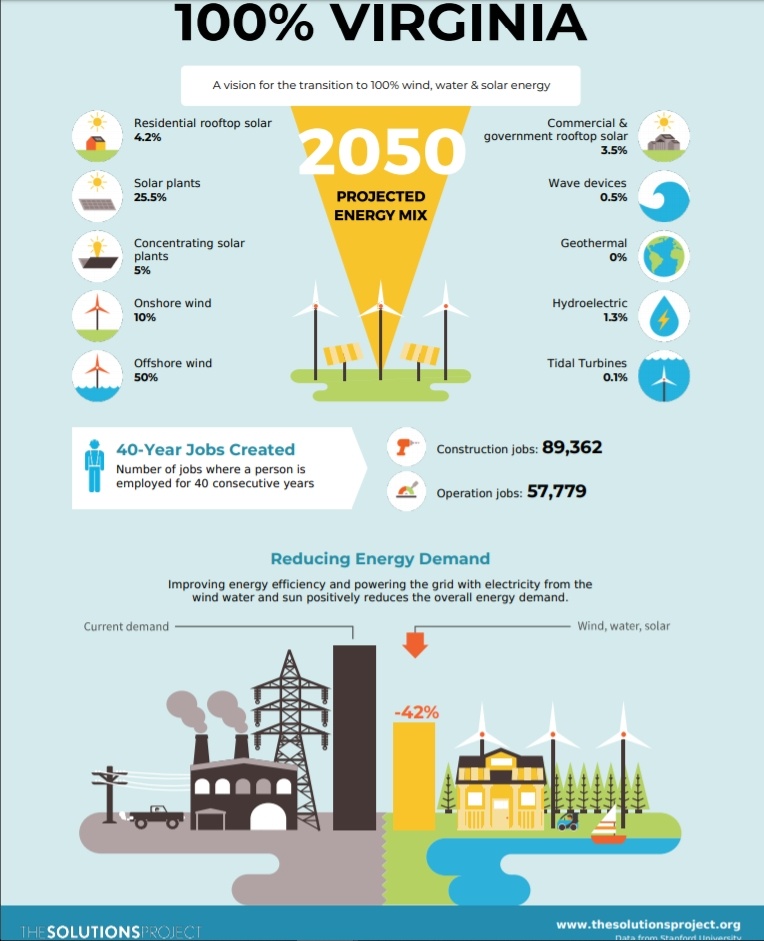
The Solutions Project has provided basic roadmaps and analytical assessments of those returns for the globe, countries, regions, and, within the United States, states. For Virginia (see graphics below), the key points:
2050 Energy Mix
60% wind (50% offshore, 10% onshore)
38% solar (utility-scale PV 25.5%, Residential rooftop 4.2%, Large rooftop 3.5%, CSP 5%)
Significant total reduction in energy demand due to energy efficiency
Over 40% reduction in energy requirements
Even with economic and population growth
Benefit streams include
Over 145,000 jobs (permanent positions)
Over 1,350 fewer (premature) deaths due to pollution
Over $140 lower energy costs, per person, per year
Nearly $7,000/year in total benefits per person, per year
Something to consider, when thinking about the numbers above and the graphics below, is that this is ‘dated’. Done several years ago, the key data inputs related to clean energy costs are from 2013. Solar, wind, battery prices have continued to plunge since then and are, in many cases, already well below costs then predicted for perhaps a decade from now. In some cases, such as offshore wind, some project prices are now below what were optimistically as the best price that would ever be achieved. E.g., if done with current data, projected total completion and power productions costs would be lower and the energy costs savings would be even (likely significantly) higher.
For the Commonwealth and creating a path forward to a Virginia Clean Economy, there is much to The Solutions Project vision even as there are substantive reasons to question and challenge whether it proves “the” path forward.
Virginia’s electricity generation currently has a large share provided by nuclear power. Certainly, as long as it can continue to operate safely this zero carbon emission generation should be maintained — certainly until, at minimum, all fossil fuel generation is removed from the grid and/or all fossil fuels are eliminated from Virginia’s economy. And, that seems likely to be at least until the mid-2040s if not later.
The inclusion of CSP (which, btw, I have had experienced with) is unclear in specific value for Virginia. Perhaps to support industrial heat requirements? For its energy storage value streams?
And …
Still, the Solutions Project concept should intrigue anyone concerned about creating a Virginia Clean Economy. The next step: securing the research and data behind this infographic to assess the analysis, review the data, and determine how much of this road map can and should be incorporated into Virginia’s Clean Economy path forward.
December 28th, 2019 · Comments Off on McAuliffe’s 2009 Clean Energy Future for Virginia
For decades, people have been working on and considering how to get Virginia on the path toward a clean energy future. And, with plunging prices for clean energy paths (solar, wind, storage (batteries), efficiency (think LED lights), electric transportation, etc) with increasing climate impacts and understanding of climate risks along with increased business pressure for and actions to advance clean energy along with incoming full Democratic control of the Virginia government, the stage is more than set for moving from considerations and working on to making serious moves to achieve that prosperous, resilient, and secure clean energy future for the Commonwealth and all Virginians.
Looking back a decade, considering that ‘considering’, Terry McAuliffe developed a significant amount of material in his “Business Plan for Virginia”. The initial release: “Chapter 1: A Comprehensive Long-Term Plan for Virginia’s Energy Future“. Looking at this for the first time in over a decade, while the issues identified then (such as exaggeration of Virginia’s tidal/wave resource potential) remain, I am struck by how much resonants today.
For example, 2009 candidate McAuliffe (sadly, not really Governor McAulifee 2014-2018) called for a serious renewable power standard (RPS) which, at that time, would have put the Commonwealth on the leading edge in the nation.
Requiring power companies to generate 25% of their electricity from renewable energy sources by 2025.”
McAuliffe(‘s team) saw a real potential for offshore wind, calling for serious work on positioning Virginia to secure economic gains (industry in Hampton Roads area) by being seizing a leading position in this emerging renewable energy realm. Candidate McAuliffe clearly suggesting that a significant portion of Virginia’s energy needs could be met from offshore:
By some estimates, anywhere from 20 percent to all of Virginia’s electricity demand could be met by off-shore wind projects because of the prevalence of Class 5 or greater winds that are found in waters less than 30 meters deep”
Reading through this rich document is painful. Candidate McAuliffe laid down a challenge:
Sadly, when considering the past decade in the light of McAuliffe’s “challenges”, it has mainly been a lost decade as Virginia fell behind other states “leaping forward on developing renewable energy, investing in energy efficiency, combating climate change” since the Commonwealth did not “maximize opportunities [then] available to invest in a sustainable energy future”.
A decade later, McAuliffe’s challenge remains relevant. However, a decade later, the situation has changed significantly to both enable and to create imperative for Virginia to meet McAuliffe’s challenge:
The climate crisis has worsened, with growing impacts near daily, with a mounting imperative for serious, aggressive, rapid action to reduce emissions while improving resiliency against future climate change impacts.
Advances in technology options and plunged renewable energy prices have made it both technically easier and much more clearly economically beneficial to move to clean energy options.
Clean energy announcements and projects (such as major businesses wanting clean electrons, Dominion announcing major offshore wind and solar projects, local governments putting up solar projects) have created a momentum to build on for serious, aggressive, and rapid moves to a 100% clean Virginia economy (within the next 10-15 years).
Democratic Party control, with strong voter support for clean energy action, removes the climate-science denial Virginia GOP’s veto over serious climate action.
As we contemplate ‘how’ to move Virginia forward, it is worth taking a moment to look back at past roadmapping toward a Virginia clean economy and leveraging that work in creating our path forward.
Rosen powerfully and accurately makes clear Rosen’s professional negligence:
It’s not naive of him. It’s malpractice. Chuck Todd’s entire brandis based on the claim that he understands politics. Since 2007 he has been NBC’s political director, which means he has influence over all coverage. He is literally the in-house expert on the subject. You don’t get to claim you are naive about politics when you have these kinds of positions. It would be like a chief risk officer saying, “I didn’t understand the gamble we were taking.” Well, that’s your job
This is only a taste of Rosen’s devastating (and merited) Todd takedown as evidenced by paragraph lead sentences:
It’s not that he was naive. He did not care to listen.
It’s not naiveté. It’s a willful blindness to what the Republican Party had become.
He’s not naive. He’s an insider who thought his read was better.
It’s not naive. It’s a lack of imagination, a failure of insight.
Rosen has been one of the clearest voices (great example) about the damaging nature of ‘both sides’ reporting and a key point is that Todd’s and Meet The Press’ “entire brand” rests on bothsiderism. And, since that is the ‘brand’ and operating motif, Todd and his producers remain clueless about what to do in the face of #Cult45 Republican disinformation (which Tood calls, misleadingly and erroneously, “misinformation”).
A key premise for Meet the Press is symmetry between the two major political parties. The whole show is built on that. But in the information sphere — the subject of Chuck Todd’s confessions — asymmetry has taken command. The right wing ecosystem for news does not operate like the rest of the country’s news system. …
So what will they do now? My answer: they have no earthly idea. This is what I mean by an epistemological crisis. Chuck Todd has essentially said that on the right there is an incentive structure that compels Republican office holders to use their time on Meet the Press for the spread of disinformation. So do you keep inviting them on air to do just that? If so, then you break faith with the audience and create a massive problem in real time fact-checking. If not, then you just broke the show in half. There is simply nothing in the playbook at Meet the Press that tells the producers what to do in this situation. As I have tried to show, they didn’t arrive here through acts of naiveté, but by willful blindness, malpractice among the experts in charge, an insider’s mentality, a listening breakdown, a failure of imagination, and sheer disbelief that the world could have changed so much upon people paid so well to understand it.
Spot on commentary, but with a significant flaw
As so often, Rosen has provided a searing assessment of a major journalistic situation that would, in a rational world, lead to reflection and, eventually, action to address the challenge.
Rosen’s discussion, however, has a glaring (likely unintended) misdirection. Reading through Rosen’s devastating critique of Todd suggests that Republican disinformation (willingness to show up in venues like Meet The Press, stare into the camera, and lie) and desire to attack (discredit) “the Press” provides an impression that this is somehow newly born, perhaps knowable only by about 2012 or so.
Tom Mann and Norm Ornstein wrote, “The GOP has become an insurgent outlier in American politics. It is ideologically extreme; scornful of compromise; unmoved by conventional understanding of facts, evidence and science; and dismissive of the legitimacy of its political opposition.” Chuck Todd as NBC’s political director, and Meet the Press as its premiere politics show could have taken seriously what these exemplary members of the Washington establishment were saying back in 2012.
Truth be told, Mann’s and Ornstein’s excellent OPED could have been written much earlier but “establishment” voices fought coming to that conclusion, openly, then just as Todd has resisted coming to it until just recently.
The Republican War on Science was treated, by journalists, writ large with ‘both sides’ reporting. For decades, when it came to Global Warming/climate change reporting, scientists were ‘balanced’ by fossil fuel-funded advocates paid to undermine science and confuse the situation. For decades, (primarily) Republican politicians have parroted this deceit. For decades, the leading lights of the GOP have been willing to look cameras in the eye and lie when it comes to climate change on the (all too often) rare occasion when the subject was raised by the Todds of the media elites. These Republicans would not just parrot the lies but would be ready to attack and seek to discredit (especially within their base) journalists who accurately reported when it came to climate change.
Science denialism could reasonably be seen as the testing and training ground, the core precedent, for the ubiquitous GOP disinformation amid the time of Trump.
Blatant denial of reality, refusal to give credence to authority, willingness to spout nonsense worked. Republican politicians didn’t pay a price for their deceit. Journalists, most frequently, didn’t challenge these politicians’ dishonest and, often, ludicrous misrepresentations about what is arguably the most important issue facing humanity. Media outlets did not make clear the level of ignorance and dishonesty. This deceit strengthened, in all too many cases, their (both individual politician’s and the Party’s) brand and strengthened the base’s allegiance. A key tool of any cult is to get followers to believe the cult over their lying eyes: this is what the GOP has demanded (and secured) from its base for a long, long time when it comes to science, when it comes to climate change and the (every more urgent) need for action.
Success in science denial made clear that falsehoods work and that too many media outlets will help in the effort. Science Denialism laid the groundwork for birtherism, for Benghazi uber alles, for the ubiquitous disinformation that is the Republican brand today.
Rosen would have well served his readership, and overall discussion of media practices, by discussing science denialism and journalistic enabling of it was a leading indicator (element) of Republican “misinformation” that Chuck Todd has admitted being “naive” about.
For Christmas 2019, Todd has admitted that it is a problem that Republicans are so willing, so eager to get on Meet The Press to spread “misinformation” even if he clearly has no clue what to do about this.
What will Todd’s 2020 Christmas gift be for highlighting yet another facet of his journalistic malfeasance?
December 25th, 2019 · Comments Off on (Com)Post-able reporting on Trump’s destructive inanity (re wind, energy, technology)
Washington Post (and other news organizations) all too often seem to fall back to ‘both sides’ discussions that foster misunderstandings and implicitly undermines truthful discussion. And, far too often this ‘bothsiderism’ combines with, it seems, fear of angering Trump (or, at least #Cult45 devotees) to create misrepresentations.
LED lighting, efficient toilets, high-efficiency washing machines/dishwashers/etc all save users significant amounts of money (even if they are more expensive to buy, they are (FAR) less expensive to own — higher cost to buy (ctb) but much lower cost to own (cto)).
Pollution is worsening under the Trump regime, APollution is worsening under Trump. This is leading to increased illnesses and worsened mortality rates. It is truthful, literally, to say that Trump policies are killing Americans.
The Post‘s article, at best, glosses over these facts as per:
Often operating from his [Trump’s] own feelings rather than scientific evidence …
Trump regularly cites his personal experience rather than science.
Read and consider that sentence(‘s construction). By using the terms “often operating”, the Post implies that there are times (actually, likely most times) where Trump is actually “operating from … scientific evidence”. Considering that Trump is perhaps the most ‘anti-science’ person to ever occupy the Oval Office, to provide an inference that some of Trump’s rantings against renewable energy and efficiency derives, ever, from any form of “scientific evidence” is to mislead, is to be untruthful in reporting.
focusing on convenience issues like cheaper lightbulbs
Here is where a journalist could be truthful, could educate. Yes, incandescent lightbulbs are “cheaper” to buy but they are far, far, far more expensive to own (see a decade old calculation — case is much stronger today+). With plunging LED prices, dependent on usage, that difference might be counted in a few weeks of ownership.+
Trump’s defenders … say the president’s … reducing regulations has helped … without harming the quality of the nation’s air or water.
… White House spokesman said “… the President has … continued to safeguard the water supply and improve air quality.”
While any with any awareness would understand the absurdity of these assertions and perhaps the article’s authors relied on such awareness, these blatantly false assertions go without context for making clear the deceit. Recent studies have documented (provided the hard data to show) that America’s air quality (for example) is deteriorating under Trump due, in no small part, to failure to enforce and the weakening of regulations designed to protect Americans’ health and well-being. The Intelligencer’s headline summarizes this well: Air Pollution Increases Under Trump, Despite His Claim of World’s ‘Cleanest Air’. For truthful reporting, the Post’s article should have read something like “Trump and his supporters falsely claim …” but, well, this would — it seems — have been ‘taking sides’ while ‘both-siderism’ is so much easier.
And, and, and …
There is so much more to raise, such as the absence of any direct comment about the incoherence of Trump’s statements nor any highlighting of how Trump’s actions to undermine clean energy options are hurting U.S. competitiveness and leading to more illness and deaths due to increased fossil-foolish pollution. We could continue for days dissecting the article and multiple doctoral dissertations taking on Trump’s deceit mentioned in it. This article was, is important in laying out how Trump’s rambling diatribes play into the GOP strategy for the 2020 election. Regretfully, following ‘both sides’ journalism and failing to label truthfully Trump’s deceit plays right into that strategy by giving more credulity to that deceit than justified in any manner.
Far from just one piece.
To be clear, such bothsiderism and a seeming unwillingness isn’t isolated to just one article. Post reporting on the evangelical Christianity Today‘s editorial calling for Trump’s removal and calling out the hypocrisy of evangelical support for Trump provides (too) many additional examples.
Today’s (dead-tree version of the continuing) story opens:
Christianity Today has seen a rush of canceled subscriptions since publishing an editorial that criticized President Trump as “immoral”. But the magazine’s president said the evangelical magazine has logged an even greater wave of new subscribers.
Do you notice what I see? “Canceled subscriptions” is reported as fact while “new subscribers” is reported with “said” which inherently suggests it is an opinion and potentially not truthful.
Later in the article, based on that editors comments, readers learn that there were 2,000 canceled and 5,000 new subscribers. Both numbers come from the same source — the magazine’s president.
Reading through the dead-tree edition of an earlier article shows similar skewing. In every case, quotations and comments about the editorial that support Trump appear first with criticism coming (often far) later in the article. And, there is commentary about the magazine losing subscribers without the truthful comment, already known at that time, that there were more new subscribers than cancellations.
Honest journalism required
“Bothsiderism” leads, especially when there are dishonest and extremist actors in play, leads to misleading (and untruthful) reporting. This, what appears to be, tip-toeing around the emotions of Trump and Cult 45 enables Republican gaslighting. At least some major media players are (finally) waking up to this. For example, Jake Tapper’s one-hour special on All the President’s lies:
“Facts are facts. The earth is not flat,” Tapper added. And the news media, he said, is supposed “to provide accurate information” and “sort through the spin — what really happened, and what is the truth, regardless of who’s asserting it.”
recitals, however, miss the most elemental plank of Trump’s years in power: lying. Falsehoods — usually intentional, occasionally accidental — undergird the formulation, promotion and defense of all presidential policy positions. They are essential to any discussion about this White House, though they’re so frequent, so relentless, that they threaten to inure the public to their ills.
“All the President’s Lies,” a one-hour special report from CNN’s Jake Tapper, seeks to refocus attention on the mendacious foundation of Trumpism.
While The Post hosts one of the best accountings of Trump’s ceaseless lying, with a seemingly exponentially growing count well above 15,000, it is well past time for The Post to maintain a focus on Trumpism’s “mendacious foundation” throughout its journalism rather than (purposefully or inadvertently enabling Trump’s gaslighting of America.
======
UPDATE: A painful front-page example in the days after this post was an article re Trumpism and deficit spending. As per Paul Krugman,
In some ways this article is credulous; it talks about Trump abandoning "traditional Republican concerns" about the deficit. There's actually no evidence the GOP ever cared about deficits, except as a stick to beat Democrats. 1/ https://t.co/uOC5VzP3hK
So I'd say that it's misleading to see all this as a change in economic philosophy. It's really about politically weaponized Keynesianism: austerity for thee, stimulus for me 7/
* This post works from the ‘dead tree’, printed edition of 24 December 2019. There are differences between the online and print edition. For example:
Print: “often operating from his own feelings rather than scientific evidence”
Online: “Trump regularly cites his personal experience rather than science.”
+ A quick calculation between incandescent + LED lightbulb assuming a 100 watt equivalent light used 40 hours per week for one month with electricity at 12.5 cents per kilowatt hour.
Incandescent: 75 cent purchase + electricity (.1 (kilowatt usage) x 40 (hours) x 4 (weeks) x 12.5 (cents per KwH)) = $2.75 in cost
LED: $2 purchase + electricity (0.013 x 40 x 4 x 12.5) = $2.26
E.g., per month, the LED would use about 25 cents of electricity and the incandescent about $2. And, the LED will last decades and the incandescent will need to replace more than once per year on average. After a decade, choosing the “cheaper” at purchase light bulb will be over $100 more expensive. Which is “cheaper” now?
Comments Off on (Com)Post-able reporting on Trump’s destructive inanity (re wind, energy, technology)Tags:Energy
December 24th, 2019 · Comments Off on Getting Virginia to 100 (back of the envelope scratches …)
There are several legislative initiatives to lay down a path forward to modernize Virginia’s electrical grid with co-benefits of boosting the Commonwealth’s economic performance, creating jobs, reducing environmental injustice, improving health (economic, environmental, human), and putting Virginia on a path to address meaningfully the Commonwealth’s climate impacts. These initiatives do not align in many ways (from stances on new fossil fuel infrastructure to energy efficiency targets to …) with a clear discordance when it comes to timelines for achieving a clean energy future.
The Virginia Green New Deal Virginia‘s key legislation introduced by Rep. Sam Rasoul (HB77) “mandates … retail electric suppliers in Virginia to generate 80% of electricity from “clean energy” resources by 2028 and 100% by 2036″.
The Virginia Clean Economy Act (VCEA) (note: announced but legislation not released/introduced) targets 60 percent clean electrons by 2036 and 100% by 2050.
The difference between these two targets is greater than the above suggests most notably due to nuclear power which currently provides about one-third of Virginia’s electricity production and the vast majority of non-fossil fuel electricity production.
HB77 explicitly defines “clean energy’ as renewable and/or energy efficiency measures.
“Clean energy” means energy efficiency, energy conservation, demand response, energy storage, and energy derived from solar, onshore wind, offshore wind, geothermal, and ocean tidal sources.
The Virginia Clean Economy Act (VCEA) targets a “carbon-free electricity grid” and thus appears to include nuclear power within its targets. (For example, as per the AEE supporting study‘s roadmapping of ‘carbon-free’ generation out to 2050.)
For those getting confused, it is understandable. Writ large, for climate/energy analysts, there is a relatively simple differentiation: “clean” refers to (near) zero-carbon (thus including nuclear) while “renewable” explicitly excludes nuclear. There are areas which can be disputed as to whether ‘renewable’ or ‘low-carbon’ or not that are part of the electricity grid but which HB77 excludes (biomass, coal-bed methane, land-fill methane, land-fill incineration) and which VCEA may or may not include. These areas are, at this time, about eight percent of Virginia’s electricity supply.
If both (nuclear + miscellaneous other) are included in the VCEA while HB77 excludes them, this means some 35-40 percent of Virginia’s electricity that VCEA counts, already, as clean while HB77’s definition is starting off with just a few percent (essentially solar installations) as clean. In other words, HB77 is far, far more ambitious than the VCEA when it comes to moving Virginia to a renewable energy electricity grid.
As a quick side note, as someone focused on the intersection of climate, energy, environmental justice, security, business and economy, my starting point is “clean” as priority: drive down carbon emissions (along with associated pollution from burning fossil fuels) as quickly as possible while maximizing the economic, social, environmental, and security co-benefits from doing so (targeting a secure and prosperous climate-friendly society).
With the above in mind, struggling to make sense of the potential paths forward to make (as per Governor McAuliffe’s assertion several years ago) “Virginia #1 on climate”, some quick thoughts as to how fast and how Virginia could achieve a carbon-free electricity grid with some quick (appropriate for back-of-the-envelope discussion) assumptions:
Aggressive moves to “electrify everything” (moves to end fossil-fuel reliance in other sectors, such as committing to 100% electric school buses (both public and private) across the Commonwealth by 2030) and economic growth will boost electricity demand but that will roughly balance out with efficiency measures (remembering that Virginia trails the pack, nationwide, re efficiency) to leave total Commonwealth electricity demand ball-park where it is today for the indefinite future.
Existing clean renewables (hydropower, solar) will be summarized as meeting about one-to-two percent of existing demand (in 2017, solar produced 443 gigawatt hours (about 0.33% of total demand) and there have been many installations since then; hydro is about 0.5% of Virginia electricity production).
Already announced Dominion plans for 2.6 gigawatts of offshore wind (roughly meeting 10 percent of Virginia electricity demand by 2026) and 2.5 gigawatts of industrial-scale solar (about 5 percent of electricity demand) along with perhaps 500 megawatts of other solar projects (perhaps 1 percent) are taken as part of ‘business as usual’ (BAU) for future planning.
Taking the above as given, by roughly 2026, about 45 percent of Virginia’s electricity will be from carbon-free sources. Thus, the question:
How and how fast can Virginia create a carbon-emissions free electricity system while meeting other requirements and securing other benefit streams (resiliency, environmental justice, economic benefits, …)?
One place to look for potential roadmapping is the Stanford-based Solutions Project, which is roadmapping paths to 100% WWS (Wind, Water, Solar) energy systems (that includes electrifying across the economy — industry, transportation, heating…). For Virginia (pdf), they propose a 2050 mix of 60% wind (50% offshore, 10% onshore), 38% solar, and 2% a mix of water (traditional hydropower, tidal, wave). For the offshore, this could imply perhaps 25-35 gigawatts of offshore wind production capacity.
Earlier this fall, Governor Northam announced a target of 30 percent renewable electricity by 2030. That target would combine with the nuclear power production for 60% “carbon-free” electricity. Existing solar and wind projects and plans get Virginia half-way to Northam’s targets. Here are some thoughts to meet and exceed the other half within the next decade.
2030: 6GW of offshore wind (more than 25% of total electricity demand)
2035: 11GW of offshore wind (more than 40%)
2040: 16+GW of offshore wind
Onshore Wind: Especially south-west Virginia, the Commonwealth has some interesting niches (think winds concentrated in a valley) of good-quality wind resources. While a number of projects have been proposed for development, Virginia doesn’t yet have any meaningful onshore wind in operations … but it could in the near future (such as 75MW from Rocky Forge as soon as 2021 with Pinewood’s 150MW potentially operational in 2022). Target of 500 megawatts of onshore wind (with, to make things interesting and create more value for the grid and local communities, tens of gigawatt hours of underground constructed pumped hydropower storage) by 2030 would provide perhaps 2-3 percent of Virginia’s electricity.
Solar: While de minimis in Virginia’s energy picture just a few years ago, solar (installations and production) is showing exponential growth in the Commonwealth from rooftops to utility-scale installations. Building on what is already announced,
clearly achievable by 2030 …
Double utility-scale solar with another 2.5GW (e.g., 5GW total)
Distributed production (think on top of large malls, schools, parking lots etc…) in commercial and government sites. 2GW
Residential / small business rooftop solar: .5GW
These would combine for 5GW of additional solar on top of existing and announced solar plans for a total of approximately 7.5GW install solar which would meet in the ballpark of 10-15 percent of total electricity demand.
Okay, just a few scratches on the back of the envelope and Virginia is ballpark 70 percent carbon-free electricity by 2030 (even while moving fast to ‘electrify everything) with a clear roadmap for 100 percent carbon-free electrons by the mid-2030s and the option, if it makes sense a decade from now, for moving to a renewable-only electricity grid by perhaps the mid-2040s.
Now, the napkin notes planning out above obviously would require legislative and regulatory action to make a reality but the above isn’t heavy lifting in technological nor economic terms. It doesn’t violate any laws of nature (no new elements of the periodic table created), doesn’t assume or rely on emergent energy technology (which, well, will occur), and doesn’t require WWII-like mobilization to make a reality.
As to that last, Virginia actually could do far, far better than the above suggests if we (collectively) rise to climate realities and necessities. With our resources (human capital, financial, natural, industrial), the Commonwealth could make a reality of Virginia being “#1 on climate issues”. With a World War II-like mobilization treating the climate emergency for what it is (an existential threat requiring action that, at the same time, creates tremendous opportunity), Virginia could achieve a 100 percent clean electricity system within the decade even while moving forcefully to ‘electrify everything’.
Comments Off on Getting Virginia to 100 (back of the envelope scratches …)Tags:Energy
December 22nd, 2019 · Comments Off on Virginia’s Clean Economy Act: Are the analytical underpinnings fatally (pessimistically) flawed
Last week, a broad environmental coalition and multiple Virginia state legislators coalesced for the announcement of the “Virginia Clean Economy Act” (VCEA). When one sees organizations like CCAN and its climate hawk founder/director Mike Tidwell pushing hard to build momentum for the VCEA, the presumption has to be that this is serious action that would put Virginia well on the path to doing what is possible and necessary for the Commonwealth to do to address the climate crisis. Compared to what had been possible when fossil-foolish, climate-science denying Virginia Republicans controlled the legislature, there is no question that this Act’s objective to have a 100% clean power system by 2050 (60% by 2036) is a breath of fresh air.
While there are many aspects of (and certainly the intent of many promoting) the legislation that merit praise, seemingly unambitious targets have caused many to scratch their heads asking why the objectives and requirements weren’t (far, far) more ambitious: ‘What is going on here?’ ‘Is there something that I don’t understand?’
For starters, a simple back-of-the-envelope calculation suggests that a 60 percent clean electrons Virginia electricity supply could well be achieved without anyone at the wheel by 2030. This would occur simply due to already announced clean (renewable) electricity projects (such as Dominion’s September 2019 announcement of a 2.6 gigawatt offshore wind project and Fairfax County going forward with more than 100 rooftop installations) and reasonable supposition as to what the market will naturally do due to the continuing plummeting of clean electron prices.
Asking around as to ‘how were the core targets arrived at’, a number of people sent me to “Virginia’s Energy Transition: Charting the Benefits and Tradeoffs of Virginia’s Transition to a 100% Clean Grid” (pdf). Published in September 2019 by Advanced Energy Economy, this report provides a detailed analytical look at the requirements for and payoffs from achieving a 100% clean power sector by 2030, 2040, or 2050. In all three cases, the analysis makes clear that Virginia and Virginia electricity ratepayers would do far better with moving to a clean electricity system rather than remaining on a fossil-foolish business as usual path. While analysis shows that the largest total benefits would occur from the most aggressive path (2030), the report concludes that this would drive up near-term homeowner costs and thus leads to a conclusion that a slower path would work better politically even if the full benefit streams would not be as high.
Reading through the report led to head scratching and concerns that issues in the report foster a misguided understanding of the status that helped drive an unambitious approach in developing the VCEE. Here are three issues along with potential implications from them:
Remaining Stove-Piped and Not Proposing Ways to Solve Logjams
The study analysis concludes that acting to achieve the 2030 target (putting aside for the moment the two following issues) would drive up household electricity bills in the mid-2020s and leave homeowners without total electricity savings until almost 2040 due to capital investment requirements (both for new clean electricity production and for paying off early retired fossil fuel systems). Not just politically, if true, this is a real issue that would be an obstacle to achieving a clean power system.
What the study failed to do, likely because of limitations in their charter, is provide options for addressing (eliminating or, at least, ameliorating) this issue. For example, the benefits of the clean electrons will accrue not just to power users. We will all have cleaner air to breath. There will be more and higher-paying jobs. The Commonwealth will have more tax revenue. Hmmm, think about that last. Couldn’t (a portion of) the additional revenues be used to eliminate that identified early cost hit? Perhaps, for example, the Commonwealth could provide borrowing authority so that renewable energy projects will have lower interest and longer term loans? Thinking outside the box to solve identified problems weren’t, however, likely in the study contract.
Using rejected Dominion Integrated Resource Plan (IRP) as key source
Long ago, an econometrics professor (who headed, btw, the CIA’s econometrics team) pounded into me the importance to reading, following, and asking questions of study footnotes. In wondering about this report’s conclusions, Appendix A’s Footnote 1 seemed sort of odd.
Footnote 1: Dominion’s May 2018 IRP submission
Footnote 1 refers to Dominion’s May 2018 Integrated Resource Plan which was submitted to the State Corporation Commission (SCC) for review. If one is unfamiliar with the Commonwealth’s energy situation and interactions with Dominion, this would seem a very reasonable basis for doing analysis and planning. After all, Dominion provides the majority of the Commonwealth’s electricity and the IRP is the required reporting about what Dominion sees over the coming 15 years.
Dominion continually insists on using outdated modeling practices to predict future electricity demand, and it doubles down on this error by proposing to satisfy that demand in a non-economic fashion. This approach marginalizes lower-cost options like energy efficiency and solar in favor of expensive, company-owned, customer-financed natural gas infrastructure—an approach that will force unnecessary costs on customers while allowing Dominion to earn high rates of returns to the benefit of its shareholders.
Dominion was required to rework elements of the IRP and returned in March 2019 with a significantly lower (though almost certain still exaggerated) forecast for future electricity demand in Dominion territory. As far as can be determined (and after having sent requests Friday to multiple people seeking to confirm this without, as of this writing, any response), the report relied solely on the May 2018 IRP’s highly inflated forecasts of electricity demand rather than using the somewhat less inflated March 2019 numbers.
Basing requirements planning with a (MUCH) higher total makes bridging the gap between today’s roughly 39 percent clean power (electricity) and a 100 clean power system (MUCH) more difficult.
If, as seems to be the case, this report relied on the rejected March 2018 IRP for its projection of future Virginia electricity demand, then it started from a (far) more pessimistic starting point than reasonable.
OBE means overtaken by events
Conducting analysis and writing a substantive report can take real resources and time. These aren’t overnight events. And, real-world events can make a report OBE even before it is printed. This report was released in September 2019. Also in September 2019: Dominion’s announcement of plans for 2.6 gigawatts of offshore wind to be installed and operating before the end of 2026. As of September 2019, therefore, a major portion (roughly 10 percent) of current Virginia electricity annual demand will be wind power by 2026. As it is an announced plan, that should make it part of ‘business as usual’ forecasting. Not surprising, this major wind project (along with other recent clean energy announcements) isn’t reflected in the report.
Put on your spectacles (pull out a microscope) to find wind in the “BAU” case: Dominion’s Offshore Wind announcement made this table OBE
Further dissection might reveal
While it might appear otherwise, the above are just a few points from an initial, cursory look at the report. It might well be that more detailed dissection would reveal additional ways in which this report provides a (highly) pessimistic basis for planning a Virginia Clean Economy.